


Key Takeaways
- The U.S. has deployed over 850 Tomahawk missiles during Operation Epic Fury, surpassing usage in past conflicts.
- Debates exist within the Pentagon about the long-term effects of depleting the Tomahawk inventory on U.S. global security commitments, particularly regarding China.
- The Pentagon is working to increase missile production to replenish stockpiles, which could take two to three years for full recovery.
Overview of the Tomahawk Missile in Recent Conflicts
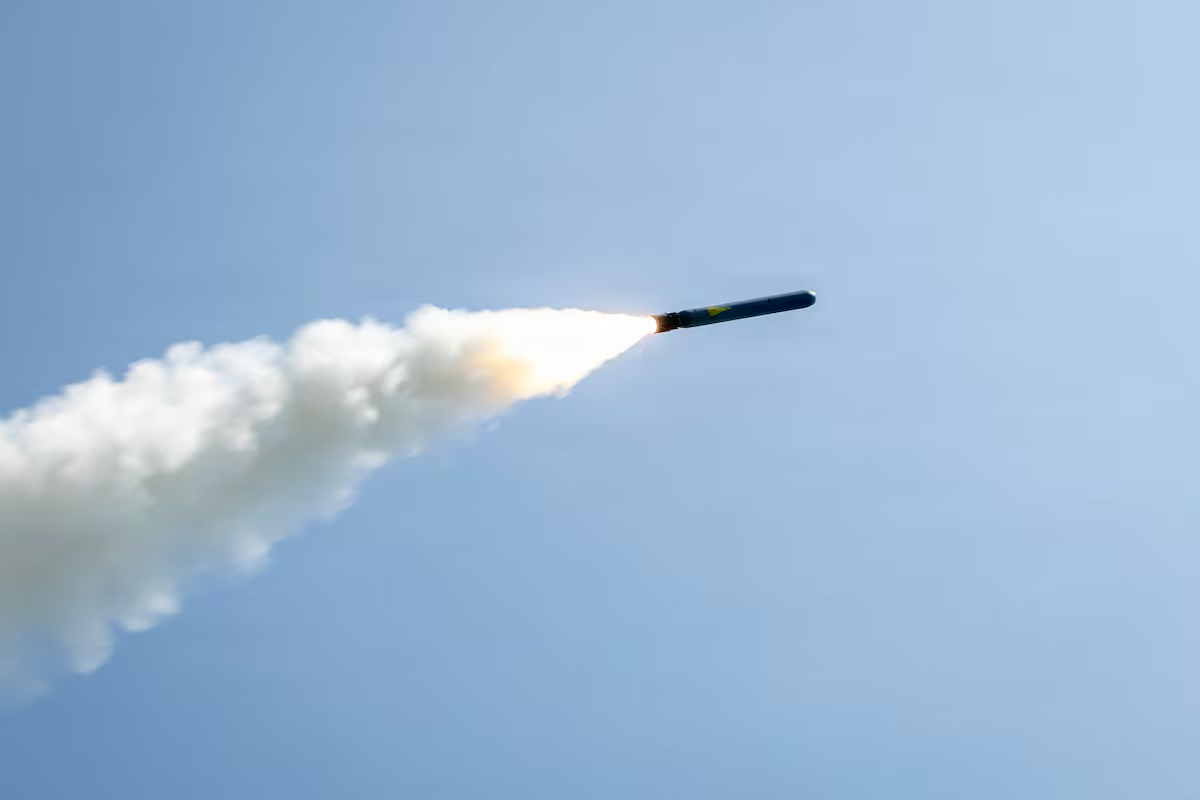
The Washington Post recently reported that the United States has launched over 850 Tomahawk long-range cruise missiles in the first month of Operation Epic Fury, a joint military initiative with Israel against Iran. This usage significantly exceeds that in earlier military engagements, as noted by Mark Cancian and Chris Park of the Center for Strategic and International Studies (CSIS). While exact figures regarding the U.S. arsenal are classified, estimates suggest the U.S. maintains around 3,000 Tomahawks, a highly advanced weapon known for its precision, flexibility, and 1,000-mile range.
Tomahawk missiles, launched primarily from ships, allow for considerable operational range without requiring nearby airbases. Their primary role in Operation Epic Fury was to mitigate Iranian air defenses until U.S. and Israeli forces achieved air superiority. Once this was secured, missile usage declined as the costs involved — approximately $3.5 million per missile — prompted a shift to less expensive munitions like JDAMs, which are significantly cheaper at around $80,000 each.
There are strategic implications tied to the use of Tomahawk missiles that extend beyond the current operation. Concerns within the Pentagon focus on how depleting missile stocks may hamper the U.S.’s capacity to deter threats in other theaters, specifically countering China’s military actions in the Western Pacific, particularly regarding Taiwan.
Cancian noted the importance of Tomahawks for deterrence against Chinese forces, which possess a vast missile arsenal. The missile’s extended reach enables the U.S. to strike with greater safety from a distance. Alongside the traditional land-attack Tomahawk, a newer variant designed to target maritime threats has also been developed, enhancing strategic options in potential conflicts at sea.
In terms of destructive capability, Tomahawk missiles possess a 1,000-pound warhead, functioning at least 10 to 20 times more destructively than the drone systems currently deployed by Iran, which typically feature much smaller warhead sizes.
Furthermore, to replenish stockpiles after extensive use during conflicts like Epic Fury, the Department of Defense has facilitated discussions to boost production rates with defense contractors. This effort has been ongoing since the Biden administration and continues to be prioritized. Producing replacements for the almost 1,000 missiles expended could take two to three years.
Amid this, the Pentagon’s strategy is adjusting to conserve Tomahawk missiles. While the overall strategy remains unchanged, there is a focus on maximizing operational capabilities using less costly munitions for extended engagement in conflict, maintaining a sufficient reserve of long-range missiles. As for the Patriot missile defense system, which has also seen significant deployment in the Gulf, there remain adequate resources to protect U.S. installations. Approximately 1,000 of an initial 4,000 Patriots have been utilized, ensuring that three-quarters of the inventory is still operational.
As missile production ramps up, discussions may arise about reallocating some resources, potentially providing Gulf allies with expedited access to necessary defense capabilities. This approach aims to balance the strategic necessity of maintaining U.S. defenses while supporting partner nations.
The content above is a summary. For more details, see the source article.









