


Key Takeaways
- The U.S. Army’s CH-47 Chinook successfully completed an autonomous landing using Boeing’s A2X software.
- This technology aims to reduce pilot workload during critical flight phases and enhance operational efficiency.
- The Chinook’s autonomy efforts complement the Army’s broader initiative for advanced aircraft, including the H-60Mx Black Hawk.
Autonomous Landing Demonstration by CH-47 Chinook
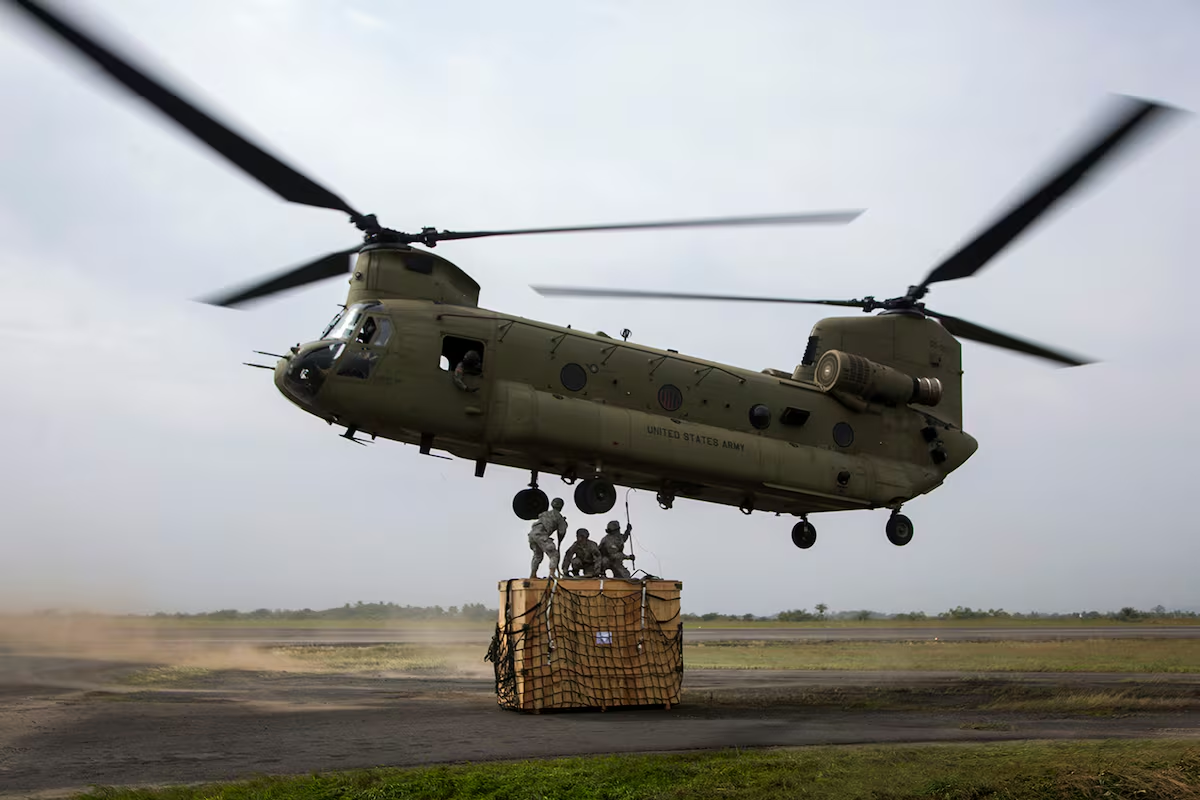
Boeing recently announced that a U.S. Army CH-47 Chinook executed a successful autonomous landing without a pilot. This event highlights the Army’s commitment to integrating autonomy into its aviation fleet. The demonstration featured Boeing’s A2X software, a key component of the Army’s strategy to enhance operational efficiency by minimizing pilot workload during critical phases of flight.
The Chinook, a longstanding workhorse of the U.S. Army used for transporting troops and heavy cargo, has been a vital part of military operations since the 1960s. It even played a role in significant missions, including the operation to capture Venezuelan President Nicolás Maduro. During the autonomous landing test, a designated pilot set essential parameters—location, altitude, approach angle, and initial speed. The A2X software then autonomously guided the aircraft to the determined landing zone.
Boeing claims that its software has successfully completed over 150 landings, achieving an impressive average final position error of less than five feet. The technology is designed not only to ensure precision but also to enable pilots to remain engaged with other mission elements, thus enhancing situational awareness.
Deanna DiBernardi, the human factors engineering lead for Boeing’s H-47 program, stated that the control laws and interface are crafted around natural piloting techniques, aiming to lighten the pilot’s workload. The anticipated result is that cockpit crews can maintain greater focus on tactical awareness during operations, which is critical in complex and demanding environments.
Looking ahead, Boeing plans to refine the A2X software before delivering it to the Army; however, no timeline for this release has been provided. The recent testing aligns with the Army’s acquisition of the H-60Mx Black Hawk, another aircraft equipped with advanced autonomy features. The H-60Mx retains the option for pilot input, similar to the Chinook’s system.
Additionally, the advancements in autonomous systems are part of the Army’s broader vision, which includes the development of the MV-75 “Cheyenne II,” a next-generation tilt-rotor aircraft aimed at enhancing capabilities for operations in the Pacific theater.
With both the Chinook and Black Hawk undergoing modifications for greater autonomy, the U.S. Army is poised to significantly advance its aviation capabilities, enhancing operational effectiveness and reducing the risks faced by pilots during critical missions.
The content above is a summary. For more details, see the source article.









