


Key Takeaways
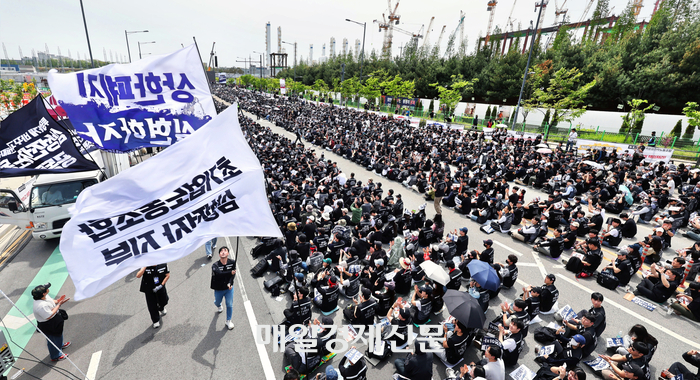
- Samsung Electronics’ union holds a protest with 40,000 members demanding the abolition of the performance pay cap.
- Labor union calls for an 18-day strike starting next month if their requests are not met, potentially leading to a significant payout in incentives.
- South Korea’s economic growth reached 1.7% in the first quarter, heavily driven by the semiconductor sector amidst rising concerns over market dependency.
Union Protests at Samsung Electronics
Samsung Electronics’ labor unions, including the newly formed “Samsung Electronics Super Enterprise Union,” are rallying at the company’s Pyeongtaek plant. Approximately 40,000 union members gathered to demand the removal of limitations on performance-based pay. The union is advocating for a share of 15% of the company’s operating profits to be allocated as incentives. If their demands are met, the potential incentive payout could reach 45 trillion won this year.
Despite a booming market bolstered by artificial intelligence (AI) advancements, union leaders aim to strike for 18 days starting November 21. They emphasized the intent to persist in their efforts until changes are made regarding the performance pay cap.
In terms of profitability, SK Hynix reported an impressive operating profit margin of 72% in Q1, outperforming other global tech giants. The demand for memory chips is notably growing due to the expansion of AI infrastructure, with predictions indicating that the demand for high-bandwidth memory (HBM) will continue to surpass supply for the next three years.
Meanwhile, the South Korean government is devising plans to support “non-resident single homeowners” looking to sell properties purchased under lease arrangements. President Lee Jae Myung expressed the need for these homeowners to prepare to sell, indicating potential relief measures regardless of existing deadlines.
Economic indicators reveal that South Korea’s real GDP grew by 1.7% in the first quarter, marking the highest increase in over five years. This growth is attributed to strong semiconductor exports and investments, but analysts caution that an over-reliance on this sector may pose risks, particularly in light of geopolitical tensions.
In military developments, J.Beer Brunson, commander of the ROK-U.S. Combined Forces Command, reported on plans to meet certain benchmarks by Q1 2029 regarding wartime operational control transfer. His remarks emphasized a desire for “strategic flexibility” for U.S. Forces in the Indo-Pacific region, while still addressing North Korean-related military needs.
The current landscape reflects critical economic and military transitions in South Korea, with labor movements, market dynamics, and government policies all shaping the future of the nation.
The content above is a summary. For more details, see the source article.









