Key Takeaways
- The Space Force’s 2027 budget request is $71 billion, allocating about $2.5 billion for commercial services.
- Officials emphasize a “commercial first” strategy to integrate private sector technology into defense systems.
- The Andromeda program aims to utilize both commercial and government solutions for satellite capabilities, with funding channels aiding innovative firms.
The Space Force has proposed a $71 billion budget for fiscal year 2027, including around $2.5 billion earmarked for commercial services such as satellite communications. However, officials indicate that the overall investment in commercial technology is much greater, as it is embedded in various programs.
Recent Pentagon strategies reflect a significant shift towards leveraging private sector investments to enhance defense capabilities. In 2024, the Space Force introduced its inaugural Commercial Space Strategy, promoting the creation of hybrid government-commercial systems. By the following year, acquisition officials instructed program offices to evaluate if their needs could be satisfied using exclusively commercial resources.
Lt. Gen. Philip Garrant, Commander of the Space Systems Command (SSC), stated that the integration of commercial technology is becoming standardized within acquisition strategies. He noted that recent solicitations and contract awards increasingly seek nontraditional firms and off-the-shelf technology.
Despite the budget not showing a substantial increase in commercial spending, a Space Force spokesperson clarified that this funding only reflects a portion of their total investment in the private sector. The challenge lies in quantifying the commercial versus custom-built components of military systems since many solutions comprise both elements.
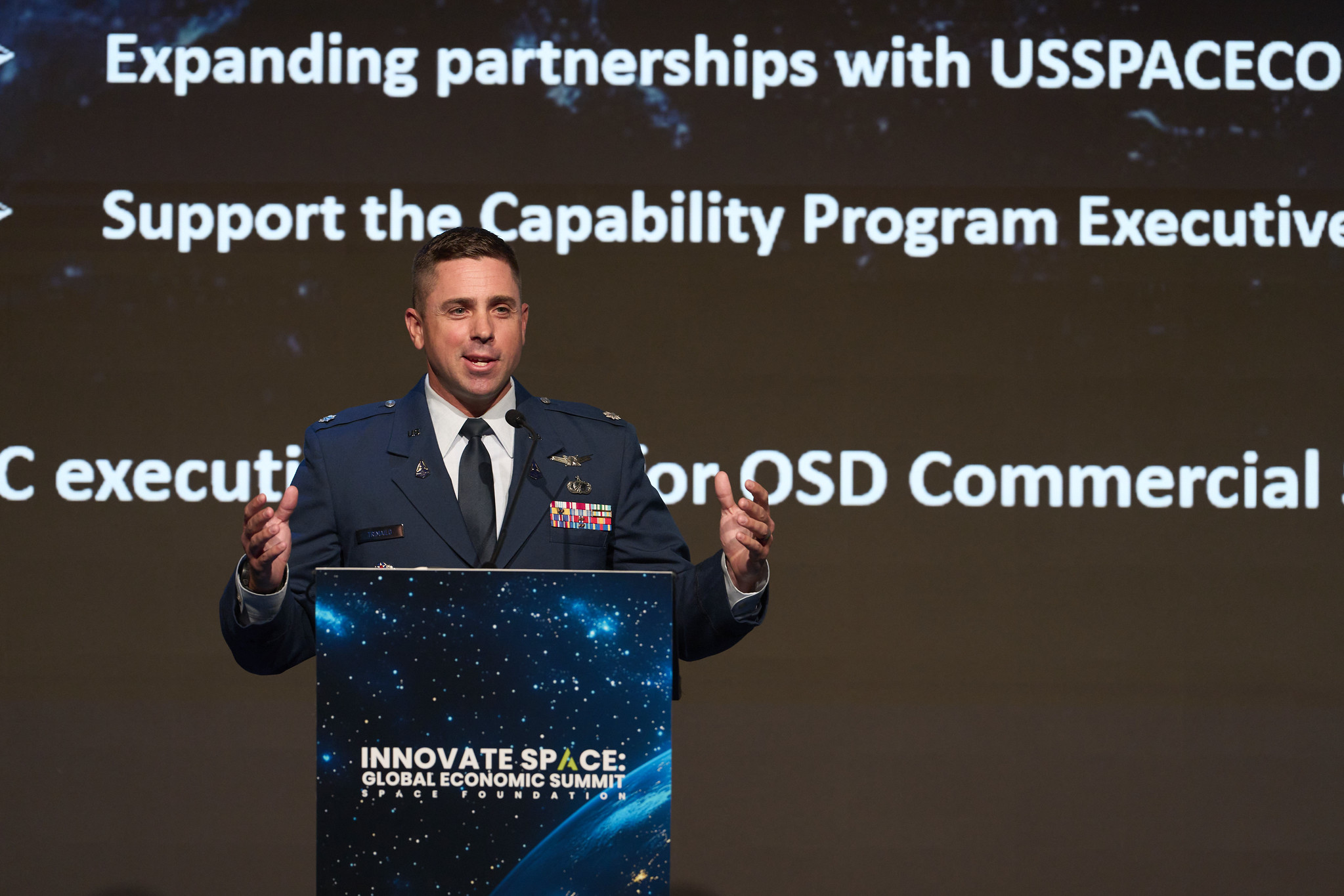
Lt. Col. Tim Trimailo, leading the Space Force’s Commercial Space Office (COMSO), emphasized that the effects of prioritizing commercially available technology are evident through ongoing programs. He cited the Andromeda project, which has selected a diverse mix of 14 companies to compete for up to $1.8 billion in contracts to develop small spacecraft for monitoring geosynchronous orbits.
Trimailo also highlighted the importance of the Small Business Innovation Research and Small Business Technology Transfer Research programs, which support U.S. firms that could meet government needs. The Space Force allocates approximately $500 million annually to these initiatives, which bridge the gap between innovative companies and military acquisition processes.
While the dedicated budget for COMSO has decreased from $168 million to $23 million in the 2027 request, Congress has historically augmented this funding. Support from this allocation has been crucial for efforts such as the Commercial Augmentation Space Reserve and Tactical Surveillance programs. Trimailo aims for these projects to transition into other program offices, minimizing the long-term role of COMSO in executing these initiatives.
Ultimately, the Space Force is focused on effectively integrating commercial technology into its operations, expecting these innovations to become foundational elements in future military capabilities.
The content above is a summary. For more details, see the source article.