


Key Takeaways
- The U.S. Air Force plans to procure Collaborative Combat Aircraft (CCA) with a budget request of $2.37 billion for fiscal year 2027.
- CCAs are semi-autonomous, jet-powered systems designed to operate alongside manned fighters, enhancing operational capabilities against peer adversaries.
- The Netherlands has committed to funding two Increment 1 CCAs, marking an initial step toward international collaboration in CCA development.
Funding and Development of Collaborative Combat Aircraft
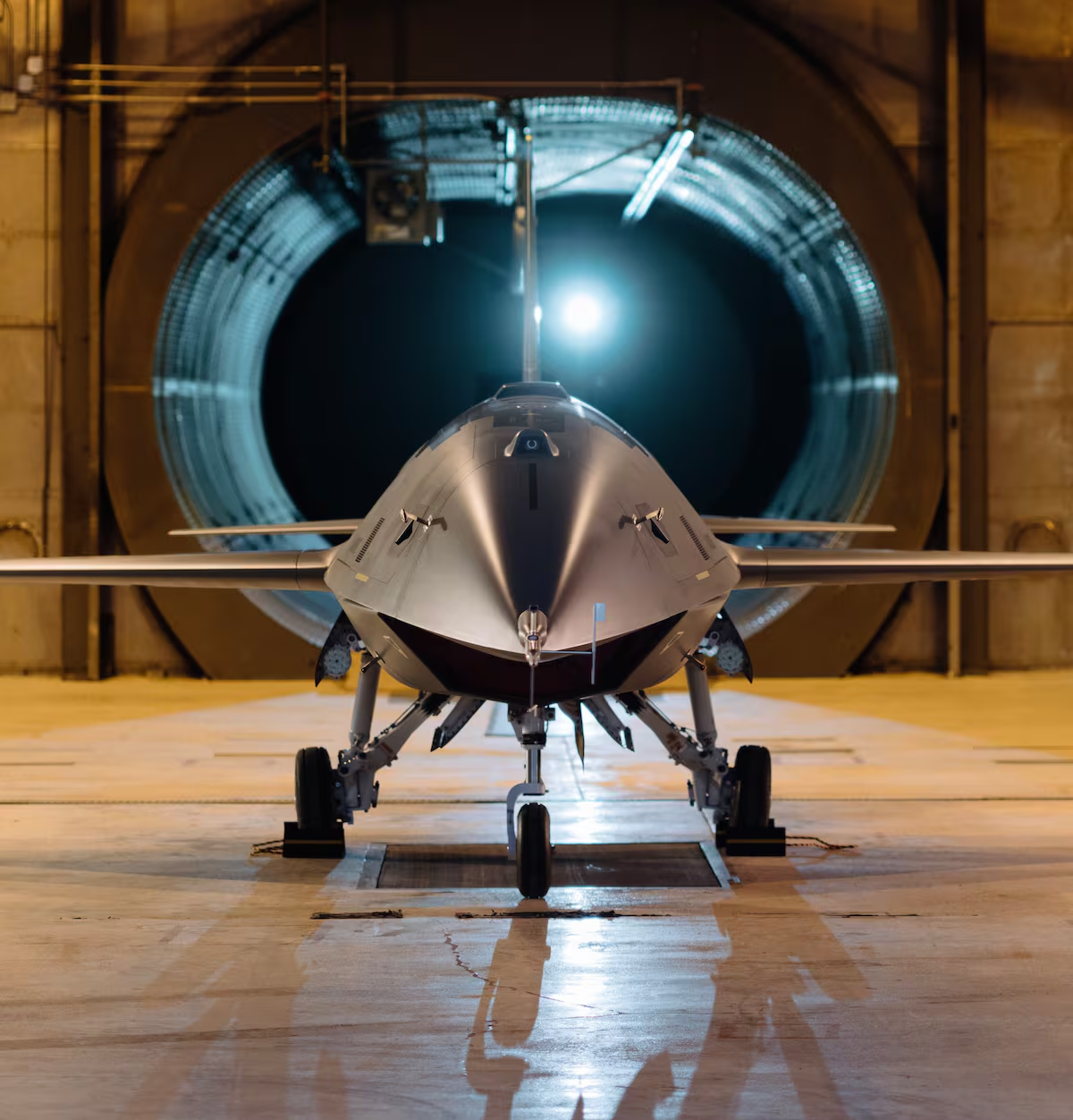
For the first time, the U.S. Air Force has requested Congressional funding for Collaborative Combat Aircraft (CCA), heralding the start of a new era termed the “loyal wingman” era. In its fiscal year 2027 budget proposal, the Air Force allocated $996.5 million for CCA procurement and an additional $150 million for FY28. Alongside approximately $1.37 billion for ongoing research and development—up from $827 million in FY26—the total request for the CCA program reaches around $2.37 billion, as indicated by recent Pentagon documents.
This significant investment in CCAs marks the largest addition to the Air Force’s $30.64 billion aircraft procurement budget, indicating a shift from testing to operational readiness. Unlike traditional drones, CCAs are jet-powered, semi-autonomous systems meant to support crewed fighters such as the F-35 and F-22, with the pilot acting as the mission commander. The CCAs utilize onboard autonomy for navigation, maneuvering, and weapons deployment.
The focus of Increment 1 CCA is primarily on air-to-air and strike missions, with plans for electronic warfare and ISR variants in future increments. The Air Force intends to acquire 100–150 aircraft in this initial phase, with long-term goals of amassing hundreds to several thousand across multiple increments. Designed to bolster combat effectiveness against adversaries like China, CCAs are intended to be affordable for potential loss while maintaining sufficient capability to engage in combat.
The Air Force envisions each manned fighter commanding multiple CCAs, with testing suggesting that one pilot could effectively manage three to five CCAs. This request signifies a commitment to CCA as a permanent component of the Air Force fleet, transitioning from experimental to operational status. However, critical decisions about maintenance, training, and integration into existing squadrons remain pending.
The increase in research and development funding highlights that Increment 1 is merely the beginning. Nine vendors are currently under contract for Increment 2 prototypes, with a focus on larger, cost-effective CCAs for anticipated Pacific operations. A final production decision for Increment 1 is expected this summer, with leading competitors including General Atomics’s YFQ-42A and Anduril’s YFQ-44A.
While the program is trending toward meeting cost targets below the original $30 million per-unit estimate, hosting a production transition generally comes with challenges. Issues like autonomy software development, supply chain logistics, and integration with manned platforms are still evolving. Congressional approval presents another hurdle, with lawmakers calling for thorough briefings on mission roles and production scaling before finalizing the budget.
In a notable development, the Netherlands has emerged as the first international ally to commit to funding two Increment 1 CCAs, which will remain U.S. property and operate under the Air Force’s Experimental Operations Unit at Nellis Air Force Base, with Dutch personnel engaged in developing operational concepts. Air Force Secretary Troy Meink emphasized the importance of cooperation with allies, stating that aligning strategies early ensures interoperability and shared advantages in future combat scenarios.
The content above is a summary. For more details, see the source article.









