


Key Takeaways
- AI-driven, real-time DRC analysis enables efficient handling of billions of violations in modern chip designs.
- Instance-complete reporting captures all errors upfront, reducing debugging cycles and improving productivity.
- A semiconductor company achieved a 70-80% improvement in DRC cycle time using the Calibre Vision AI platform.
Revolutionizing DRC Analysis for Advanced SoCs
In today’s semiconductor landscape, working with System on Chips (SoCs) at 2 nm and below presents unique challenges, particularly in Design Rule Check (DRC) analysis. Early DRC runs can generate hundreds of millions, if not billions, of violations, complicating collaboration and prioritization for engineering teams. Traditionally, designers would face delays waiting for lengthy DRC checks to conclude before beginning to address issues, leading to inefficiencies and bottlenecks.
The solution lies in adopting real-time, AI-powered DRC analysis methods. With advanced tools like Calibre Vision AI, engineers receive incremental results during the DRC run, enabling immediate insight into problems without the need for prolonged waiting. This shift allows teams to address critical issues dynamically, effectively breaking the cycle of “run, debug, and rerun.”
Instance-Complete Analysis
Traditional DRC methodologies often limit the visibility of reported violations due to historical tool constraints, leaving teams unaware of the full scope of errors. The introduction of instance-complete analysis captures every violation throughout the chip hierarchy, providing a holistic view from the outset. This comprehensive reporting allows for early detection of systemic issues, significantly reducing frustration and debugging cycles.
Achieving this involves modern file formats, like OASIS, and retaining hierarchical awareness throughout the analysis process. Scalable algorithms are employed to manage large data sets without compromising the depth of information relayed.
Leveraging AI for Efficient Debugging
When flooded with billions of errors, understanding where to start can be overwhelming. AI can streamline this by grouping related violations into actionable “Signals,” allowing engineers to target root problems rather than addressing symptoms across numerous design errors. Additionally, it identifies “Signatures,” or recurring patterns causing multiple violations, enabling a focused debugging approach.
This capability leads to an effective parallel DRC debugging strategy. Rather than waiting for the entire job to finish, teams can start addressing violations almost immediately after detecting them, preventing prolonged delays caused by early catastrophic mistakes during the analysis phase.
Team Collaboration and Status Tracking
With complex projects generating significant amounts of data, clarity and coordination among team members become critical. Tools like Calibre Vision AI provide built-in status tracking for Signals, enabling teams to see whether issues are assigned, in progress, or resolved. This real-time communication mitigates confusion and unifies the focus on problem resolution.
Advanced Filtering Techniques
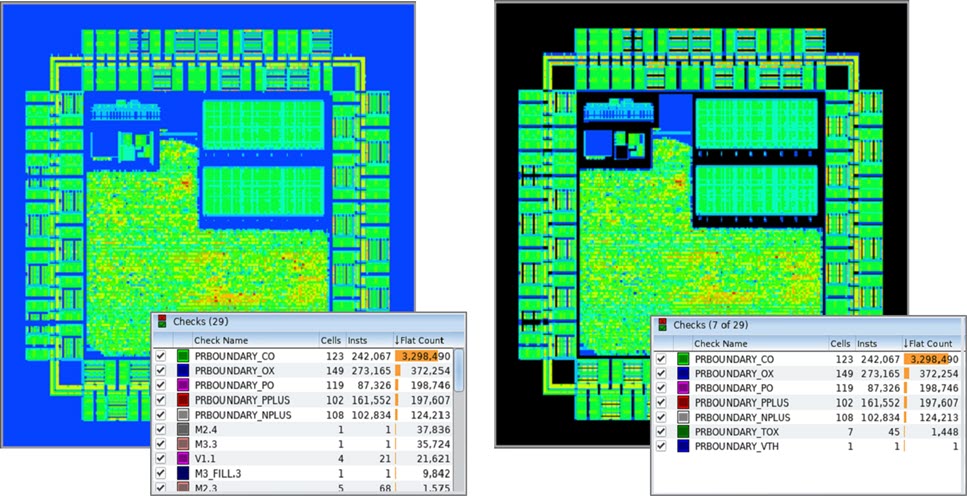
Faced with overwhelming data sets, engineers benefit from global filters that allow for focused analysis. Teams can zoom in on specific blocks or rule checks, which enhances productivity by reducing noise from irrelevant results. The tool’s ability to retain filtering settings ensures that engineers do not start from scratch with each session.
Impact on Cycle Times
Real-world implementations of Calibre Vision AI demonstrate significant improvements. A leading semiconductor firm recently achieved a 70-80% reduction in DRC iteration cycle time while managing historically challenging projects. Previously, their DRC runs produced over 600 million violations, but by utilizing the platform’s advanced features, they managed to enhance operational efficiency dramatically.
In summary, the advancement of DRC analysis through AI-driven tools provides modern engineers with the means to effectively manage the complexity of contemporary SoCs. By adopting instance-complete reporting, leveraging AI for violation grouping, enabling real-time analysis, and enhancing team workflows, hardware developers can streamline the debugging process—transforming DRC into a manageable, organized task rather than a cumbersome challenge.
The content above is a summary. For more details, see the source article.









