Key Takeaways
- Recent research on Uranus’ rings reveals differing compositions, with the mu ring composed of ice and the nu ring rich in dust and organic molecules.
- Data from multiple telescopes over two decades helped illuminate these findings, suggesting unique origins for the ring materials.
- The contrasting characteristics of the rings raise questions about the history of Uranus’ moon Mab and the dynamics of its ring system.
Insights into Uranus’ Unique Rings
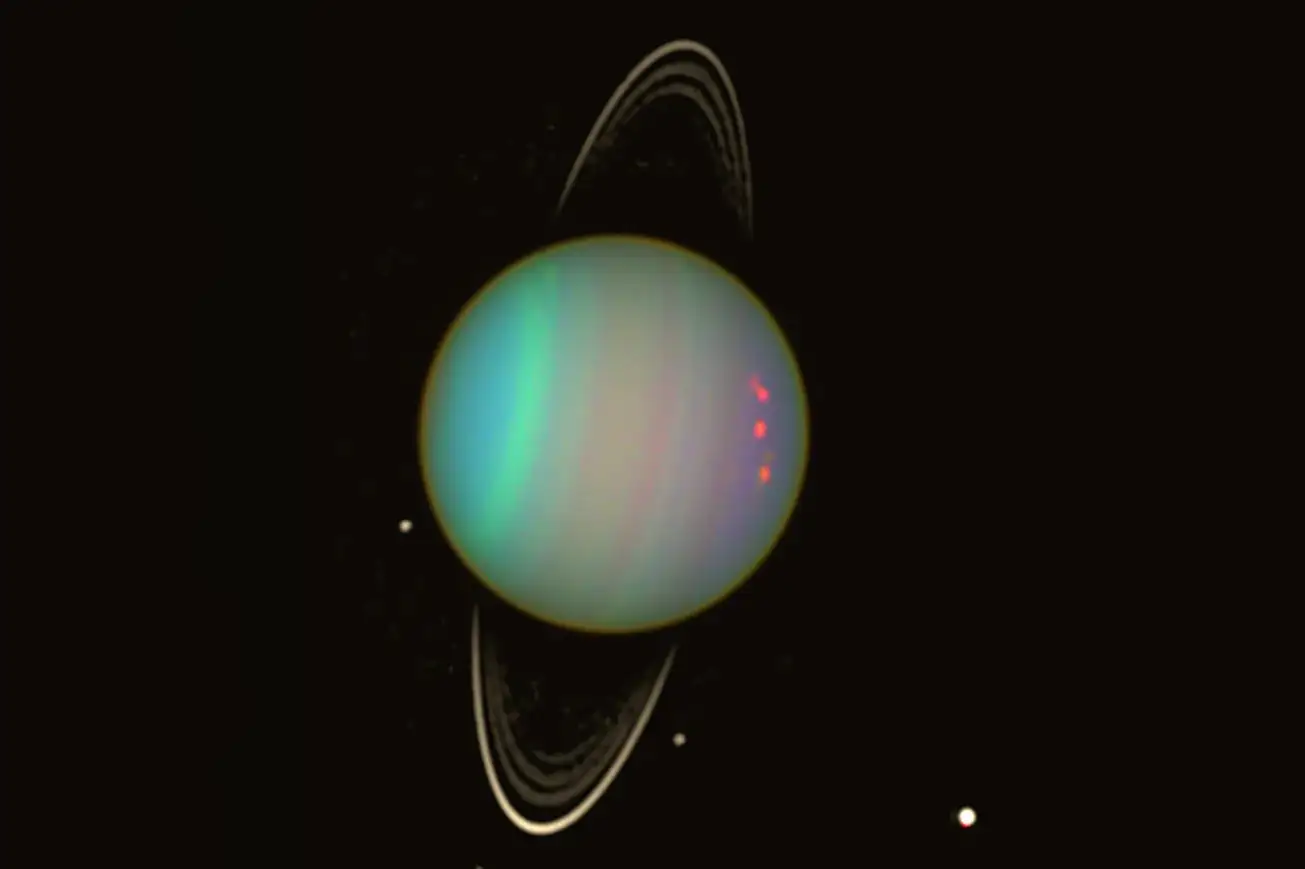
New observations of Uranus’ rings from the combined analyses of data from the Keck Telescope, Hubble Space Telescope, and James Webb Space Telescope have unveiled intriguing differences in their compositions. While the mu ring, the outermost of Uranus’ rings, appears blue and is comprised primarily of tiny ice grains, the nu ring exhibits a reddish hue and contains dust along with complex organic materials known as tholins.
The findings suggest that the icy particles in the mu ring likely originate from Uranus’ small moon Mab. This observation indicates that Mab is composed of ice rather than rock, distinguishing it from other nearby moons. The method by which these ice particles escaped Mab remains uncertain, although it is hypothesized that impacts from micrometeoroids may have dislodged them rather than any eruptive activity, as Mab is too small (approximately 12 kilometers wide) to produce significant plumes similar to those from Saturn’s moon Enceladus.
In contrast, the nu ring’s dusty composition aligns with expectations, but the rocky bodies contributing this dust have yet to be identified. Notably, this ring’s brightness has varied over time—specifically, it decreased by half between 2003 and 2006—suggesting a significant collision may have occurred prior to 2003, temporarily increasing its brightness.
The stark differences between the mu and nu rings prompt a broader inquiry into the origins of their material sources, especially given their proximity within the Uranus system. The hypothesis posits that numerous rocky bodies in the rings might stem from a previous moon that shattered or fragmented. However, Mab’s distinctive icy composition raises new questions about its past and the dynamics of the Uranus system as a whole.
Researchers emphasize that these findings provide valuable insights into the history and composition of Uranus’ ring system. According to astronomer Tracy Becker, the new data highlight the complexity of the system, indicating that more unanswered questions remain. This complexity suggests that understanding Uranus and its rings may require further investigation to piece together the various elements at play, enriching our comprehension of this distant ice giant.
The content above is a summary. For more details, see the source article.