


Key Takeaways
- Rohde & Schwarz and Greenerwave achieved fast, accurate near-field testing of a 50 cm SATCOM antenna, completing measurements in just 32 minutes.
- The new approach effectively reduces testing constraints for large SATCOM systems and offers a cost-effective alternative to traditional methods.
- Results matched simulation models within 1 dB, validating the reliability of the near-field testing technique for antenna performance verification.
Breakthrough in SATCOM Antenna Testing
Rohde & Schwarz and Greenerwave have made significant advancements in antenna testing through a recent joint measurement trial, which focused on a 50 cm Ku-Band electronically steerable array (ESA) antenna. This innovative near-field testing method offers remarkable speed and accuracy, recording a full radiation pattern in just half an hour. The results closely matched existing simulation models, only varying by a decibel, underscoring its reliability as a performance verification tool.
SATCOM antennas are crucial components in today’s satellite communication systems, operating in Low Earth Orbit (LEO), Medium Earth Orbit (MEO), and Geostationary Orbit (GEO). There is a growing need for detailed understanding of antenna radiation patterns to ensure dependable operations. Conventional far-field testing, however, often requires large chambers that are not practical for antennas of this size. While compact antenna test ranges (CATRs) represent a smaller option, they still demand significant time for dual-axis positioning, making testing cumbersome.
The collaboration between Rohde & Schwarz and Greenerwave introduced a more efficient solution. Greenerwave’s SATCOM user terminals integrate reconfigurable intelligent surfaces (RIS) technology, allowing the design of electronically steerable antennas that optimize performance while minimizing energy consumption and reliance on semiconductor components.
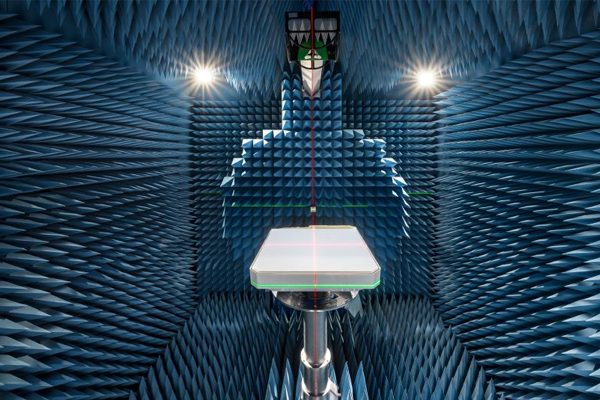
The trial employed Rohde & Schwarz’s advanced R&S TS8991 measurement system, which features a conical cut positioner and an R&S ZNA vector network analyzer, to evaluate Greenerwave’s passive single-aperture ESA. This antenna was engineered for low power usage and simple integration into various applications.
The test encompassed an extensive upper hemisphere measurement, down to a polar angle of 120 degrees, capturing ten Ku-Band frequencies over a span of 32 minutes, facilitated by a hardware trigger function. Data processed using the R&S AMS32 antenna measurement software allowed for a near-field-to-far-field transformation through a FIAFTA algorithm.
Comparative analysis with data from both the original numerical twin model simulation and results from Greenerwave’s CATR setup revealed peak gain variations between 0.3 dB and 1 dB, affirming the precision of the newly implemented near-field solution. Additional software export options enable users to continue their analysis in programs like CST Microwave Studio or MATLAB.
This trial marks a pivotal moment in the characterization of large SATCOM antennas, demonstrating that the R&S TS8991 system can deliver both rapid and accurate results in a near-field setup. This offers an efficient alternative to the extensive requirements of traditional far-field chambers or CATRs, streamlining the testing process for manufacturers involved in broadband, IoT, or backhaul antennas requiring flexible beam control and high data rates. Furthermore, the system can be easily integrated into research labs, significantly shortening test cycles and reducing overall development costs. For further details on satellite testing solutions from Rohde & Schwarz, visit their website.
The content above is a summary. For more details, see the source article.









