


Key Takeaways
- Union Minister Jagat Prakash Nadda spoke at the 79th World Health Assembly about the transformative potential of AI in healthcare.
- India’s Digital India initiative and National Health Policy aim to create an inclusive digital health ecosystem, preparing for future technologies.
- Nadda emphasized the need for ethical governance and international collaboration in AI development to ensure equitable healthcare for all.
AI’s Transformational Role in Healthcare
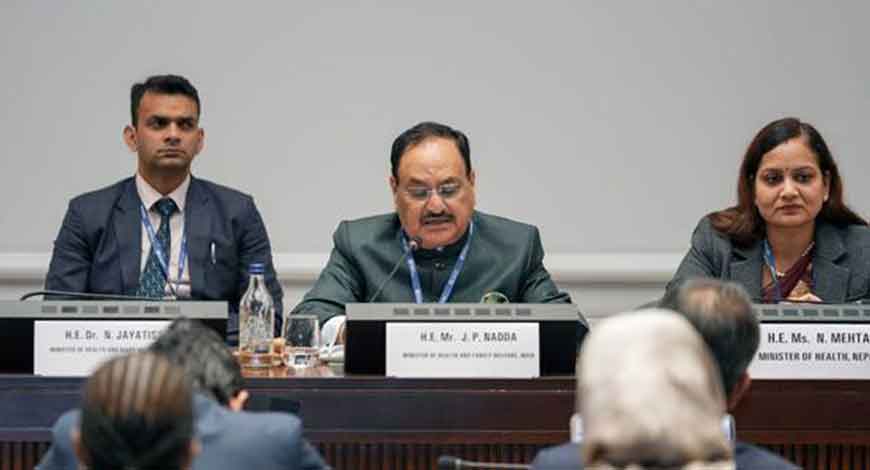
Union Minister of Health and Family Welfare, Jagat Prakash Nadda, addressed a session focused on “Artificial Intelligence in Health” during the 79th World Health Assembly in Geneva. His speech highlighted the significant potential of AI to enhance healthcare systems, governance, economies, and citizens’ lives globally. However, he stressed that the adoption of AI should be underpinned by strong regulation, thorough research, ethical oversight, and an unwavering commitment to equity to ensure its benefits are accessible to all.
Nadda acknowledged that India laid a comprehensive digital foundation over ten years ago through the Digital India initiative, launched in 2015 under Prime Minister Narendra Modi’s leadership. This initiative aims to transform India into a digitally empowered society, particularly preparing for future technologies such as AI. He noted that the National Health Policy of 2017 envisioned creating a digital health ecosystem that is integrated, interoperable, inclusive, and scalable, laying the groundwork for subsequent initiatives.
In 2021, the Indian government launched the Ayushman Bharat Digital Mission, which incorporates consent-based digital health data frameworks. While recognizing the importance of digitization, Nadda emphasized that proper governance frameworks specific to the health sector are crucial for the responsible deployment of AI technologies. During the India AI Impact Summit in February 2026, the government introduced the Strategy for AI in Healthcare for India (SAHI), described as a comprehensive approach emerging from the Global South. SAHI aims to guide India’s healthcare advancements ethically and transparently.
Highlighting India’s vast diversity, Nadda mentioned the challenges in governing AI across 1.4 billion citizens who speak 22 official languages. He cautioned that while AI could alleviate healthcare disparities, poorly designed systems might exacerbate existing inequalities. To counter this risk, he presented BODH – Benchmarking Open Data Platform for Health AI, which ensures that AI solutions in India are evaluated against real-world datasets for equitable performance nationwide.
Nadda called for greater international collaboration, stating that no single country can effectively tackle the challenges posed by AI in isolation. He reaffirmed India’s readiness to partner with global entities to enhance trusted health data ecosystems, foster collaborative research, and pursue ethical AI development. The discussion ultimately centered on the principle that technological innovations should adhere to regulations, build trust, and prioritize equity and public good.
In closing, Nadda highlighted that the future of AI in healthcare is determined not solely by algorithms but by the collective decisions of governments, institutions, and societies. Reflecting Prime Minister Modi’s vision, he expressed India’s commitment to “All-Inclusive Intelligence,” urging the global community to ensure AI serves as a force for global good.
The content above is a summary. For more details, see the source article.









