


Key Takeaways
- Itera has unveiled a groundbreaking circuit board technology featuring liquid-metal tracks that can be reconfigured in real time.
- The boards utilize a glass substrate with microscopic channels, allowing for dynamic creation of conductive paths.
- Initial prototypes are confirming the technology’s potential, attracting significant interest from major sectors like automotive and defense.
Innovative Liquid-Metal Circuit Board Technology
Itera has introduced a revolutionary circuit board technology that utilizes liquid-metal tracks capable of being reconfigured on demand, a concept that evokes science fiction imagery such as the T-1000 Terminator from “Terminator 2: Judgment Day.” The company, named after the concept of iteration, emphasizes the prototyping advantages this technology offers.
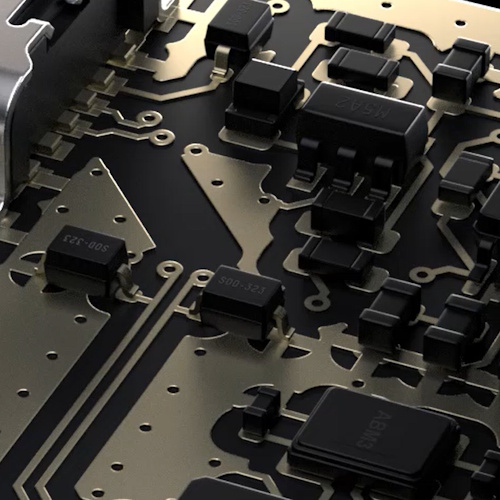
Unlike traditional circuit boards made from fiberglass and copper, Itera’s prototype consists of multiple layers of ultra-thin glass embedded with microscopic channels. This design allows liquid metal to flow and create conductive traces and vias visibly and dynamically. The liquid metal can be repositioned, effectively functioning like a “field-programmable metal array” as described by CEO AJ Cooper.
As a demonstration of the board’s capabilities, each pixel within the glass substrate can either contain liquid metal or remain empty. When adjacent pixels are filled, they merge to form conductive connections. Additionally, embedded thin-film transistors allow the board’s routing to be compiled, erased, and remade in seconds, a significant upgrade from traditional methods where designs are permanently etched into copper.
Another innovative feature of this technology is that it can “remember” its configurations, similar to electronic ink in e-readers. Once traces are established, they maintain their structure until directed to change. Moreover, the architecture allows engineers to observe electrical activity throughout the entire board, enabling more effective troubleshooting.
Currently, Itera’s proof-of-concept device is a single-layer board measuring approximately 70 mm square, with plans to expand into two-layer versions. The ultimate aim is to scale up to larger boards suitable for modern commercial designs. Itera envisions future applications that would allow engineers to make iterative physical design changes as fluidly as software developers do with code.
Interestingly, Itera does not sell these boards outright; instead, they provide a service reminiscent of AWS for electronics. Clients can submit design files, and Itera assembles the components on its reconfigurable substrate, offering remote access for real-time interaction. This removes the lengthy waiting periods for new PCB productions, thereby speeding up development cycles considerably.
The initial interest in Itera’s technology is substantial, with major industry players from automotive, defense, and computing sectors reserving the company’s initial production capacity. Although these companies choose not to publicly identify themselves, their involvement serves as a strong endorsement, hinting at the competitive edge that faster hardware iterations could provide.
As Itera progresses, there is cautious optimism regarding the transformative potential of this technology. By moving well beyond prototyping to demonstrate working hardware and securing funding, Itera may be on the precipice of a significant shift in how electronic circuit designs are developed and tested. The future of engineering could very well look different with the adoption of this innovative approach.
The content above is a summary. For more details, see the source article.









