


Key Takeaways
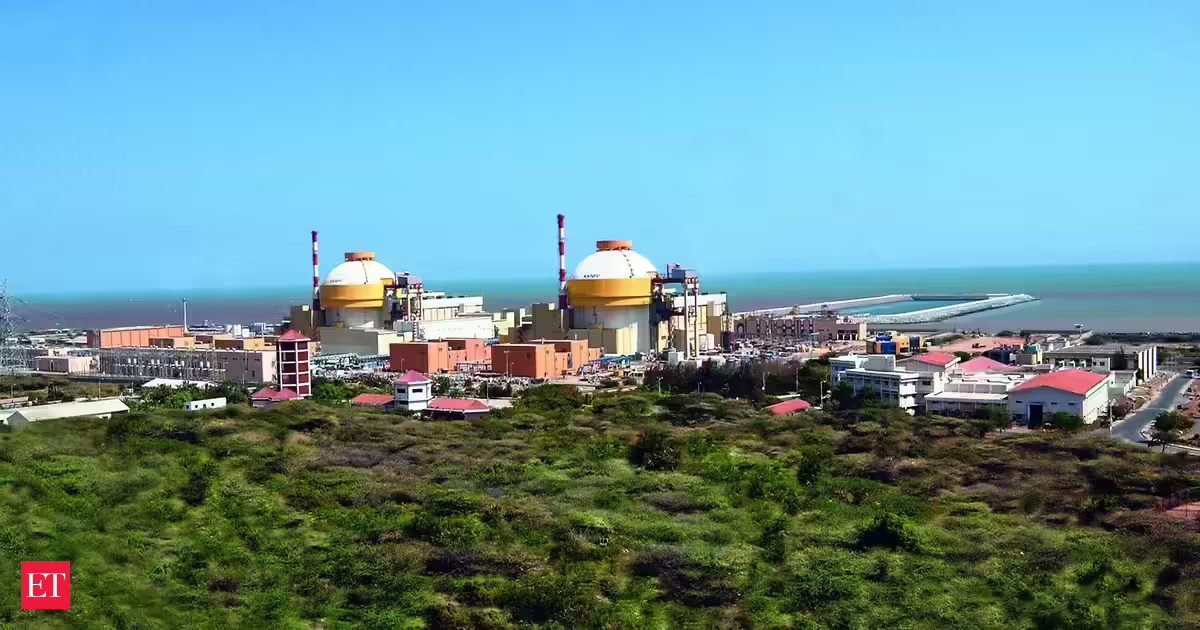
- The Nuclear Power Corporation of India Limited has installed the reactor pressure vessel at Unit-5 of the Kudankulam Nuclear Power Project in Tamil Nadu.
- This significant milestone was achieved with technical assistance from Rosatom, Russia’s nuclear energy corporation.
Reactor Installation Marks Major Milestone
The Nuclear Power Corporation of India Limited (NPCIL) successfully installed the reactor pressure vessel (RPV) at Unit-5 of the Kudankulam Nuclear Power Project (KKNPP) in Tamil Nadu. This pivotal progress was facilitated by collaboration with Russia’s Rosatom, a leader in nuclear energy. The installation took place on June 15, supported by Rosatom’s engineering division.
The RPV, an essential steel component weighing approximately 320 tonnes, enshrines the reactor core where nuclear fission occurs. The installation utilized the open-top method, allowing a heavy-duty crane to place the vessel into the reactor building before erecting the dome. This technique was effectively employed during the earlier phase of the KKNPP’s construction, showcasing the expertise shared between India and Russia.
Mikhail Novikov, director of projects in India at Russia’s Atomstroyexport, emphasized the enduring partnership between the two nations, stating, “The secret to the success of the Kudankulam NPP project is the long-standing and fruitful cooperation between India and Russia.” Currently, Indian professionals are involved in the construction and commissioning of four power units, while two others have been operational for over ten years.
NPCIL highlighted that this milestone underscores the significance of international collaborations in advancing India’s nuclear energy agenda. The organization reaffirmed its commitment to energy security, environmental responsibility, and sustainable development through its Nuclear Energy Mission for a developed India (Viksit Bharat).
The Kudankulam Nuclear Power Project operates under an Intergovernmental Agreement established in 1988, which was later amended in 1998. Since the connection of Units 1 and 2 to the national grid in 2013 and 2016, respectively, they have generated over 127 billion kilowatt-hours (kWh) of electricity as of April 2026.
The ongoing development of Units 3, 4, 5, and 6 constitutes the second and third phases of the KKNPP project, with each unit equipped with a WWER-1000 reactor. Once all six reactors are commissioned, the Kudankulam plant will boast a total capacity of 6,000 MWe, positioning it among the largest nuclear power facilities in the country.
The content above is a summary. For more details, see the source article.









