


Key Takeaways
- China’s new PL-16 missile is designed to match the U.S. AIM-260, offering significant range and advanced capabilities.
- The missile’s features allow it to effectively target critical airborne assets like tankers and reconnaissance aircraft.
- Analysts remain uncertain about the PL-16’s operational status, as information is derived from unofficial leaks and technical presentations.
China’s Advancements in Air-to-Air Missile Technology
China has introduced the PL-16, a new air-to-air missile that significantly enhances the People’s Liberation Army’s capabilities in potential Asia-Pacific conflicts. Experts suggest that this beyond-visual-range missile may rival the U.S. military’s Lockheed Martin AIM-260 Joint Advanced Tactical Missile (JATM).
The PL-16 reportedly boasts an impressive operational range of 200 to 300 kilometers (124 to 186 miles) and incorporates advanced dual-pulse rocket motor technology. This allows for a second burst of propulsion during flight, enhancing its maneuverability and effectiveness when targeting larger, slower aircraft. Malcolm Davis, a senior analyst with the Australian Strategic Policy Institute, noted that the missile’s design enables it to target vital U.S. Air Force and Navy assets, which could dramatically affect operational capabilities in the region.
The strategic intent behind the PL-16 is clear: to neutralize key combat enablers used by U.S. and allied forces. Davis emphasized the potential for a “battle changer” effect as the PL-16 could target platforms such as airborne early warning and control systems or refueling tankers from long distances, thus impacting U.S. naval air power projection.
The missile race between China and the U.S. is intensifying, with the JATM being a response to China’s earlier PL-15 missile. Analysts are closely monitoring how quickly the U.S. can move forward with JATM production, as China accelerates its PL-16 development. The uncertainty around U.S. military intervention in conflicts over Taiwan or the South China Sea adds another layer of complexity to the strategic landscape.
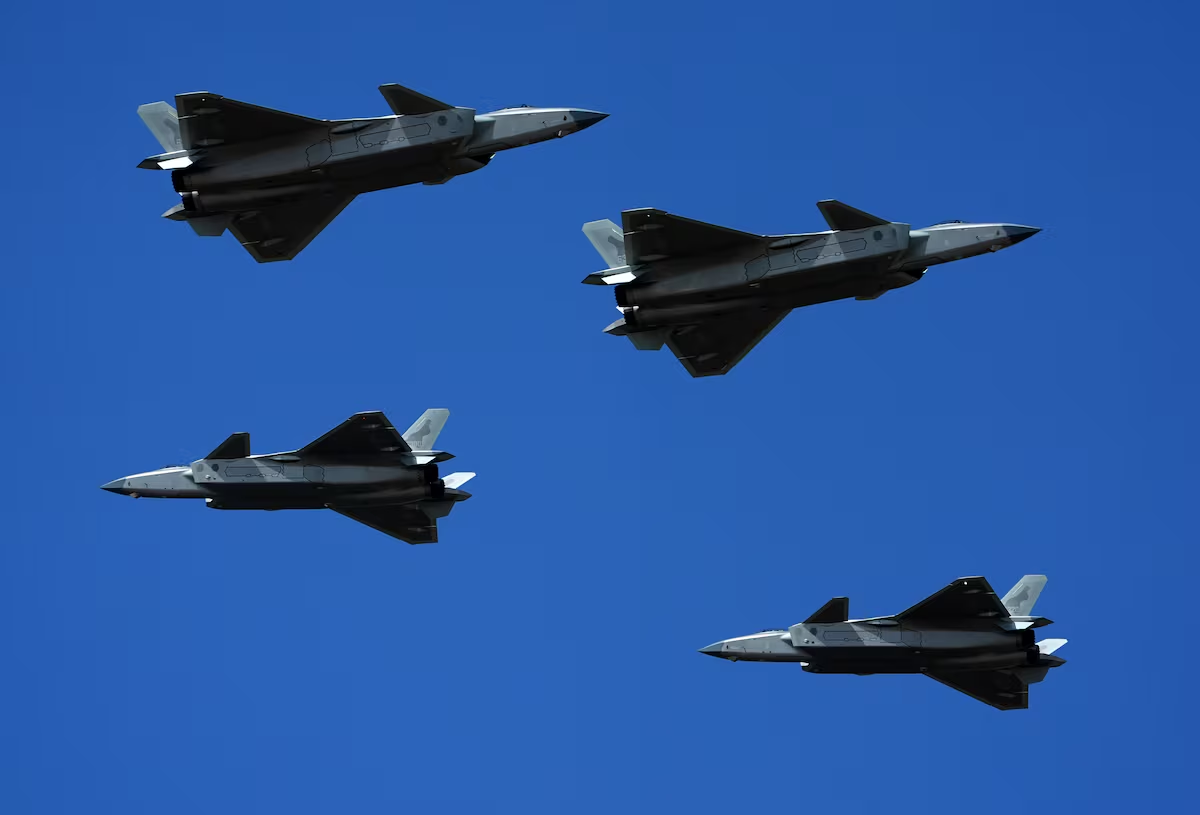
Enrico Cau, an associate researcher at the Taiwan Strategy Research Association, remarked that while the PL-16 could pose a significant threat to larger bombers like the B-52, its effectiveness against smaller, more agile aircraft remains uncertain. Meanwhile, the PL-16’s compatibility with China’s stealth fighters, including the J-20 and the upcoming J-35, allows for enhanced mission capabilities. Reports suggest that a J-20 could carry up to six PL-16 missiles, improving its ability to remain engaged in combat scenarios.
Information regarding the PL-16 remains largely speculative, sourced from leaked presentations and unofficial military documents, with no confirmation from Beijing on its development status. Presentation slides indicate that the missile could be approximately four meters long, with a diameter of 203 millimeters and a weight of 200 kilograms.
The specifications of the PL-16 suggest a strategic shift from its predecessor, the PL-15, which had a maximum range of 200 kilometers. Observers believe this advancement will enable Chinese aircraft to carry more missiles and sustain operations longer without needing to retreat.
While there is a consensus on the likelihood of the PL-16 being actively developed, analysts caution that current online resources do not provide definitive information regarding its range and propulsion technology, leaving questions about whether the missile is in active production. The evolution of the PL-16 highlights the ongoing modernization of China’s military capabilities and the escalating arms competition in the Asia-Pacific region.
The content above is a summary. For more details, see the source article.









