


Key Takeaways
- Slate’s upcoming pickup will now feature a lithium iron phosphate (LFP) battery instead of a nickel manganese cobalt (NMC) battery.
- The change allows Slate to offer the truck at a starting price of $24,950, making it the cheapest new EV and truck in the U.S.
- Production is set to begin in the fourth quarter of this year, with improved range of 205 miles compared to previous estimates.
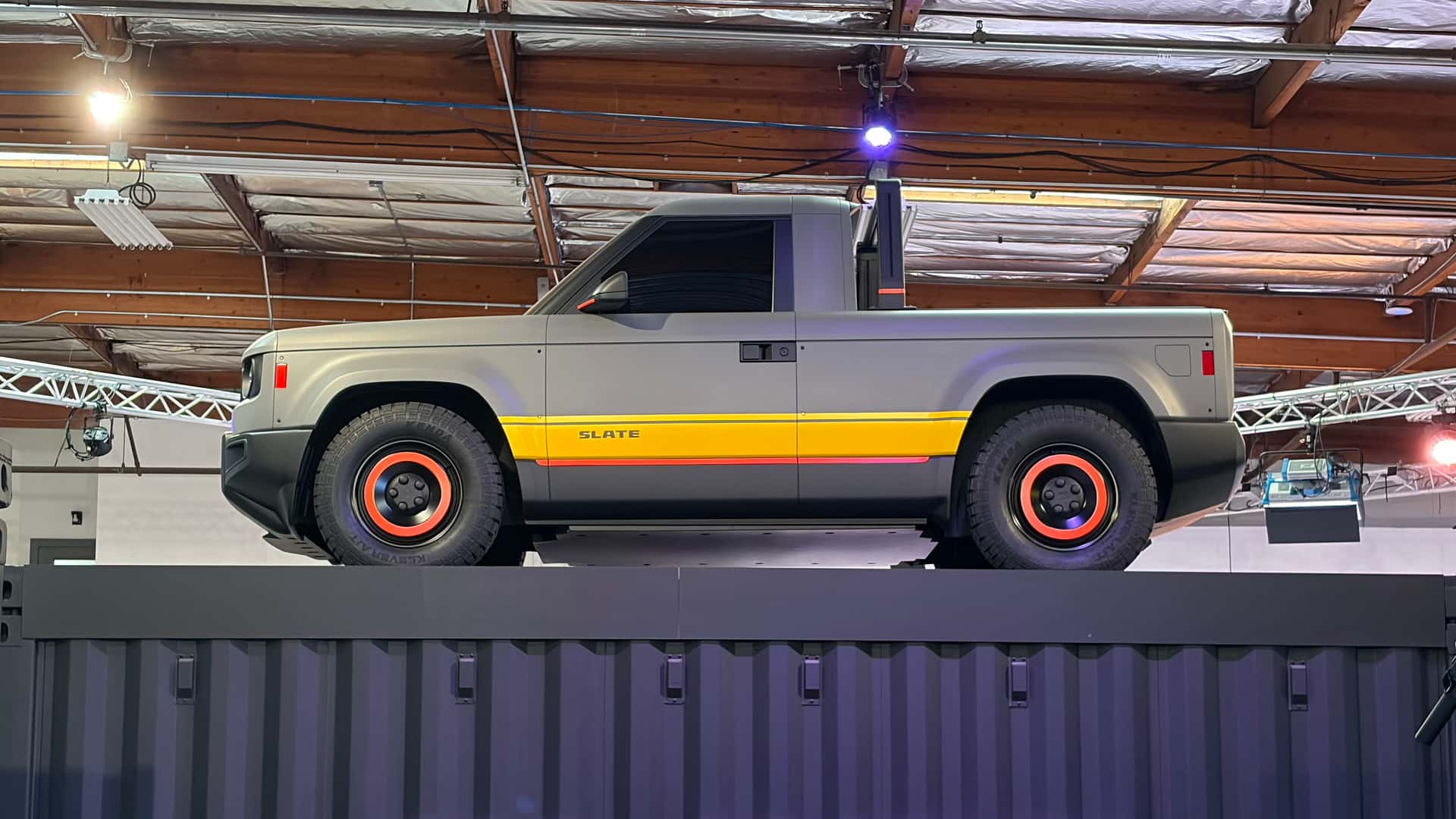
Slate, backed by Jeff Bezos, is set to launch its minimalist pickup with a revised battery choice later this year. The company has switched from a previously planned nickel manganese cobalt (NMC) battery to a more affordable lithium iron phosphate (LFP) pack sourced from Gotion, which will manufacture the batteries in Illinois, close to Slate’s Indiana production facility.
The LFP batteries are renowned for their durability and cost-effectiveness, making them suitable for Slate’s target market. While LFP cells offer less energy density than NMC batteries—resulting in a reduced driving range—the emphasis on affordability aligns with Slate’s mission. The pickup, priced at $24,950, will make it the most economically accessible new EV and also the cheapest truck in America when sales commence by the end of the year.
Initially, Slate opted against LFP batteries due to compliance issues with the $7,500 federal EV tax credit, which stipulated strict regulations around the provenance of battery materials. The requirement aimed to avoid connections with “foreign entities of concern,” particularly those in China, where LFP battery supply chains are predominantly located. Consequently, the startup went with NMC cells from SK On, a South Korean supplier.
Recent legislative changes have pushed the program in a different direction. The elimination of the stringent sourcing criteria allowed Slate to revisit its battery options. The company’s president of vehicles, Chris Barman, emphasized that LFP batteries became increasingly viable as their availability improved since the initial plans were laid out.
The new 65-kilowatt-hour LFP pack has proven to be more cost-effective than previously anticipated. Its production proximity significantly cuts down on logistics expenses. The switch to a module-free design using prismatic cells allows for a more compact battery pack layout, increasing the pickup’s range from an earlier estimate of 150 miles to 205 miles in its production model.
Such improvements are crucial as the LFP chemistry permits complete charges and near-depletion discharges, which is advantageous for low-range vehicles. However, this transition has led to a trade-off in performance. The new pack has resulted in a decrease in power output, changing from 201 horsepower to 181; however, the vehicle’s acceleration remains steady at approximately eight seconds to reach 60 mph.
While earlier iterations of the pickup considered offering a larger battery with a maximum range of 240 miles—similar to competitors like the Chevy Bolt—Slate executives ultimately decided 205 miles was a sufficient target for the time being. Head engineer Eric Keipper noted that this decision allows for flexibility to gauge consumer reactions moving forward.
Preorders for the Slate pickup are now open, with production set to commence in the last quarter of this year. As interest builds, the automotive sector is keen to see if this venture will resonate with potential buyers.
The content above is a summary. For more details, see the source article.









