


Key Takeaways
- China’s Dong Feng-17 (DF-17) ballistic missiles are capable of evading defenses, posing a significant threat to military vessels.
- The recent media display aims to signal China’s military advancements in response to U.S.-led exercises in the region.
- Analysts emphasize the need for the U.S. to develop its own hypersonic weaponry for adequate deterrence against the DF-17.
Assessing China’s Dong Feng-17 Missile Capabilities
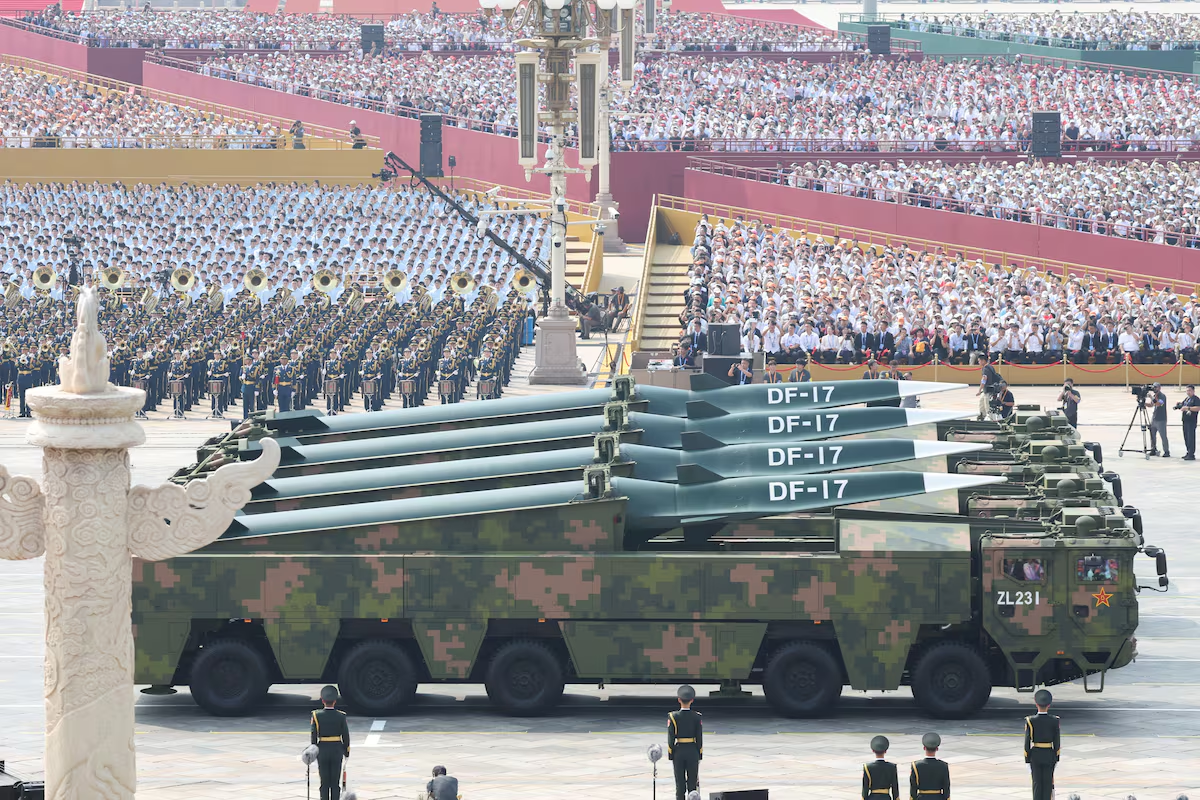
China’s Dong Feng-17 (DF-17) ballistic missile has been a part of the People’s Liberation Army (PLA) arsenal for over a decade and has been operational since 2019. Recently, the missile has garnered increased attention following its showcase in Chinese media, where it was touted as a premier military asset. Analysts argue this public display serves as a warning to the United States and other military forces in the Asia-Pacific region about its capabilities.
The DF-17 is armed with a hypersonic glide vehicle, granting it the ability to cruise at low altitudes and alter its trajectory unpredictably. According to the Center for Strategic and International Studies, these medium-range missiles can reach distances ranging from 1,800 to 2,500 kilometers and can be equipped with conventional or nuclear payloads. Given their design, the missiles pose a significant threat to large military targets like aircraft carriers.
The timing of showcasing the DF-17 coincides with U.S.-led military exercises, specifically the Rim of the Pacific (RIMPAC) and U.S.-Japan joint drills, which were perceived as hostile maneuvers targeting China. Experts suggest this strategic announcement by China may be an effort to bolster its deterrent capabilities. Alexander Huang, chairman of the Council of Strategic and Wargaming Studies in Taipei, indicated that the missile’s features make it difficult to intercept, especially for surface targets.
The footage, aired by the state-run outlet CGTN, emphasized the missiles’ ability to conduct “ultra-precise” attacks and evade advanced defense systems without being restricted to fixed launch sites. This feature would greatly enhance strike efficiency and operational safety on the battlefield, showcasing China’s advancements in military technology.
Further reinforcing the strategic implications of the DF-17, Chen Yi-fan, an academic at Tamkang University, noted that the missiles reflect the PLA’s growing confidence in its ability to overwhelm regional defense systems. The message conveyed through this military show-of-force is that the DF-17 can execute saturation strikes that complicate military planning for adversaries.
The U.S. military is taking note of the increasing number of PLA naval drills around Taiwan, as well as tensions with the Philippines over territorial claims in the South China Sea—key areas of interest considering the strategic importance of Taiwan, a self-ruled entity with U.S. backing.
Experts like M. Taylor Fravel from MIT argue that the DF-17’s hypersonic capabilities significantly enhance its battlefield potential, making it difficult to track compared to traditional missiles. Consequently, U.S. forces may need to develop advanced long-range radars to detect and counter these threats proactively.
In response, U.S. defense strategies include the development of its own hypersonic capabilities, such as the Long-Range Hypersonic Weapon system. U.S. analysts emphasize that accelerating these developments is essential for establishing credible mutual deterrence, especially given the DF-17’s potential uses in conflicts involving perceived threats to Chinese sovereignty.
The content above is a summary. For more details, see the source article.









