


Key Takeaways
- The Design Automation Conference (DAC) focused on AI automation and advanced semiconductor technologies despite location concerns.
- UMC is expanding its capacity and infrastructure in Singapore and Taiwan, while China starts producing immersion DUV lithography systems.
- The U.S. Department of Commerce announced up to $874M in CHIPS Act funding for semiconductor R&D across various companies.
DAC Sparks Excitement in Semiconductor Innovations
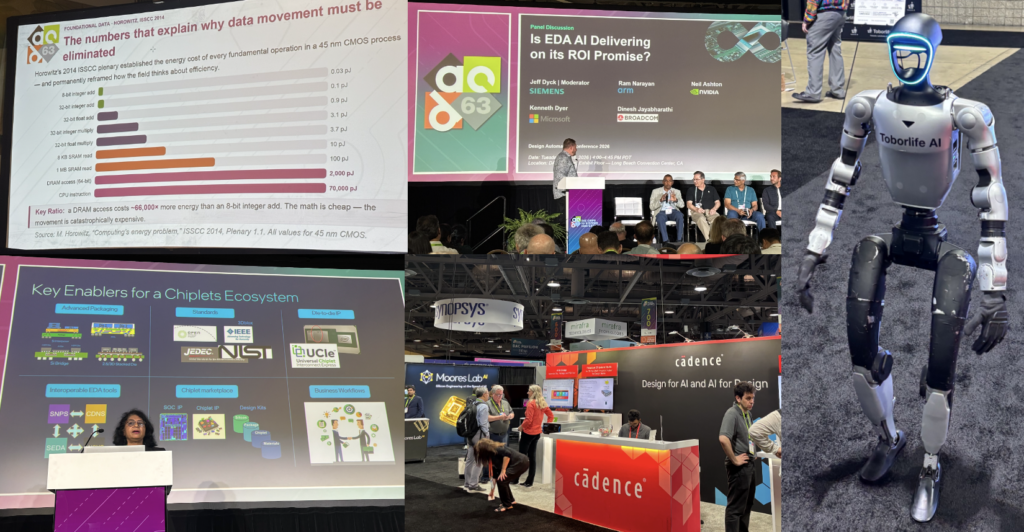
The recent Design Automation Conference (DAC) held in Long Beach, California, showcased a fervent atmosphere around emerging technologies in the semiconductor industry. Initially criticized for its remote location, the event successfully spotlighted several hot topics, including AI automation, multiphysics simulation, and AI-driven chip design.
Major companies made significant announcements. Synopsys launched new autonomous AI workflows for chip design in partnership with Microsoft and Nvidia, focusing on end-to-end solutions that integrate electronic design automation (EDA) and computer-aided engineering (CAE). Cadence, working with Nvidia, introduced an AI platform aimed at enhancing PCB and advanced packaging design through specialized autonomous agents. Siemens EDA also joined the fray with self-verifying workflows that leverage Nvidia’s technology to uphold accuracy in IC design.
In terms of market developments, Universal Microelectronics Corporation (UMC) detailed plans to expand its production capabilities significantly. The company is enhancing its facilities in Singapore and Taiwan to meet the rising demand for AI and edge-computing applications. In a separate geographical development, Japan faced manufacturing disruptions due to a 7.1-magnitude earthquake in Kumamoto, impacting various chip manufacturers.
China has accelerated its semiconductor production by launching domestically developed immersion DUV lithography systems, though these technologies still lag behind industry giants like ASML in terms of efficiency and reliability.
The Semiconductor Industry Association (SIA) unveiled a comprehensive report forecasting a record $796 billion in global chip sales for 2025, with projections reaching $1.5 trillion by 2026. U.S.-based companies captured 53% of the market share, while semiconductor investments in the U.S. have exceeded $770 billion since 2020, supporting over 160 projects. Additionally, global silicon wafer shipments are increasing, and wafer fab equipment sales are projected to rise due to AI-driven demand.
The ongoing shortage of DRAM is expected to persist, fueled by high-bandwidth memory (HBM) requirements for AI infrastructures, while NAND supply could ease as newer fabrication technologies come online.
Significantly, the U.S. Department of Commerce has formalized partnerships with seven companies under the CHIPS Act, offering up to $874 million in funding to enhance R&D endeavors across multiple domains, such as integrated photonics and thermal sampling technology. Companies like GlobalFoundries, Kepler, and Extropic are among the beneficiaries, aiming to innovate in areas ranging from next-gen silicon photonics to advanced packaging.
In notable industry collaborations, Nvidia and SK Group are working towards a substantial partnership valued at over $500 billion, focusing on AI capabilities. Intel is actively advancing its Secure Enclave initiative with support from the U.S. Department of Defense, ensuring a reliable supply chain for advanced semiconductor manufacturing.
On the technology front, advancements include initiatives from various organizations and universities, addressing everything from developing safety standards in automotive chip design to fostering AI-aligned security practices. New programs and partnerships for semiconductor education are gaining traction, reflecting a collective effort to bolster the industry’s workforce.
Amid these developments, the semiconductor sector continues to navigate complexities in supply chains and emerging technologies, positioning itself for significant growth and transformation in the coming years.
The content above is a summary. For more details, see the source article.









