


Key Takeaways
- The U.S. Air Force is investing $75 million in Boeing’s new long-range guided bomb, the GBU-75.
- This bomb, enhanced from a standard JDAM, can reach over 300 nautical miles, offering capabilities similar to cruise missiles.
- The Navy has already tested the GBU-75, demonstrating its effectiveness in engaging targets from safer distances.
New Long-Range Weapon Development
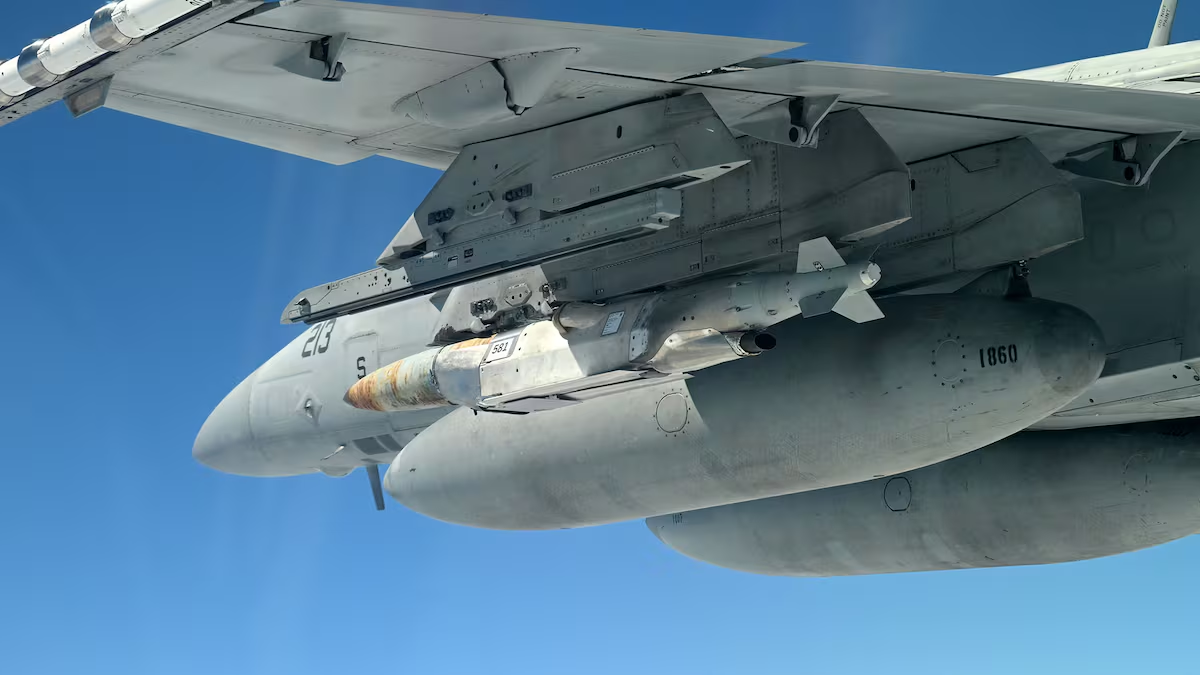
The U.S. Air Force has allocated $75 million for the initial production of the GBU-75, a jet-powered guided bomb developed by Boeing. This advanced weapon can fly over 300 nautical miles, significantly enhancing its range compared to traditional munitions. The GBU-75 is an upgrade to the existing Joint Direct Attack Munition (JDAM) system, integrating Boeing’s BSU-111/B Payload Delivery Unit. This kit comprises a wing and a turbojet engine that transforms a standard 500-pound JDAM into an effective long-range bomb.
Boeing has invested nearly $100 million of its own resources into the development of the GBU-75. According to Bob Ciesla, vice president of Boeing’s Precision Engagement Systems, the mass production of the GBU-75 will offer a cost-effective, sustainable solution for addressing both land and sea threats to U.S. and allied forces.
The JDAM system has previously been enhanced with various modifications. Earlier versions included a tail kit that provided approximately 15 nautical miles of steerage, followed by a wing kit that extended the range to 40 nautical miles. The new TDI-J85 engine, designed by Kratos, allows the GBU-75 to operate at a much longer range.
Beyond conventional land attacks, the JDAM LR has a variant known as QuickStrike, which is equipped with a ship-tracking sensor. Boeing has conceptualized deploying large quantities of these weapons on Air Force bombers, although no official purchases from the Air Force have been announced yet.
The Air Force Life Cycle Management Center at Hill Air Force Base is responsible for procuring JDAMs for both the U.S. Air Force and Navy. The Navy has been at the forefront of testing the GBU-75; in April, Super Hornet aircraft successfully released two JDAM LRs during exercises off the California coast. One test involved a bomb that operated for 34 minutes and accurately reached its target, while a second test demonstrated the weapon’s capability to alter altitude during flight.
Capt. Sarah Abbott, the Navy’s Precision Strike Weapons program manager, emphasized the strategic advantage of enhancing the range of JDAM systems. She noted that this capability allows pilots to strike targets from greater distances, thereby improving safety and effectiveness in contested environments.
An appealing aspect of the GBU-75 program is its reliance on existing infrastructure. Navy budget documents indicate that the GBU-75 is a modification of the baseline JDAM program, utilizing current production lines and guidance systems. Importantly, any aircraft capable of deploying a conventional JDAM can also drop the GBU-75 without requiring modifications.
Although the contract award for the GBU-75 was not listed in the Pentagon’s daily announcements as of August 5, it is classified as an undefinitized action. This means that work began before an official agreement on pricing was finalized, a process that the Government Accountability Office has flagged as potentially risky due to its reimbursement structures.
Boeing’s release did not specify how many GBU-75 bombs are included in this contract, nor did it disclose their cost or delivery timelines.
The content above is a summary. For more details, see the source article.









