


Key Takeaways
- AVIDrone achieved the highest payload-to-weight ratio of 3.84 to 1 in DARPA’s Lift Challenge, winning $1.25 million.
- The competition aimed to innovate vertical lift in small drones, with impacts expected across various industries.
- Secondary awards were given for design and technology improvements to teams demonstrating notable innovations.
AVIDrone Leads Lift Challenge with Record Payload Capacity
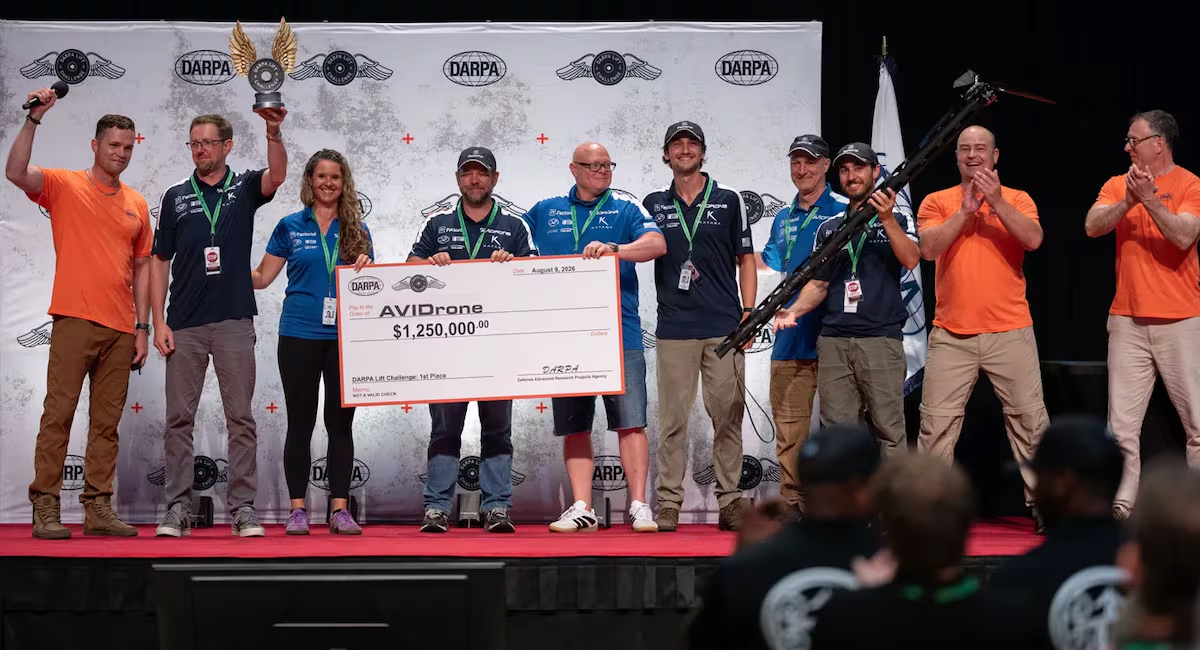
The Defense Advanced Research Projects Agency (DARPA) recently wrapped up its Lift Challenge, focusing on advancing small unmanned aerial systems. While no participant met the ambitious objective of lifting four times their drone’s weight, notable advancements were made. Canadian company AVIDrone, with its U.S. base in Maryland, secured first place with its Katana heavy-lift drone. This drone, weighing 29.3 pounds, successfully lifted a payload of 112.4 pounds, achieving a remarkable payload-to-weight ratio of 3.84 to 1 over a distance of approximately five nautical miles.
AVIDrone attributed its success to a combination of extensive expertise, proprietary flight-control technologies, and a history of designing aircraft for heavy cargo applications. The Lift Challenge had been set up to stimulate innovation in the small-drone sector, with millions in prize money available to promote technological advancement.
Phillip “Donna” Smith, the program manager for the Lift Challenge, characterized heavy vertical flight as a pivotal technological milestone, essential for widespread adoption in multiple industries, including agriculture, logistics, and construction. AVIDrone’s first-place finish earned the company $1.25 million and highlighted the competition as a stimulating environment for idea development and practical applications in drone technology.
Following AVIDrone, Massachusetts-based MTech Operations secured second place with a payload-to-weight ratio of 3.64 to 1, winning $750,000, while California’s Xtreme Aerial Concepts came third with a ratio of 3.45 to 1, earning $500,000. In addition to the cash prizes, DARPA also recognized excellence in design and technology. Awards were given for categories such as Most Revolutionary Aerodynamic Design to a team from the University of Maryland and Most Revolutionary Powertrain Design to the Texas-based Portal Aircraft Company. Utah’s DefendTex was acknowledged for having the highest theoretical ratio in the competition at 9.63 to 1, although it did not complete a scored run.
Smith emphasized that the Lift Challenge went beyond monetary prizes, fostering a networking environment that brought together inventors, investors, and users. This collaboration is expected to lead to new projects and innovations. “The community that is built can start moving and (try) to solve problems that different organizations have across the United States or even the world,” he noted.
Overall, the Lift Challenge not only rewarded advancements in drone technology but also facilitated a collaborative spirit among participants, paving the way for future innovations in the field.
The content above is a summary. For more details, see the source article.









