Key Takeaways
- Researchers at Ghent University are testing 3D-printed hydrogels as potential radiation shields for space missions.
- Hydrogels absorb large amounts of water, providing effective radiation protection without the risks associated with free-flowing water.
- The project aims to advance the use of superabsorbent polymers in both manned and unmanned space missions.
Space Radiation Challenges
Space is a hazardous environment where astronauts and their equipment face significant risks from high levels of radiation. Solar flares and cosmic events expose explorers to radiation far greater than what humans encounter on Earth. In fact, a single day in space can equate to a full year of radiation exposure on the planet. As missions aim further afield, such as to Mars, effective shielding becomes crucial for astronaut safety.
Studies have indicated that water could be a good radiation shield because of its density and high hydrogen content, which interacts with incoming radiation. However, using free-flowing water poses several complications: it can limit astronaut mobility, lead to uneven protection, and risks leaks in punctured containers.
Innovative Hydrogel Use
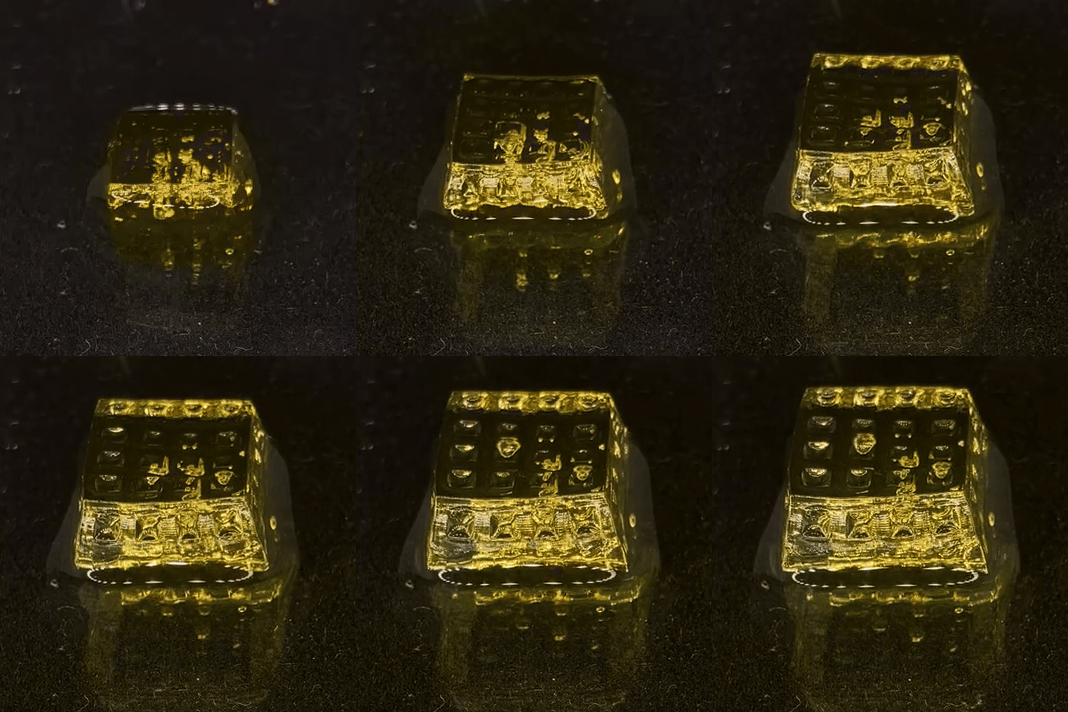
To address these challenges, a team from Ghent University’s Polymer Chemistry and Biomaterials Group is exploring superabsorbent polymers (SAPs) as a next-generation alternative for radiation protection. SAPs can absorb large quantities of liquid, similar to the way “grow monster” toys expand in water. When these materials swell, they become hydrogels, which are both effective and safer than conventional methods.
Lenny Van Daele, a researcher on this project, notes that hydrogels are commonplace in everyday items like contact lenses and diapers. Their capability to retain water makes them an appealing option for radiation shielding in habitats and spacesuits during extravehicular activities (EVAs). Importantly, the retained water within a hydrogel remains in place, providing consistent protection and eliminating the risk of leaks due to punctures.
Potential Applications in Space Exploration
Malworzata Holynska from the European Space Agency suggests that the application of hydrogels could extend beyond crewed missions, potentially serving as radiation shields for uncrewed spacecraft or as water reservoirs once retrieval methods are optimized. The versatility of the superabsorbent polymer makes it suitable for various processing techniques, and the team is utilizing 3D printing to create these structures in almost any desired shape.
Peter Dubruel, the project lead, emphasizes the ongoing demand for lightweight radiation protection materials. Previous research confirmed that hydrogels are safe for space conditions, paving the way for current efforts aimed at shaping the material into 3D structures and scaling up production to make this technology more industrially feasible.
The innovative use of 3D-printed hydrogels could vastly improve safety standards for astronauts facing the dangers of space radiation, enhancing the feasibility of long-duration space missions.
The content above is a summary. For more details, see the source article.