


Key Takeaways
- Adelaide Airport has installed over 3,800 solar panels, increasing its solar capacity to 3.5 MWp.
- The airport generates all its electricity from renewable sources, having achieved carbon neutrality in December 2024.
- Efforts to enhance sustainability include a Power Purchase Agreement for 100% renewable energy and energy-efficient upgrades.
Adelaide Airport Enhances Renewable Energy Capacity
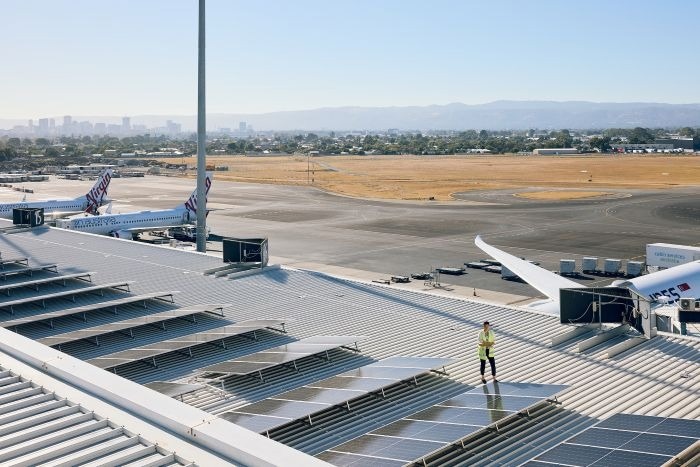
Adelaide Airport has made significant strides in its commitment to renewable energy with the installation of over 3,800 solar panels on the roofs of its domestic and international terminals. This new photovoltaic (PV) system has a capacity of 2.3 MWp and is projected to generate approximately 3,282 MWh of energy annually. Consequently, the total solar capacity at the airport has increased to 3.5 MWp, a level sufficient to power about 1,000 homes.
This installation, carried out in collaboration with Iberdrola Australia, has effectively expanded the airport’s solar output. The prior solar output consisted of a smaller system on the terminal roof and a system located on the multi-storey car park, together totaling just 1.28 MW. Importantly, Adelaide Airport already relies entirely on renewable electricity sourced from on-site generation and local wind farms, particularly those operated by Iberdrola at Lake Bonney.
In December 2024, Adelaide Airport became the first major airport in Australia to achieve carbon neutrality, having decreased its carbon emissions by nearly 90 percent since 2018. This reduction has been accomplished through various measures, such as enhancing energy efficiency, increasing onsite renewable energy, and purchasing wind energy from local farms.
Brenton Cox, Managing Director of Adelaide Airport, highlighted the positive impact of the new solar system, stating it will fulfill 15 percent of the terminal’s energy requirements. He emphasized that sustainable practices are a central part of the airport’s strategic plan, aimed at connecting and shaping South Australia while prioritizing cost-effective renewable energy for long-term sustainability.
Cox noted that although achieving carbon neutrality was a noteworthy accomplishment, the airport still has substantial work to do in its overall sustainability efforts. The decarbonization strategy focuses on reducing carbon intensity through efficient alternatives, increasing onsite renewable energy production, and supporting local renewable projects via their electricity contracts.
The new installation consists of about 3,800 solar panels and 16 inverters. Ross Rolfe, Chairman and CEO of Iberdrola Australia, expressed satisfaction with delivering this behind-the-meter solar project. He mentioned that this on-site generation complements the existing 100 percent renewable energy retail contract between Adelaide Airport and Iberdrola Australia. This cohesive approach not only lowers energy costs for the airport but also ensures reliable access to clean energy over time, serving as a model for sustainable operations at Australian airports.
Adelaide Airport’s commitment to sustainability extends beyond solar power. The airport is also taking steps to promote sustainable aviation fuels, upgrade lighting systems to LED, and optimize usage of equipment to help further reduce energy consumption and emissions. The renewable energy integration is part of a comprehensive strategy aimed at fostering a greener future for air travel in Australia.
The content above is a summary. For more details, see the source article.









