


Key Takeaways
- Ambi Robotics has launched Prime-1, the first AI foundation model designed for robotic sorting in warehouses.
- Prime-1 utilizes data from over 20 million images and 150,000 operating hours, enabling versatile 3D perception and package handling.
- The model enhances adaptability and scalability for customers, improving efficiency in rapidly changing logistics environments.
Introducing Prime-1: A Breakthrough in Warehouse Robotics
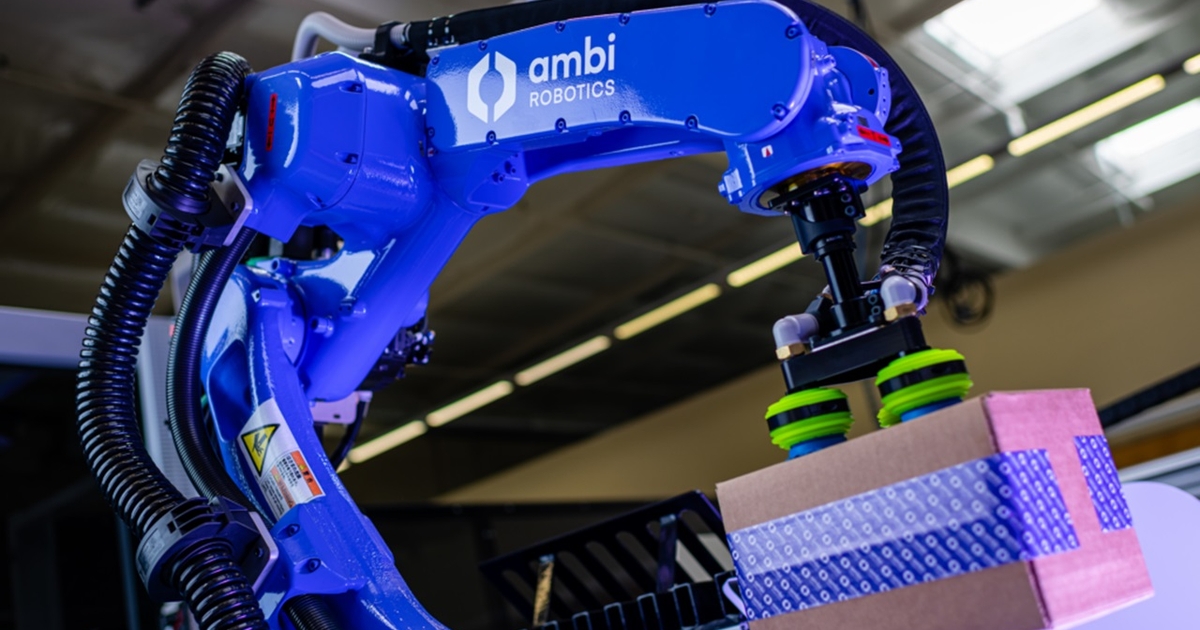
Ambi Robotics has unveiled Prime-1, the first artificial intelligence foundation model geared towards robotic sorting in commercial warehouse settings. Optimized for a range of complex tasks, Prime-1, an acronym for “production-ready industrial manipulation expert,” employs a single transformer model that enhances higher-level computer vision applications. This innovation allows the robots to efficiently handle various sorting operations, including 3D perception, package picking, and quality control.
To develop Prime-1, Ambi Robotics pre-trained the model using self-supervised deep learning techniques on an extensive dataset of over 20 million images. This data was collected over 150,000 operating hours from their fleet of AI-powered robots already working in U.S. warehouses. To put this into perspective, the training data represents roughly 1% of what Ambi has gathered, equating to the continuous operation of a single robot for 17 years. Such a robust dataset ensures that Prime-1 is well-equipped with real-world warehouse data from similar systems already deployed on a large scale.
Jeff Mahler, co-founder and chief technology officer of Ambi Robotics, emphasized the importance of this new model in addressing the critical challenges faced by warehouse robotics. He stated, “Prime-1 allows our customers to leverage collective learning from our entire production fleet, empowering them to stay ahead in the rapidly evolving logistics landscape with increasing demand.” He noted that the model would enable companies to quickly adapt to market changes while ensuring operational efficiency — a crucial requirement in industries where speed and precision are vital.
In addition to leveraging extensive image data, Prime-1 was trained on over one trillion tokens, enabling it to capture generalizable features relevant to 3D reasoning tasks. This expansive training helps the model perform various operations involving depth estimation and robotic picking more effectively. Evidence from production testing indicates that both quality and performance in downstream tasks improve with a greater volume of data used during pre-training, suggesting that large-scale pre-training can yield better outcomes than relying solely on labeled training data.
Ambi’s co-founder and chief scientist, Ken Goldberg, added insights into the advancements in AI research: “Emerging AI research shows that generative pretrained models can outperform previous architectures.” The engineering team at Ambi harnessed four years of proprietary data to train this state-of-the-art generative model specifically for 3D operations often required in warehouse logistics. Real-world tests have demonstrated that Prime-1 significantly exceeds the capabilities of prior systems used by the company.
As the logistics sector grapples with increasing demands and evolving operational needs, Prime-1 stands as a testament to the potential of AI in enhancing the productivity and adaptability of robotic systems in warehouses.
The content above is a summary. For more details, see the source article.









