Key Takeaways
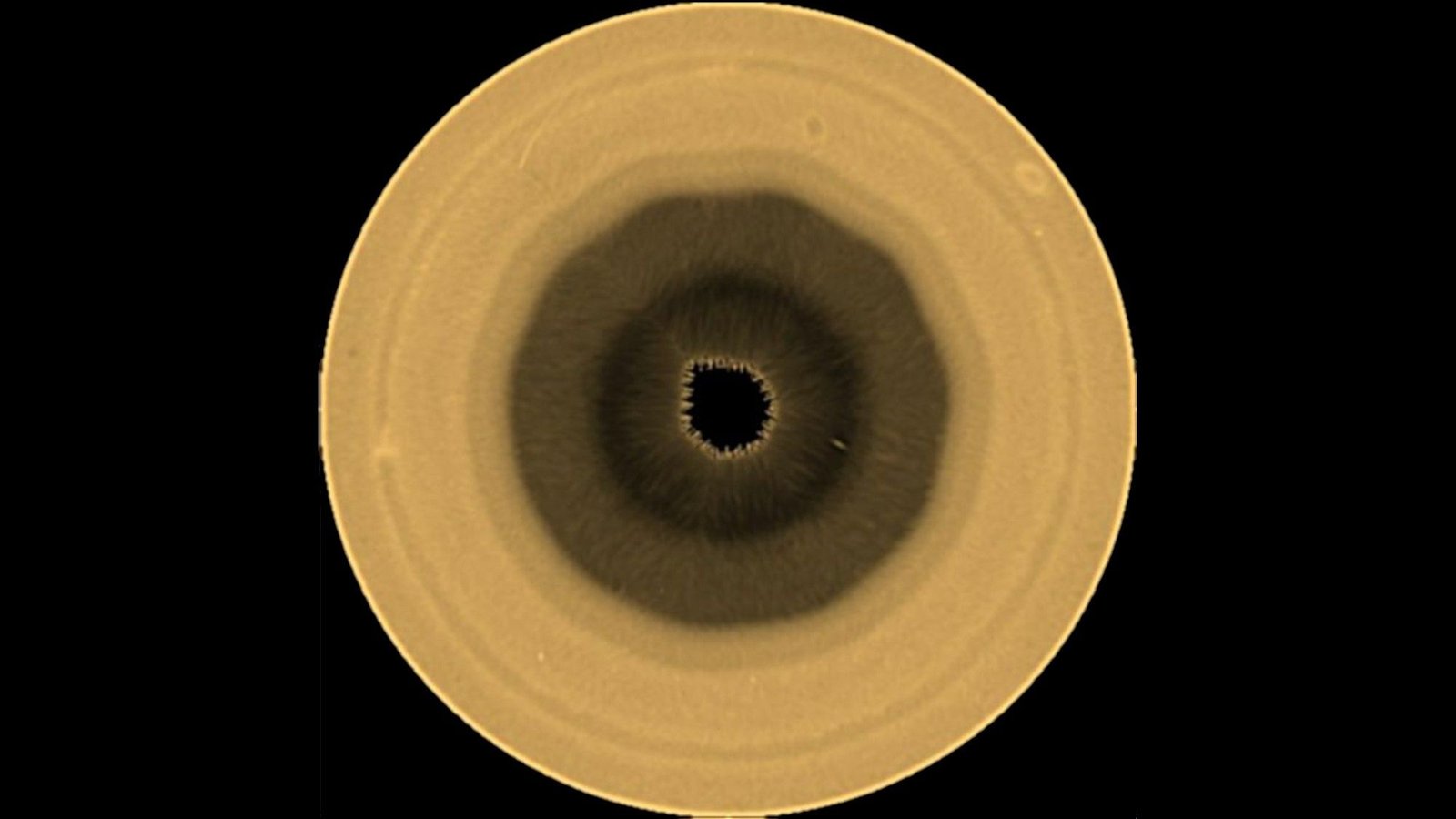
- A newly discovered 10-sided cloud pattern, or “decagon,” spans about 104,250 miles around Saturn’s south pole.
- This pattern adds to the previously known hexagonal cloud structure at Saturn’s north pole, which has been documented since 1988.
- Researchers aim to understand the decagon’s evolution and its atmospheric dynamics using data from NASA’s Hubble Space Telescope.
Discovery of the Decagon
Recent studies have unveiled a giant 10-sided pattern of clouds, termed a “decagon,” surrounding Saturn’s south pole, marking a significant find in planetary meteorology. This decagon is approximately 104,250 miles wide, with each of its ten sides measuring around 10,425 miles. It joins the well-known hexagon cloud formation at Saturn’s north pole, which measures about 20,000 miles across and has been observed since its discovery in 1988.
The hexagon was first identified through data from NASA’s Voyager missions in the early 1980s, and until now, no similar formations had been noted on the planet. Agustin Sanchez-Lavega, a planetary scientist from the University of the Basque Country in Spain and lead author of the study, emphasized the importance of this discovery in enriching the understanding of atmospheric phenomena. He stated, “It tells us that the hexagon is not a unique, singular feature, as was previously thought.”
Revealing the Decagon
The decagon was detected in images captured by the Hubble Space Telescope in 2023, following a period where Saturn’s southern hemisphere was obscured from Earth-bound observations from 2012 to 2023. Sanchez-Lavega remarked on the surprise of the finding, emphasizing the ongoing research that hadn’t indicated the existence of a polygonal formation in the southern region before now.
The decagon exhibits slower dynamics, taking about 800 days to complete one rotation around Saturn. Previous studies suggested that the hexagon’s formation is related to jet streams in the planet’s atmosphere. Research indicates that disturbances in these jets can result in specific shapes, leading to the hexagonal appearance.
In the case of the decagon, computer simulations conducted by Sanchez-Lavega’s team imply that it formed from a trapped meandering wave influenced by a similarly curving atmospheric jet. However, unlike the long-stable hexagon, the decagon shows variability in darkness across its sides, suggesting that it may still be in a state of evolution.
Future Research and Implications
The potential for understanding the decagon’s future is a significant aspect of the ongoing research. Scientists are interested in whether this feature might undergo instability or increase in stability as solar radiation peaks near its latitude in 2032. Additionally, plans are in place to investigate the three-dimensional structure of the decagon, including its cloud formations, atmospheric temperatures, and wind patterns.
These details will assist researchers in forming advanced models to explain the decagon’s creation and its long-term behavior in Saturn’s atmospheric dynamics. The findings are documented in the journal Science Advances as of September 2nd.
The content above is a summary. For more details, see the source article.