Key Takeaways
- BepiColombo’s final flyby of Mercury occurred on January 8, 2025, using the planet’s gravity to adjust its trajectory for a Mercury orbit in 2026.
- Real spacecraft vibrations captured by the Italian Spring Accelerometer (ISA) are transformed into audible sounds that reflect the spacecraft’s conditions during the flyby.
- The flyby provided insights into how solar radiation pressure and Mercury’s gravitational field affect the spacecraft’s operation.
Final Flyby of Mercury
On January 8, 2025, the BepiColombo spacecraft executed its sixth and final flyby of Mercury, utilizing the planet’s gravitational pull to navigate toward an intended orbit around Mercury in 2026. This mission, a collaboration between the European Space Agency (ESA) and the Japanese Aerospace Exploration Agency (JAXA), aims to deepen our understanding of Mercury and its environment.
The auditory experience of the flyby is captured in a sonification soundtrack, showcasing real vibrations from the spacecraft, measured by its Italian Spring Accelerometer (ISA). The sounds represent an hour of data sped up into a minute, revealing a consistent hum resulting from various activities onboard. These include fuel sloshing in tanks, vibrations from solar panels, and the movement of vapors through heat pipes.
As BepiColombo approached Mercury, the ISA detected additional forces affecting the spacecraft. Notably, brief audible shocks resembling soft bongs occur when the spacecraft moves in and out of Mercury’s shadow, where sunlight is temporarily blocked. One of ISA’s key objectives is to analyze changes in solar radiation pressure, the force generated by sunlight as the spacecraft orbits the Sun and Mercury.
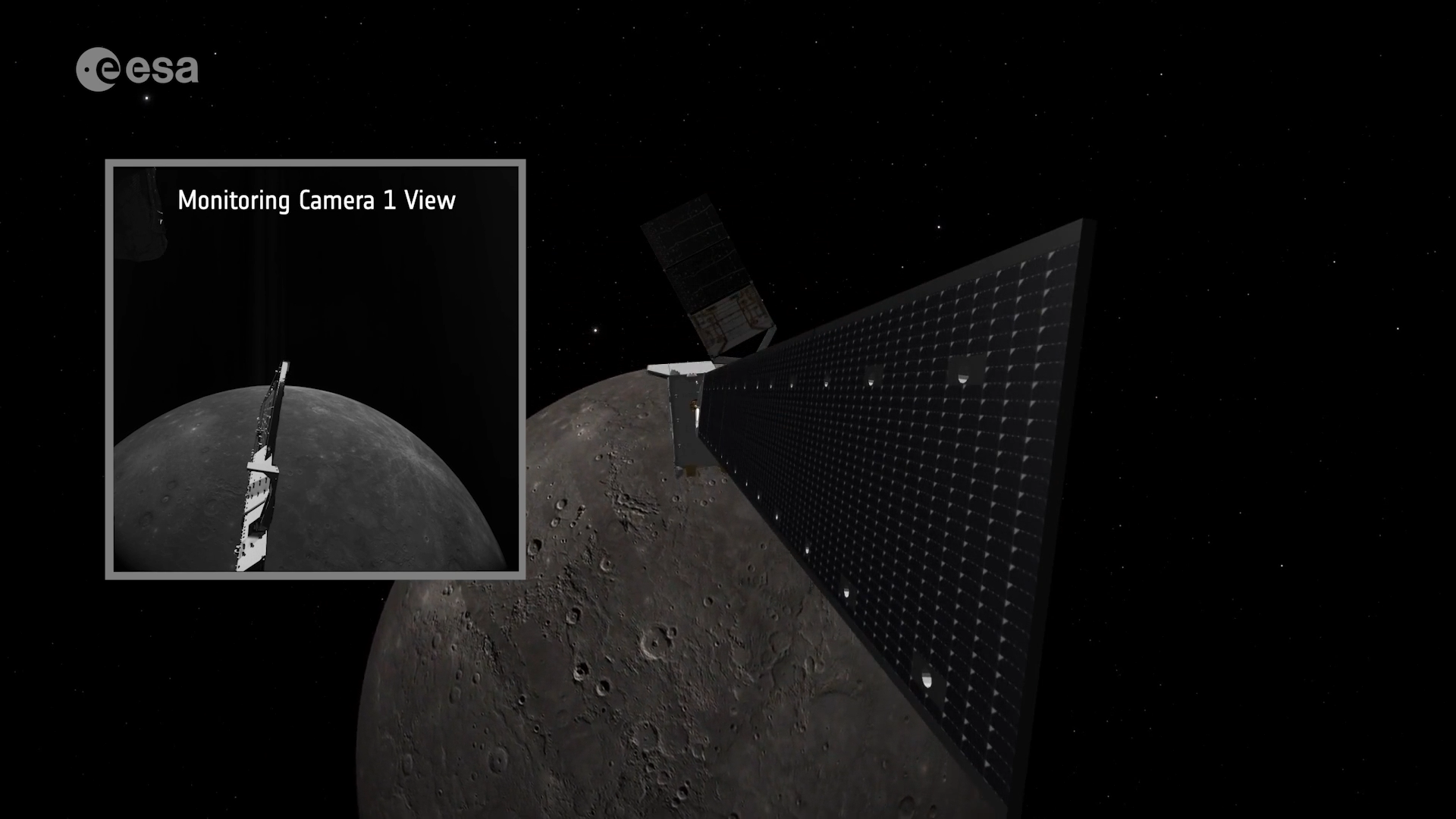
The loudest sounds in the audio include a rumbling noise, primarily caused by the rotation of BepiColombo’s large solar panels. The first rotation coincides with the spacecraft entering Mercury’s shadow at 00:17 in the video, while a second rotation around 00:51 is visually confirmed by onboard cameras.
Further into the flyby, around 30 seconds into the soundtrack, faint sounds resembling wind intensify. These fluctuations arise from Mercury’s gravitational field, which exerts varying forces on different parts of the spacecraft, causing structural responses. To maintain its orientation amid these changes, the onboard reaction wheels adjust their speed, creating a frequency shift detectable in the audio.
This flyby marks the last opportunity to capture many of these vibration effects, as BepiColombo’s solar panels make the spacecraft more vulnerable to vibrations. The module housing these panels will not participate in the orbital phase with the mission’s two accompanying orbiter spacecraft.
The flight path of BepiColombo is further illustrated through an accurate simulation in the accompanying video, which utilizes the SPICE-enhanced Cosmographia visualization tool. An inset at 38 seconds displays real images taken by the spacecraft’s monitoring cameras.
Collectively, the mission’s findings aim to enhance scientific knowledge about Mercury and pave the way for future explorations of the planet and beyond. Detailed reports and video material of BepiColombo’s sixth Mercury flyby are available for further public consumption and analysis.
The content above is a summary. For more details, see the source article.