Key Takeaways
- The South Pole–Aitken basin, the moon’s largest impact crater, may contain deep lunar material, crucial for upcoming Artemis missions.
- A study reveals that the basin was likely created by a differentiated asteroid impacting at a shallow angle, contributing to its unique shape.
- Samples from the region could provide insights into the moon’s age and geological evolution, benefiting scientific research and exploration.
Scientific Insights into the Moon’s Formation
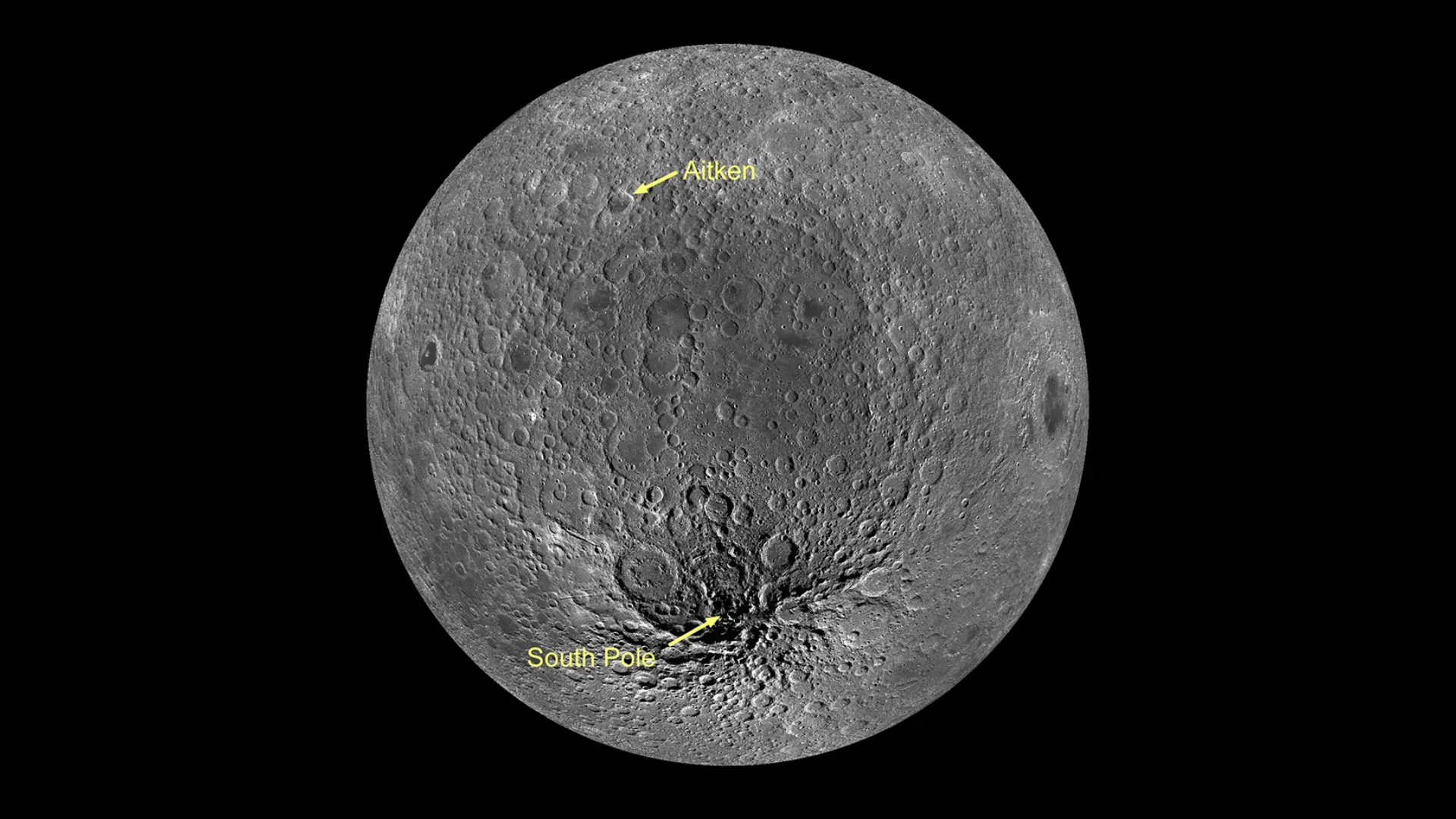
Recent research has revealed groundbreaking insights into the formation of the South Pole–Aitken (SPA) basin, the largest impact structure on the moon, which stretches over 1,200 miles (approximately 2,000 kilometers) across. Conducted by a team led by Shigeru Wakita from Purdue University, the study suggests that the SPA was likely formed by a differentiated asteroid, raising significant implications for future lunar explorations.
The SPA basin represents one of the moon’s most scientifically important features because it potentially unveils material from the moon’s mantle. Understanding how this basin formed—specifically the size, speed, and direction of the impacting body—has been a topic of extensive debate among scientists.
Utilizing high-resolution 3D simulations, the research team concluded that the distinctive tapered-ellipse shape of the basin is best explained by an impact from a large asteroid, approximately 160 miles (260 kilometers) wide, that had a differentiated structure, consisting of a dense iron core and a rocky outer layer. The asteroid struck the moon at a shallow angle of about 30 degrees, traveling at a velocity of eight miles per second (13 kilometers per second). This trajectory resulted in “decapitation” of the asteroid’s upper layers while its denser core continued to move forward, shaping the SPA’s unique form.
In contrast, an undifferentiated asteroid would have likely resulted in a rounder impact structure. The study highlights that this impact would have ejected material from the mantle toward the lunar south pole. As the Artemis lunar missions are set to explore this area, astronauts landing there could potentially encounter these valuable deposits, excavated from depths exceeding 56 miles (90 kilometers).
The researchers assert that the Artemis III mission could allow for sampling of SPA ejecta if it successfully lands in the planned polar region. NASA’s Artemis program has undergone revisions, with the first crewed moon landing now scheduled for Artemis 4, no earlier than 2028.
If validated, the findings may lead to the return of samples that could assist scientists in determining the age of the SPA basin and elucidating the composition of the moon’s deep interior. Such information could provide significant insights into the moon’s geological evolution since its formation over 4 billion years ago, answering longstanding questions about the moon’s history.
The study detailing these findings was published on May 7 in the journal Science Advances, contributing vital knowledge to lunar science and reinforcing the importance of the Artemis missions for future exploration efforts.
The content above is a summary. For more details, see the source article.