Key Takeaways
- On April 14, a celebrity crew, including Katy Perry, spent 11 minutes in space aboard Blue Origin’s New Shepard.
- Despite the mission’s technological achievements, many public figures and experts criticized it as environmentally irresponsible.
- Skeptics argue that the flight’s claims of sustainability are misleading, as water vapor emissions can still impact the environment.
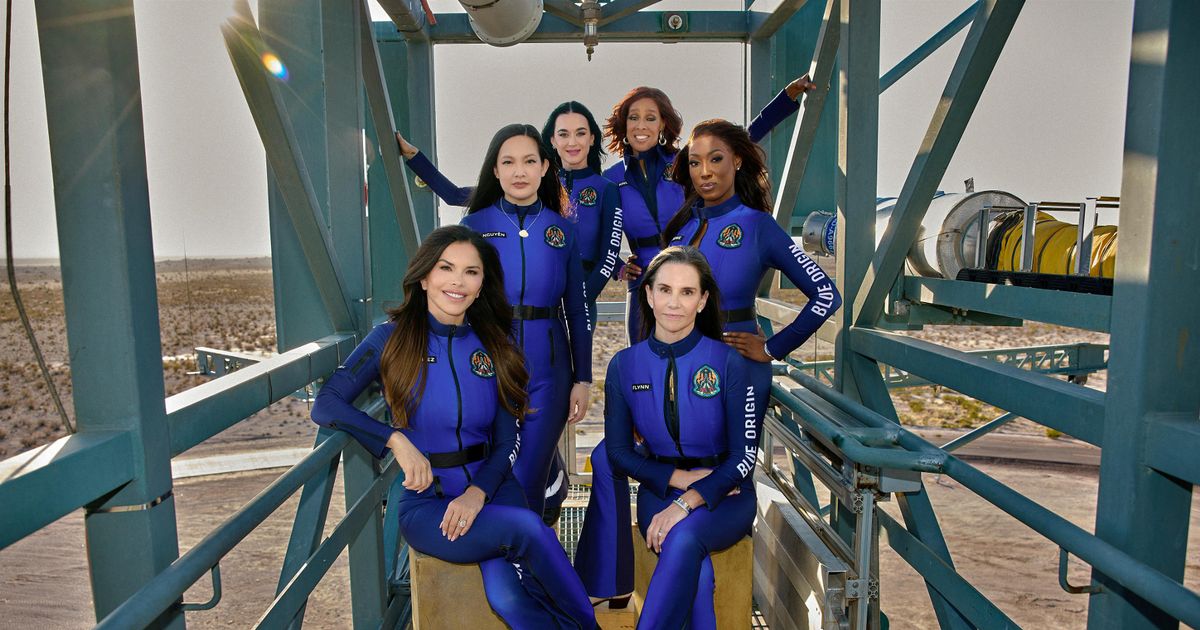
On April 14, a group of six celebrities embarked on an 11-minute space flight aboard Blue Origin’s New Shepard rocket. The mission, originating from Blue Origin’s West Texas facility, featured an all-female crew comprising Katy Perry, Lauren Sánchez, Gayle King, Aisha Bowe, Amanda Nguyen, and Kerianne Flynn, all donned in custom blue spacesuits. This flight marked a significant milestone in the growing trend of private space tourism, achieving an altitude beyond the Karman Line, which is recognized as the border of outer space.
While the mission garnered excitement for its celebrity factor and the advancement of space travel technology, public response has been mixed, with notable backlash. American model Emily Ratajkowski took to TikTok to express discontent, labeling the mission an “end-time s–t” moment and criticizing the environmental impact of such joyrides. She raised concerns about the disparity between advocating for the planet and engaging in luxurious space travel funded by companies that contribute to environmental degradation.
Blue Origin claims that its New Shepard rocket produces only water vapor as a by-product, with no carbon emissions. However, many experts question this assertion. Eloise Marasi, a professor of atmospheric chemistry, explained that while water vapor is technically a greenhouse gas, its release can still negatively impact the ozone layer and contribute to climate changes. Critics on platforms like Reddit echoed Ratajkowski’s sentiment, arguing that the mission seemed more like a marketing stunt than a meaningful contribution to space exploration.
Comments from onlookers highlighted the absurdity of celebrities calling themselves astronauts after a brief amusement ride in space. The perception of an extravagant, short-lived adventure contrasts sharply with growing environmental concerns and calls for sustainability. Many feel that such high-profile missions occur at a time when climate issues warrant more serious consideration, undermining the mission’s intended purpose of raising awareness about Earth’s fragility.
While the New Shepard mission undeniably represents a technological achievement in making space travel more accessible, it also invites scrutiny over its environmental implications and the motivations behind such high-profile stunts at a time when sustainable practices are crucial. Moving forward, the challenge remains to balance the allure of space tourism with the pressing need for environmental responsibility.
The content above is a summary. For more details, see the source article.