


Key Takeaways
- The Indian government is identifying locations for new hydropower plants in Jammu and Kashmir to boost energy generation.
- Plans include diverting water to northern states like Punjab, Rajasthan, and Delhi through canals or tunnels.
- India is transitioning towards renewable energy while maintaining thermal power capacity for stability.
Hydropower Development in Jammu and Kashmir
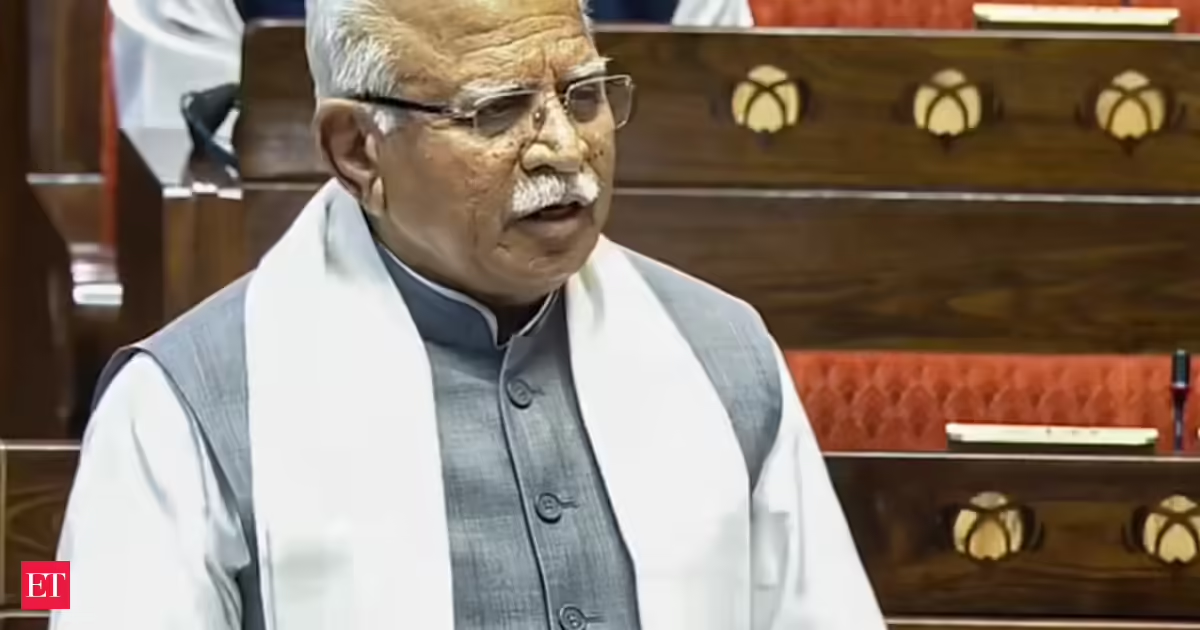
The Indian government is taking significant steps to enhance power generation in Jammu and Kashmir. Union Power Minister Anil Kumar Jain has announced ongoing efforts to identify potential sites for new hydropower plants in the region. Although some plants are currently operational, the government is focused on restoring reservoir capacity through desilting. Work has also recommenced on three to four stalled projects.
Jain indicated that the government is exploring the diversion of water from Jammu and Kashmir to northern states, including Punjab, Rajasthan, Haryana, Uttar Pradesh, and Delhi. Several routes are under evaluation to determine which can be constructed most quickly and financially feasible. The alignment through Jammu city faces feasibility issues, while another route bypassing the city is being assessed.
These developments come amid a broader initiative to strengthen India’s power infrastructure in anticipation of increasing electricity demand. The focus is shifting towards renewable energy sources, with a greater emphasis on solar power. However, since solar energy is not available continuously, the government is exploring storage solutions to enhance reliability in power supply.
In addition to hydropower and solar energy, nuclear energy is also expected to contribute significantly to India’s future power mix. Currently, the country has around 8GW of nuclear capacity, with an additional 12GW under development. Prime Minister Narendra Modi’s administration aims to expand nuclear capacity to approximately 100GW by 2047, encouraging states to host at least one nuclear project each.
Thermal power generation continues to be vital in ensuring a stable supply of electricity, with around 20,000MW of thermal capacity currently under development. Projects are planned until 2032, beyond which the reliance on new coal-based plants may diminish as renewable energy projects expand, resulting in a target for net-zero emissions by 2070.
The minister highlighted the improvements in the power supply over the past decade. The demand-supply gap has significantly narrowed from about 5.5% in 2014-15 to roughly 0.1% for the period of 2024-25. This change is attributed to both technical advancements and capacity expansion.
Regarding the financial performance of power distribution companies (discoms), Jain mentioned that while profits amounting to approximately Rs 2,700 crore have been reported recently, the sector still faces substantial accumulated losses of around Rs 6.7 lakh crore. These losses largely stem from tariffs being set lower than the actual cost of electricity supply, particularly when state governments provide subsidized rates.
Overall, India is making critical strides towards a diversified and sustainable energy future, balancing the growth of renewable sources with necessary infrastructure improvements to ensure reliability in power supply.
The content above is a summary. For more details, see the source article.









