Key Takeaways
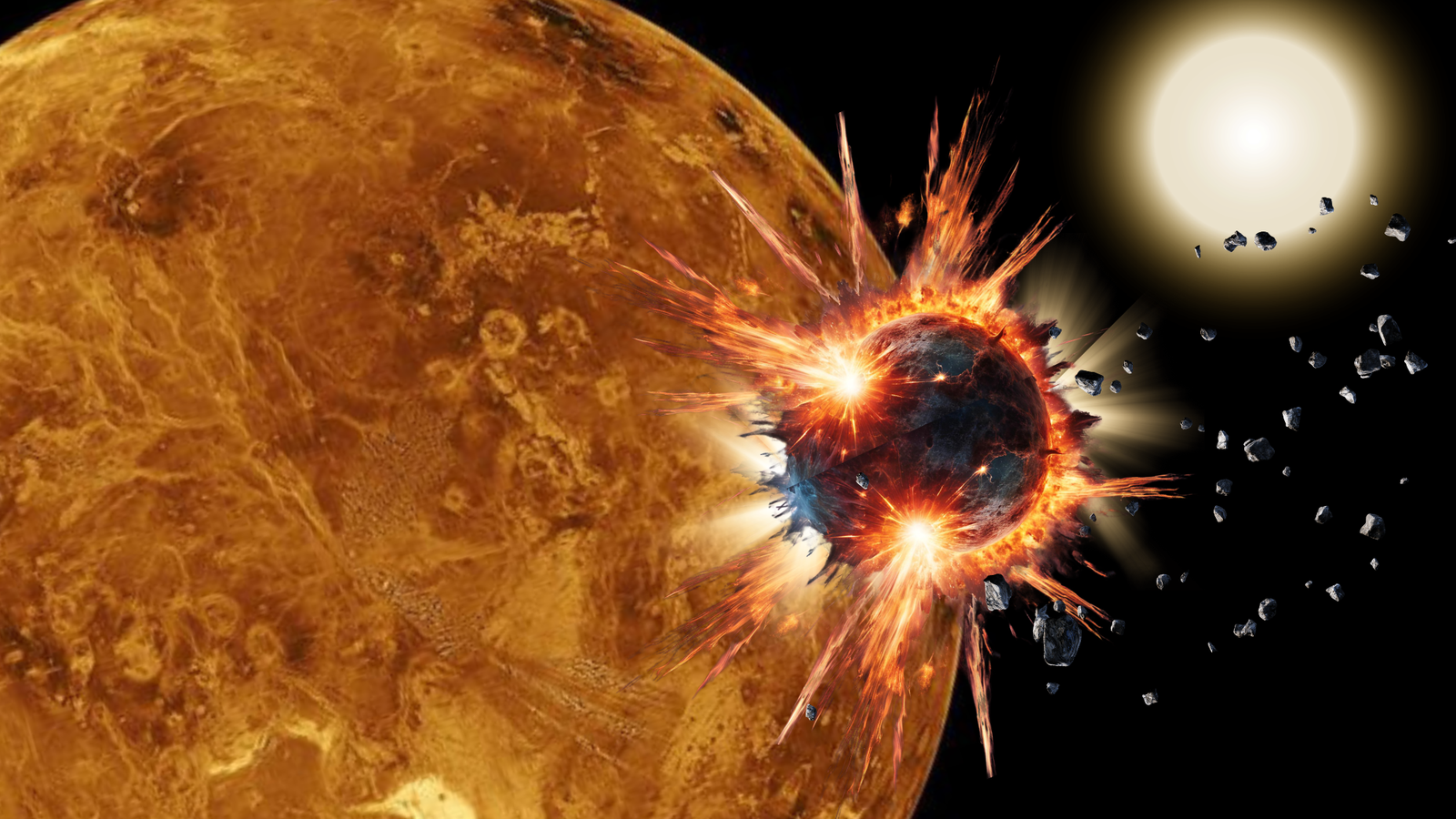
- Researchers suggest Venus may have consumed its own moon due to gravitational forces acting over billions of years.
- Simulations indicate a moon’s survival depended on specific conditions such as Venus’s rotation speed and the moon’s mass.
- Future missions like NASA’s DAVINCI probe could provide insights into Venus’s past and potential for lost moons.
Venus’s Moon Mystery Unveiled
Scientists have long wondered why Venus, often termed Earth’s twin, lacks a moon. While the planets share similarities in size and composition, they differ significantly in environmental conditions. Venus’s extreme temperatures can melt lead, and its atmosphere is filled with sulfuric acid, while Earth enjoys a stable moon. Current understanding identifies two planets in the solar system without moons: Venus and Mercury.
Recent research led by Stephen R. Kane from the University of California, Riverside, posits that Venus may have once had a moon but ended up consuming it. Kane’s team built a simulation examining the gravitational dynamics between Venus, a hypothetical moon, and the sun to understand this phenomenon better. “I have always had a fascination with moon formation and evolution in the solar system,” Kane shared.
The researchers meticulously developed their model, ensuring it could replicate the dynamics of the Earth-moon system. Their investigation revealed that a moon orbiting Venus would not drift outward like Earth’s moon. Instead, the simulations indicated that such a moon would likely spiral inward over time, ultimately disrupted by Venus’s gravitational pull. Surprisingly, larger moons could face a quicker demise, as their mass would enhance the drag on Venus’s rotation, hastening their destruction.
Kane pointed out that the survival of a hypothetical moon would hinge on two critical factors: Venus needed to be spinning rapidly at the time of the moon’s formation, and the moon had to remain relatively small—ideally no larger than Earth’s moon. These conditions seem inconsistent with prevailing theories about early Venus’s environment.
Direct evidence of a lost moon remains elusive. “Finding observable traces from a moon that may have existed billions of years ago is incredibly challenging,” Kane remarked. However, there are indirect means to gather insights. The research team suggests that if a moon had disintegrated, debris could have impacted the surface or atmosphere, potentially leaving chemical markers. Missions like NASA’s upcoming DAVINCI (Deep Atmosphere Venus Investigation of Noble gases, Chemistry, and Imaging) could be instrumental in measuring Venus’s atmospheric composition and helping validate these models.
Kane’s findings not only have implications for understanding Venus but also extend to exoplanets. The research predicts that similar, slowly rotating Venus-like planets may generally lack significant moons, offering astronomers a framework for future exoplanet studies.
As the team awaits more data from both Venus and exoplanets, they are eager to explore other questions raised by their research. Future investigations will focus on the atmospheric and compositional impacts of a moon consumption event and may even extend to other celestial bodies like Mercury and Mars. The research is available as a pre-peer-reviewed paper on arXiv, marking a significant advance in unraveling the secrets of Venus and its unique geological history.
The content above is a summary. For more details, see the source article.