


Key Takeaways
- Artificial Intelligence (AI) is enhancing Master Data Management (MDM) by automating processes, ensuring data accuracy, and enabling real-time insights.
- Industries such as mining, energy, food and beverages, chemicals, and manufacturing are leveraging AI-driven MDM solutions to improve efficiency and compliance.
- Verdantis is leading innovations in AI-integrated MDM, focusing on dynamic data enrichment, predictive maintenance, and automated deduplication to transform enterprise data management.
The digital economy thrives on data, often termed the “new oil.” In this context, Master Data Management (MDM) plays a pivotal role in maintaining accuracy, consistency, and reliability across organizational data. With the rise of Artificial Intelligence (AI), MDM’s importance has surged, providing new methods for managing data amidst growing complexities and volumes.
One significant challenge organizations face today is the proliferation of data silos, quality issues, and time-consuming manual processes. These challenges can hinder operational efficiency. AI-driven solutions are mitigating these issues effectively—research from McKinsey & Company indicates that AI can bolster operational efficiency by up to 25%, decreasing the need for manual data management.
MDM serves sectors like mining, energy, food and beverages, chemicals, and manufacturing by streamlining operations. For instance, in the mining industry, AI-enhanced MDM enables predictive maintenance by analyzing historical data to forecast potential equipment failures, thereby decreasing costly downtimes. Similarly, the energy sector benefits from optimized grid operations and enhanced asset performance through real-time data insights.
The food and beverage industry faces strict regulatory standards, and AI-equipped MDM systems improve tracking of ingredients and supplier data to ensure compliance and product safety. In the chemical industry, AI supports R&D, production, and regulatory compliance by facilitating efficient data management.
Manufacturers benefit from AI-powered MDM by linking Bill of Materials (BoM) data, which minimizes downtime and aids in agile production responses. Automating data processes helps maintain accuracy and optimize inventory management.
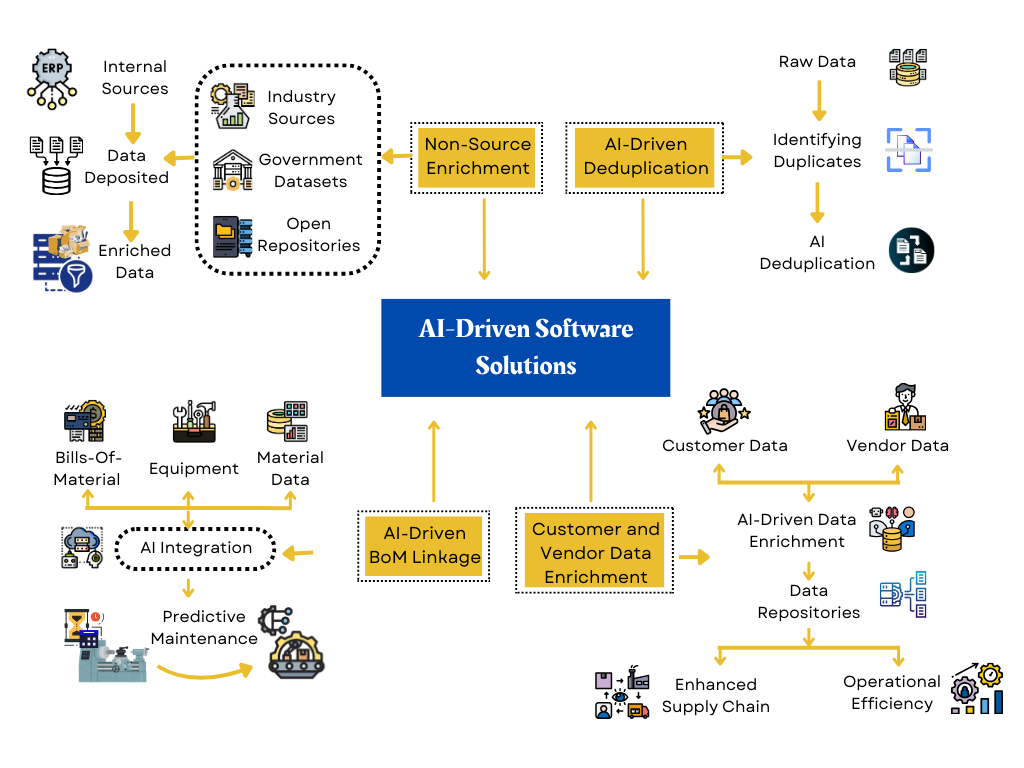
A standout in this revolvement is Verdantis, which integrates AI into MDM, providing innovative solutions to overcome data challenges faced by enterprises. For example, their non-source enrichment method enhances material master data accuracy by using real-time, publicly available data, driving substantial improvements in decision-making and operational efficiency.
Moreover, Verdantis’ automated BoM linkage fosters predictive maintenance. This innovative approach helps companies reduce maintenance planning time by up to 30%, thus improving production uptime and efficiency.
Data duplication remains a persistent issue for enterprises. Verdantis introduces AI-powered deduplication tools capable of detecting duplicated records without predefined rules, enhancing overall data quality and reducing management costs by up to 20%.
Furthermore, their AI-powered entity enrichment solutions address the customer and vendor data complexities in the banking and financial services industry. Enhanced data quality leads to better insights, improving customer experiences and vendor management.
Looking ahead, MDM is evolving towards a future largely influenced by AI. The concept of MDM 2.0 is anticipated, which aims to revolutionize data management through innovations such as conversational interfaces, hyper-automated processes, and real-time predictive analytics. Ultimately, these advancements are set to transform data into a strategic asset, driving operational excellence and innovation.
Organizations that adopt these AI-driven MDM frameworks are poised to unlock greater efficiency and agility. Verdantis is positioned to lead this transformation, enabling enterprises to leverage their data as a powerful tool for competitive advantage in an increasingly connected world. The possibilities for growth and innovation in the data landscape are vast, marking the beginning of an exciting journey toward an AI-enhanced future in enterprise data management.
The content above is a summary. For more details, see the source article.









