Key Takeaways
- The Hubble Space Telescope captures stunning imagery of the Large Magellanic Cloud, a nearby dwarf galaxy.
- Located 160,000 light-years away, the Tarantula Nebula within it is the most massive star-forming region known.
- The observations help researchers study the significance of cosmic dust in star and planet formation.
The Splendor of the Large Magellanic Cloud
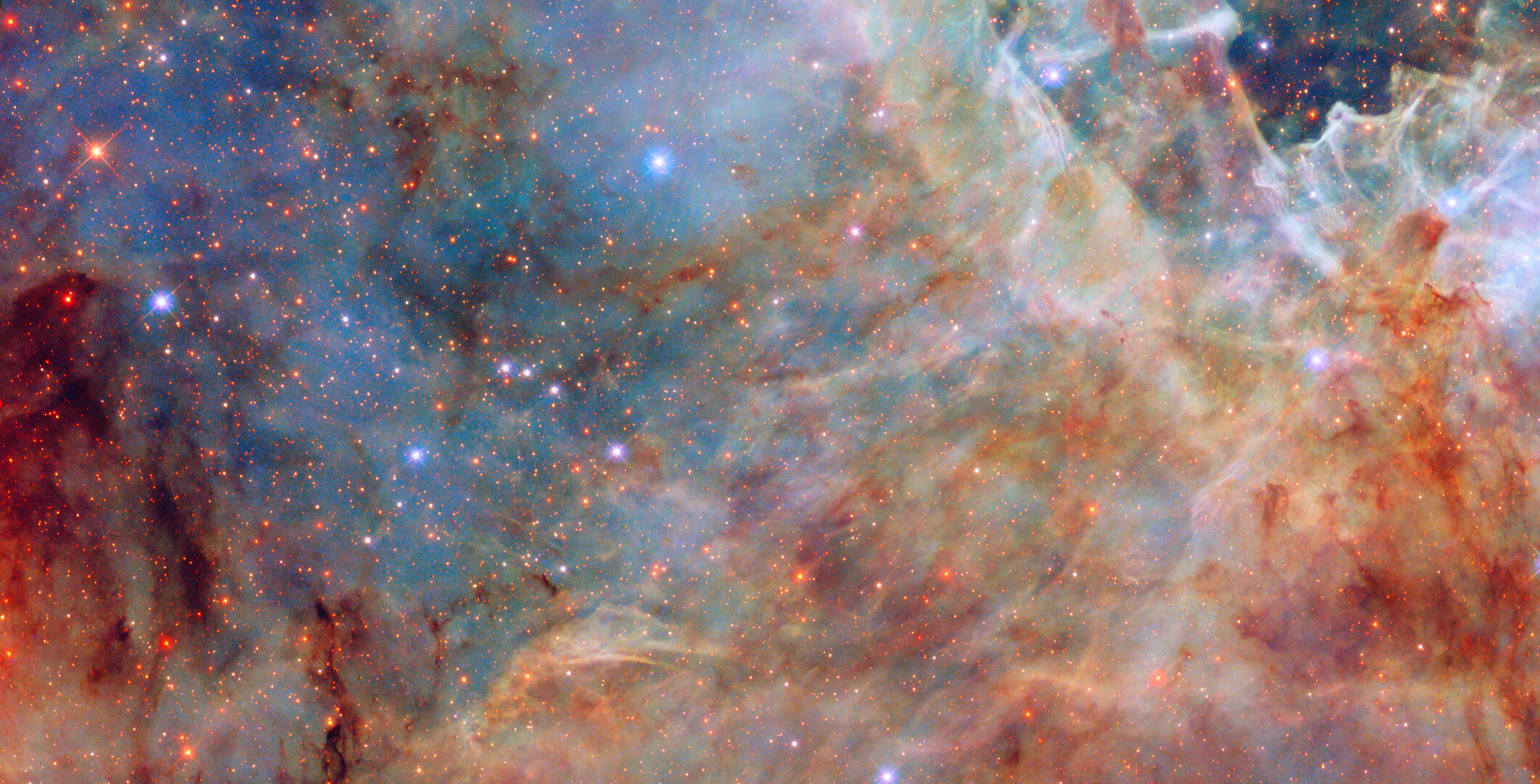
Today’s featured image from the NASA/ESA Hubble Space Telescope presents breathtaking views of the Large Magellanic Cloud (LMC), a dwarf galaxy situated approximately 160,000 light-years from Earth. Found in the constellations Dorado and Mensa, the LMC possesses only 10 to 20 percent of the Milky Way’s mass but hosts some of the most remarkable star-forming regions in the nearby universe.
Among these regions is the Tarantula Nebula, recognized as the largest and most efficient star-forming area nearby. The image highlights the nebula’s outskirts and showcases a vivid scene where serene blue gases intermingle with brownish-orange dust while a sprinkle of multicolored stars provides a visual feast. In this section, stars obscured by dust clouds take on a redder hue compared to those outside. This color difference occurs because the dust absorbs and scatters blue light more effectively than red, allowing the red wavelengths to reach telescopes more readily.
The image captures not only visible light but also ultraviolet and infrared wavelengths, offering a comprehensive view of this cosmic environment. Hubble’s observations of similar dusty nebulae across the universe facilitate ongoing research into the nature of cosmic dust. This research is critical in understanding the processes involved in the formation of new stars and planets.
The discovery of massive stars, some nearly 200 times the Sun’s mass, at the heart of the Tarantula Nebula underscores its significance in stellar evolution studies. Researchers continue to use Hubble’s capabilities to probe these distant dust grains, aiming to decipher the essential role cosmic dust plays in the lifecycle of stars and the formation of planetary systems.
In essence, the Hubble Space Telescope continues to unveil the wonders of the cosmos, offering insight into the complexities of star formation and the intricate relationships between stars, dust, and the galaxies that host them.
The content above is a summary. For more details, see the source article.