Key Takeaways
- The European Space Agency has launched Proba-3, a dual-satellite mission that operates as a single observatory to create artificial solar eclipses.
- Proba-3 enhances solar corona observations, capturing details about solar wind and coronal mass ejections with unprecedented precision.
- Initial findings indicate faster-than-expected solar wind motions, offering valuable insights into solar activity and its impact on Earth.
Proba-3 Mission Overview
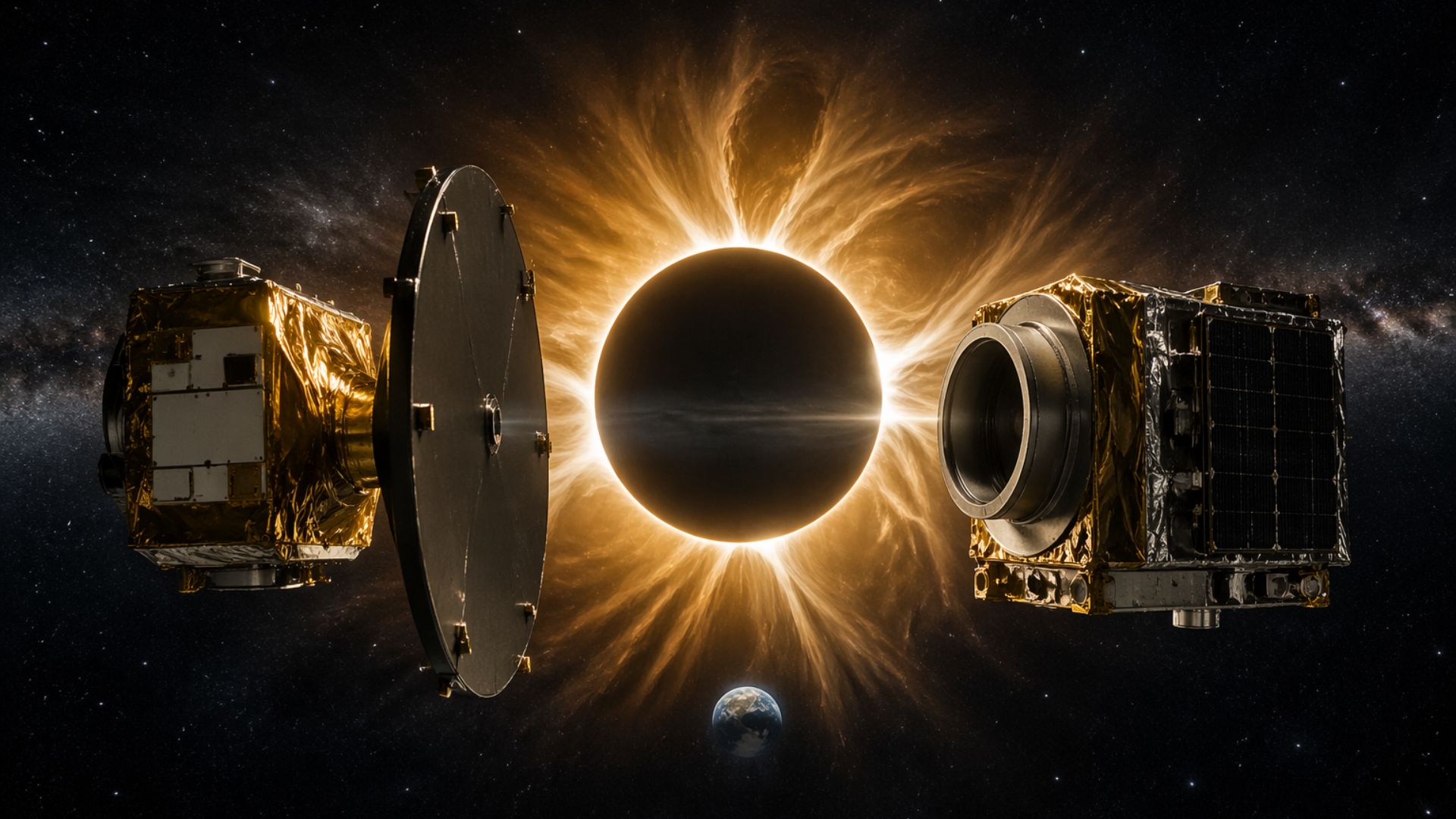
The European Space Agency (ESA) has initiated the Proba-3 mission, teaming two satellites to act as a single, high-precision observatory. This innovative approach enables the creation of artificial solar eclipses, allowing for continuous and controlled observations of the Sun’s corona, addressing longstanding challenges in heliophysics.
Traditional methods of observing the solar corona are hindered by the intense light from the solar disk. Proba-3’s satellites, the Occulter and Coronagraph, were engineered to overcome this hurdle by blocking direct sunlight and capturing detailed images of the corona. The Occulter uses a 1.4-meter disk to shade the Coronagraph, enabling more extended and precise observational periods compared to natural eclipses.
The satellites are designed to operate in close formation, adjusting their positions autonomously to maintain the necessary geometry for accurate observations. Each orbit lasts approximately 19.7 hours, allocating five to six hours for optimal measurements. This precision is not limited to solar observations; the technology may be applied to future space missions, including satellite servicing and modular observatories.
The mission targets the inner solar corona, where solar wind and coronal mass ejections form. Understanding these phenomena is crucial, as they directly affect space weather and technological systems on Earth. The ASPIICS instrument fills a critical observational gap by studying the corona between 1.1 and 3 solar radii, revealing critical temperature and plasma acceleration information.
During its operational phase, which began in 2025, the mission successfully performed 57 artificial eclipses, accumulating over 250 hours of observation time. Initial analyses from this data showed unexpected speeds in solar wind structures, highlighting the advantages of continuous observation within this orbital framework.
In addition to the ASPIICS, Proba-3 is equipped with the DARA radiometer for measuring total solar irradiance and the 3DEES instrument studying energetic electrons in radiation belts. This mission goes beyond mere observation, serving as an orbital laboratory that tests navigation and function-sharing among independent spacecraft.
The Proba-3 initiative marks a significant step in advancing solar observation technology and creating a flexible model that could influence future space missions. By transforming a rare astronomical event into a recurring scientific tool, it establishes new possibilities for observing and understanding solar dynamics and their implications for Earth.
The content above is a summary. For more details, see the source article.