Key Takeaways
- The ESA’s Plato mission has successfully completed rigorous tests in a space-like environment, ensuring its capabilities for upcoming tasks.
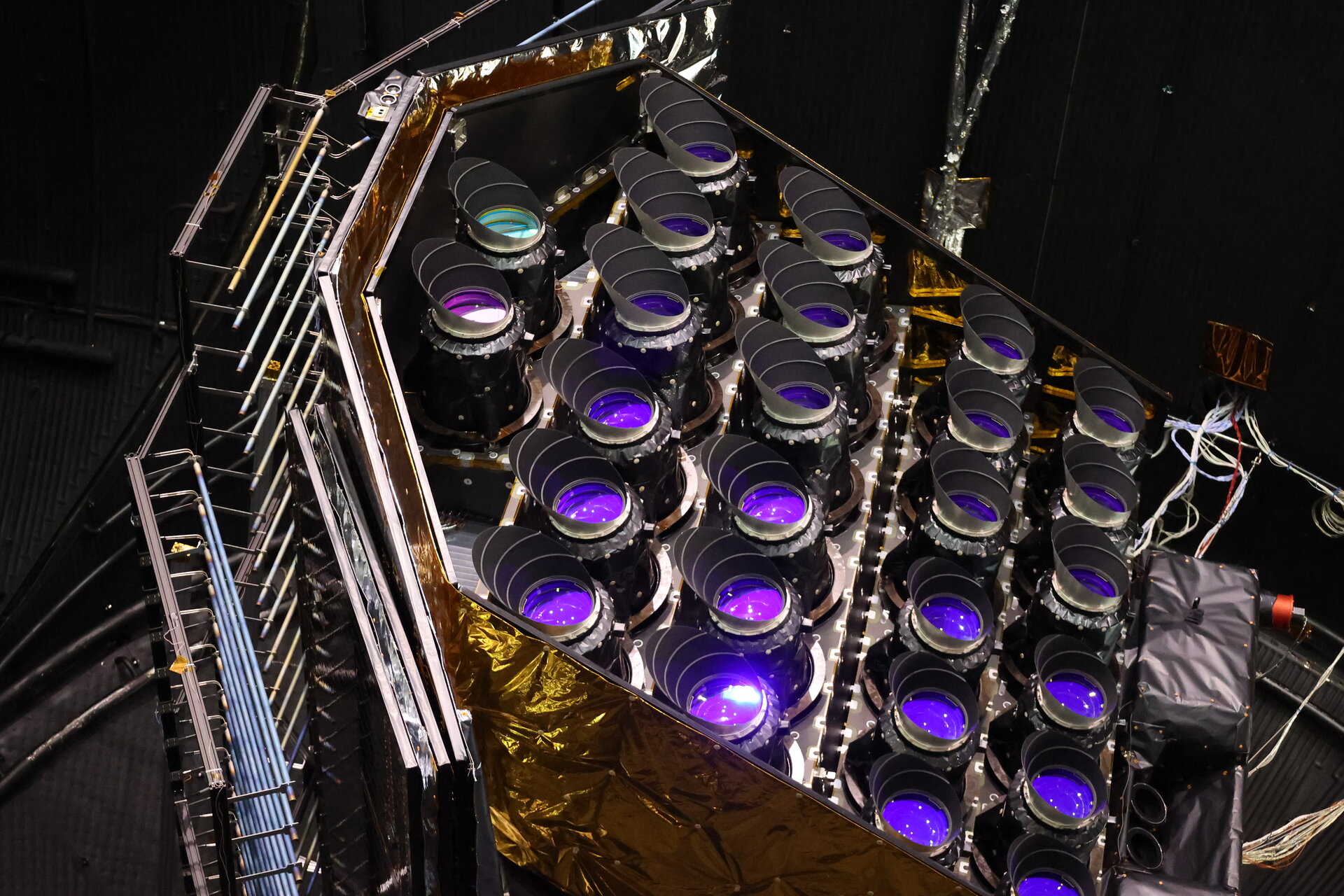
- Plato aims to discover Earth-like exoplanets around Sun-like stars using 26 highly sensitive cameras.
- The spacecraft is scheduled for launch on an Ariane 6 rocket in January 2027, with preparations underway for its deployment.
Plato Mission Advances Towards Launch
The European Space Agency’s (ESA) Plato mission has reached a significant milestone by finishing a comprehensive series of tests designed to simulate the conditions it will face in space. These evaluations took place inside the Large Space Simulator (LSS) at ESA’s Test Centre, where engineers aimed to validate the spacecraft’s functionalities in an environment reminiscent of outer space.
To replicate these conditions, the LSS chamber was evacuated to create a vacuum, and liquid nitrogen circulated its walls to replicate the cold of space. Simultaneously, heating elements were activated to simulate sunlight, ensuring that Plato was thoroughly examined for its performance under extreme circumstances.
The primary objective of the Plato mission is to identify potentially habitable, Earth-like planets orbiting stars similar to the Sun. The spacecraft is equipped with 26 ultrasensitive cameras essential for detecting minute fluctuations in star brightness — a method crucial for identifying planets transiting in front of their host stars. Ana Heras, ESA’s Plato Project Scientist, emphasized that achieving a precision level of under 80 parts per million is vital for successfully locating such planets.
The tests also involved rigorous evaluations of Plato’s cameras under varying thermal conditions to ensure optimal performance. As Project Manager Thomas Walloschek stated, the spacecraft was subjected to both hot and cold phases to confirm that it can function effectively in extreme environments. For instance, during the hot phase, components were operated at full power, and temperatures reached as high as 150 °C, while simultaneously keeping the cameras cool between –70 °C and –90 °C.
Having completed these tests, the data collected will now undergo analysis to further refine thermal models necessary for predicting the performance of Plato’s cameras in orbit. This ongoing data evaluation is crucial as launch preparations progress. The spacecraft is expected to be ready for launch by the end of 2026, with a lift-off operation slated for January 2027 aboard an Ariane 6 rocket.
Plato, which stands for PLAnetary Transits and Oscillations of stars, will play a vital role in expanding knowledge of terrestrial exoplanets, especially those located within the habitable zones of Sun-like stars. The collaboration behind the mission involves various European research institutions and industries, facilitated by ESA. As the countdown to launch commences, the scientific community eagerly anticipates the insights that Plato will bring to the field of exoplanet research.
The content above is a summary. For more details, see the source article.