Key Takeaways
- The 2026 FIFA World Cup match ball, Trionda, was tested in space to study its performance in microgravity.
- The experiment aims to enhance understanding of football dynamics, especially regarding balance and center of mass.
- Trionda features advanced technology, including a motion sensor chip for real-time data transmission to support officiating decisions.
Trionda: The 2026 FIFA World Cup Ball in Space
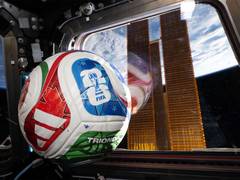
The Trionda, the official match ball for the 2026 FIFA World Cup, reached the International Space Station (ISS) as part of a NASA experiment to study football dynamics in microgravity. This initiative aims to investigate how balance and center of mass affect a ball’s movement. The ISS crew replicated a 2019 study to observe variations in performance based on the ball’s equilibrium.
NASA highlighted the importance of understanding a ball’s movement for enhancing sports technology. The research seeks to improve the embedded technologies within match balls, which could significantly affect gameplay. The agency remarked, “Helping to improve the beautiful game is just one of the ways NASA science done on the International Space Station makes life better for people on Earth.”
Developed by Adidas, the Trionda is notable for its significance; its name translates to “three waves” in Spanish, symbolizing the first World Cup jointly hosted by Canada, Mexico, and the United States. The ball’s design incorporates elements that represent these nations: colors representing each host country and a four-panel design that forms a triangle at the center, signifying unity. Additionally, it features distinct symbols like a maple leaf for Canada, an eagle for Mexico, and a star for the US.
Trionda also includes cutting-edge innovations aimed at boosting match performance. It has deep seams to improve flight stability and embossed surface details to enhance grip in adverse weather. The ball is equipped with a 500Hz motion sensor chip that sends real-time data to the Video Assistant Referee (VAR) system. This technology supports referees in making critical decisions regarding offside calls and other pivotal game moments.
The intersection of sports science and space research through this experiment underscores the evolving landscape of sports technology, making the Trionda a prime candidate for testing in a microgravity environment. This initiative not only showcases the synergy between space exploration and athletics but also opens avenues for future sports innovations derived from space research.
The content above is a summary. For more details, see the source article.