

Key Takeaways
- Firefly Aerospace’s Blue Ghost moon lander has taken its first photos of the moon from Earth orbit.
- The lunar mission is part of NASA’s Commercial Lunar Payload Services program, carrying 10 science experiments.
- Blue Ghost launched on January 15 and is scheduled for a translunar injection burn to begin its moon journey in about ten days.
Blue Ghost Mission Update
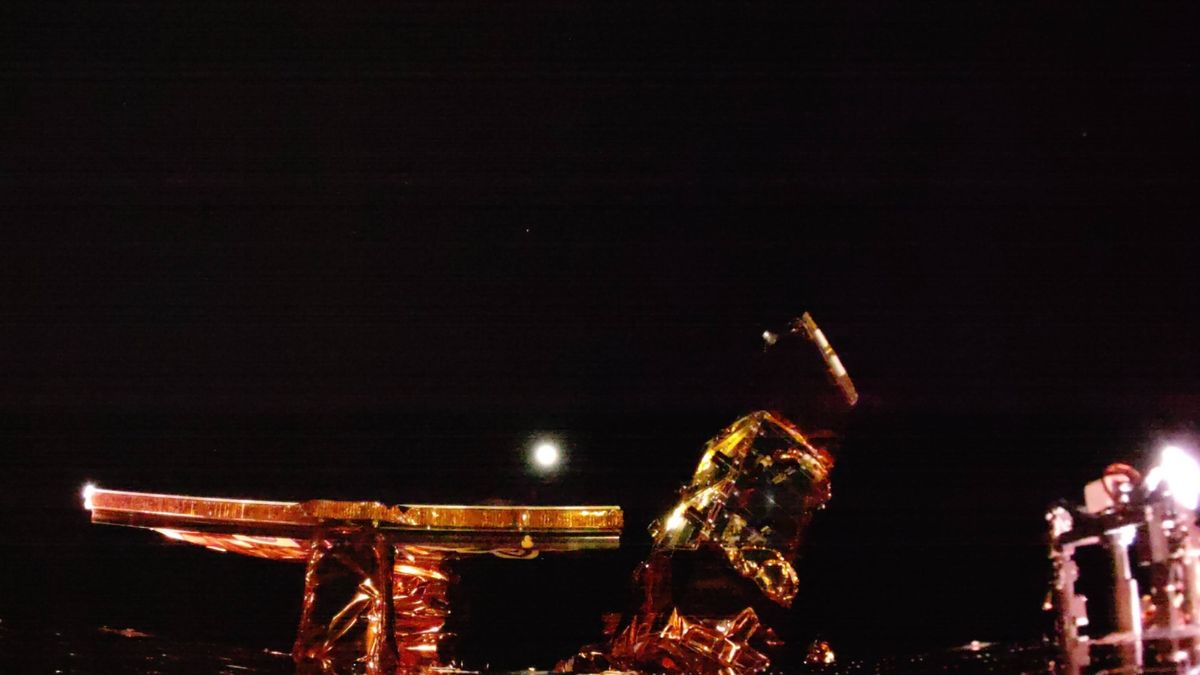
Firefly Aerospace’s Blue Ghost moon lander has successfully captured its first images of the moon from Earth orbit. The Texas-based company shared two photos on January 27: one showing the moon as a distant gray dot in stark blackness and a selfie of the lander with the moon above its golden structure. Firefly expressed excitement about the mission on their social media account, stating, “While Blue Ghost is in Earth orbit, we’ll continue to keep an eye on our final destination! To the moon!”
Launched on January 15 atop a SpaceX Falcon 9 rocket, Blue Ghost is Firefly’s inaugural moon lander. The Falcon 9 also deployed another lunar lander, Resilience, created by the Japanese firm ispace, on the same mission. Blue Ghost’s mission, dubbed “Ghost Riders in the Sky,” aims to assist NASA’s Commercial Lunar Payload Services (CLPS) program through the implementation of ten science experiments designed to gather crucial data for NASA’s Artemis program, aimed at returning astronauts to the lunar surface.
As of now, Blue Ghost’s mission appears to be progressing well. The lander remains in good health in Earth orbit, having completed two engine burns on schedule. In approximately ten days, Blue Ghost will execute its most critical engine firing, known as a translunar injection burn, which will set the spacecraft on a trajectory toward the moon. The lunar transit is expected to take around four days. Once in lunar orbit, Blue Ghost will spend 16 days preparing for its landing attempt in Mare Crisium, a large lunar basin.
Designed to be solar-powered, Blue Ghost will operate on the moon’s surface for about two weeks, powering down shortly after sunset in its operational area. The recent moon images are among several notable observations from Blue Ghost, which has also recorded a solar eclipse and captured stunning “blue marble” views of Earth.
As for the other lunar lander, ispace’s Resilience launched concurrently with Blue Ghost and is also tracking well. Resilience is set for a lunar flyby around February 15, but it is taking a longer and more circuitous route than Blue Ghost. It will enter lunar orbit about four months post-launch and aims to land roughly two weeks after that.
This marks ispace’s second attempt at a lunar lander; the first successfully reached lunar orbit in March 2023 but failed during the subsequent landing attempt. With ongoing developments, Blue Ghost and Resilience promise to advance lunar exploration efforts and contribute valuable data to future manned missions.
The content above is a summary. For more details, see the source article.