Key Takeaways
- Proba-3 satellites have created 57 artificial solar eclipses since July 2025, providing over 250 hours of high-resolution footage of the Sun’s corona.
- Initial findings indicate solar wind speeds in the inner corona can reach 250–500 km/s, significantly faster than previous estimates of 100 km/s.
- The Proba-3 mission, which includes advanced instruments like the ASPIICS coronagraph, aims to deepen understanding of solar behavior and space weather patterns.
Innovative Observations of the Sun
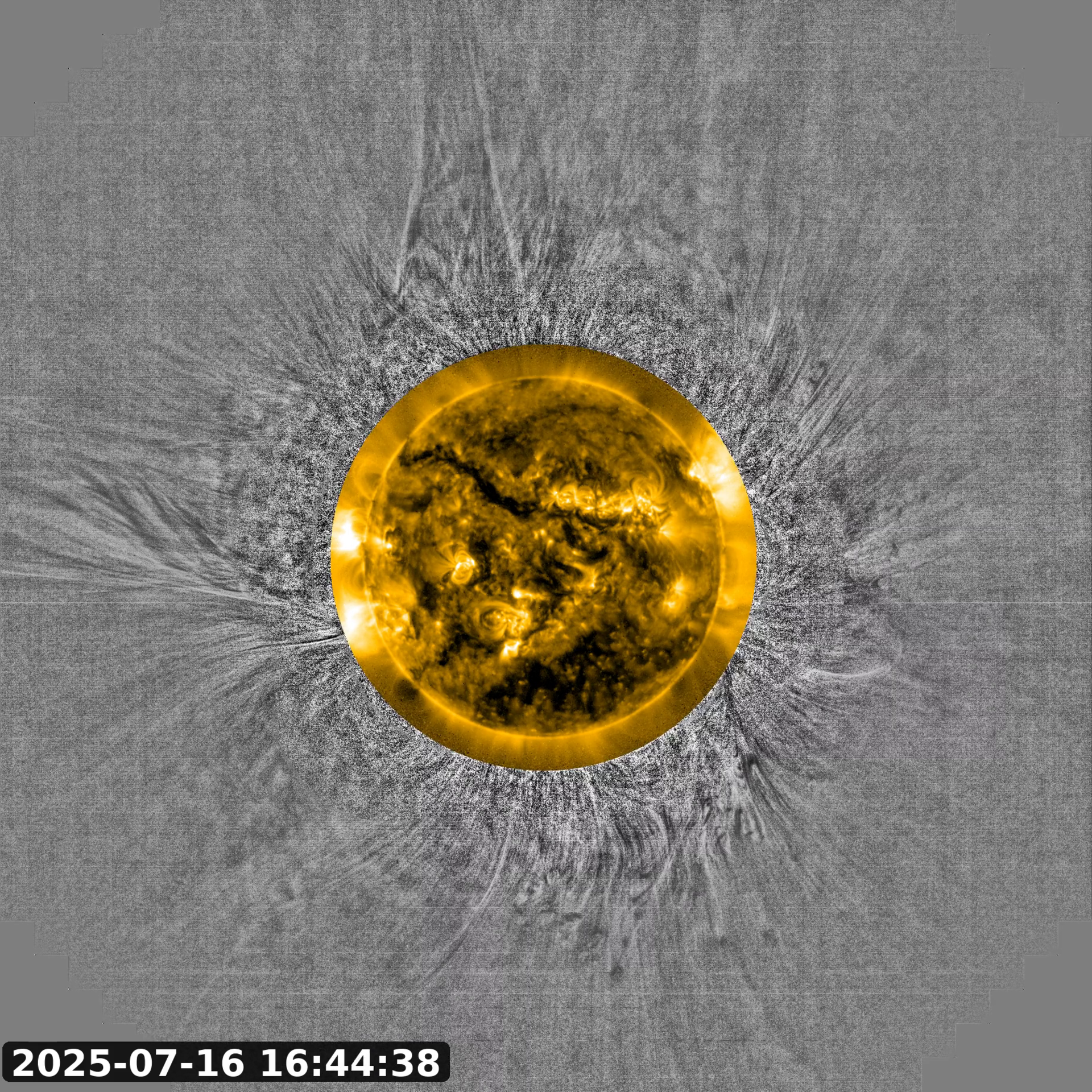
The European Space Agency’s Proba-3 satellites are revolutionizing how scientists study the Sun’s atmosphere, known as the corona, by creating artificial solar eclipses. Launched in December 2024, Proba-3 has successfully performed 57 eclipses since July 2025, yielding more than 250 hours of high-resolution video. This extensive observing time is equivalent to that collected through approximately 5,000 total solar eclipse campaigns on Earth.
Historically, total solar eclipses provided the best views of the Sun’s inner corona, but these events are infrequent and brief. Proba-3 circumvents this limitation by utilizing two spacecraft that operate in a precise formation, allowing the Occulter to block the Sun’s direct light and enabling the Coronagraph to capture detailed imagery of the corona for up to five hours at a time. Notably, Proba-3’s ASPIICS coronagraph can observe regions as close as 70,000 kilometers from the Sun’s surface — a feat unmatched by other instruments.
This innovative approach has unveiled intriguing movements within the inner corona, which were previously undetectable. Joe Zender, ESA’s project scientist, emphasizes that the intricate dynamics observed at such low optical wavelengths around the Sun represent a significant advancement in solar research.
Tracking Solar Wind Dynamics
Proba-3’s observations reveal critical insights into solar wind behavior. Scientists can now closely track how solar wind accelerates near the Sun, leading to unexpected findings. While fast solar wind streams typically flow steadily from magnetic structures called coronal holes, slow solar wind has proven to be more complex and variable.
Initial findings suggest that slow solar wind gusts, driven by dynamic interactions of the Sun’s magnetic field, can move at speeds of 250–500 km/s — three to four times faster than former expectations. Andrei Zhukov, principal investigator for ASPIICS, highlights that this new data sheds light on the non-uniform and fluctuating nature of slow solar wind, which has historically been challenging to analyze.
Future Research Opportunities
Proba-3 is only beginning to unveil the mysteries of the solar corona. A significant portion of the data collected remains to be analyzed, presenting opportunities for scientists to explore pivotal questions such as the mechanisms behind solar wind acceleration, the processes driving coronal mass ejections, and the reasons for the corona’s higher temperatures compared to the Sun’s surface.
This mission marks a significant leap in space-based solar and heliophysics research, with the ASPIICS coronagraph offering unparalleled views and data. Proba-3’s other instruments, including the Digital Absolute Radiometer (DARA) and the 3D Energetic Electron Spectrometer (3DEES), further enhance the mission’s capabilities, allowing for comprehensive investigations of solar energy and Earth’s radiation belts.
In conclusion, Proba-3 is set to provide invaluable data to further scientific understanding of solar phenomena and their implications for space weather.
The content above is a summary. For more details, see the source article.