Key Takeaways
- A drone test flight showcased a student-developed radar retroreflector at ESA’s technical centre in the Netherlands.
- The retroreflector enhances radar visibility for small airborne vehicles, extending detection range and lowering costs.
- This initiative evolved from a university competition into an international collaboration with ESA and multiple partners.
Milestone in Radar Technology
A recent drone test flight at the European Space Agency’s ESTEC in the Netherlands highlighted a novel radar retroreflector created by students from Ruhr University Bochum, Germany. This marks a significant advancement in radar technology intended to enhance the visibility of small airborne vehicles like drones and sounding rockets.
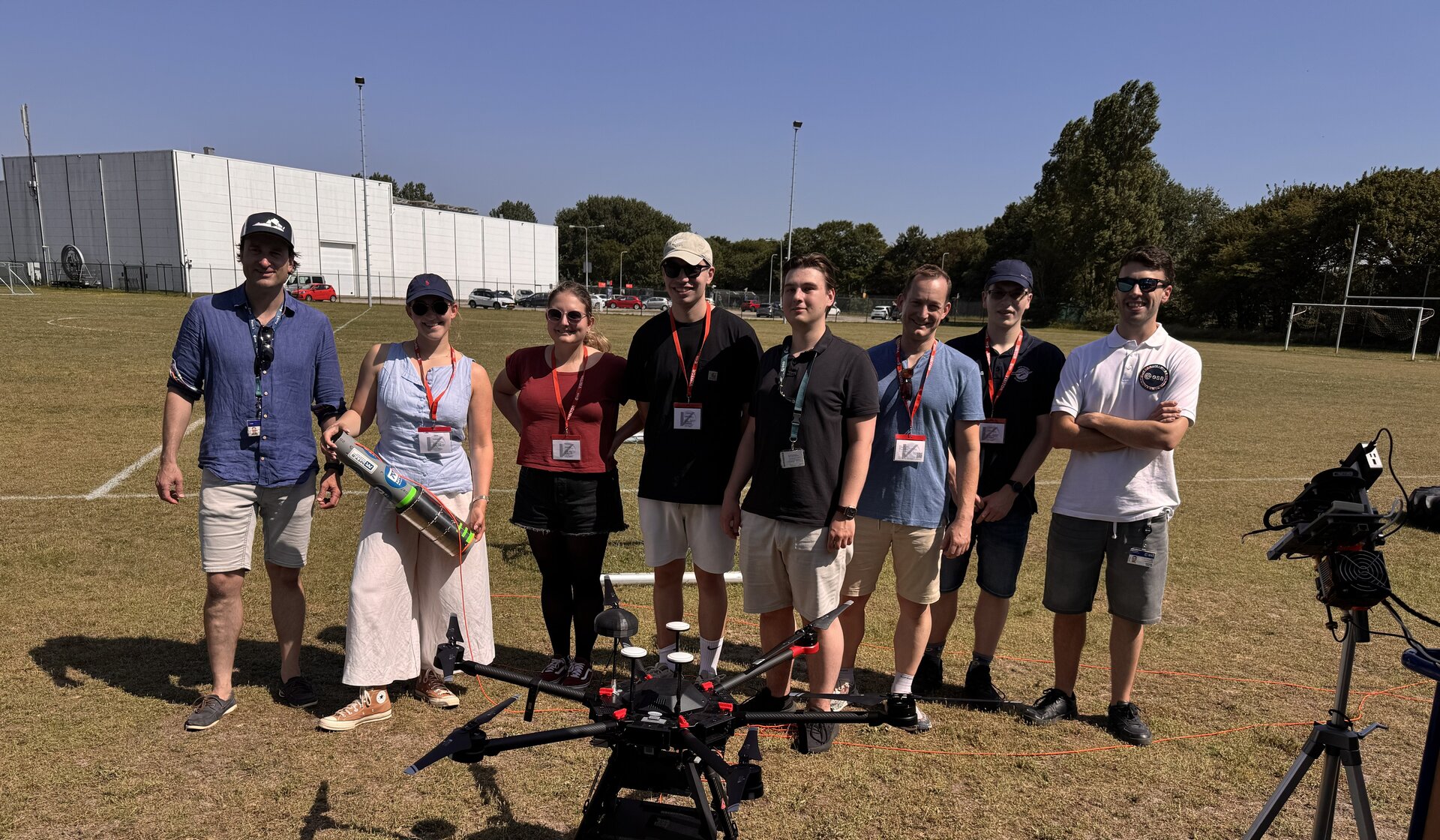
The demonstration involved a 50 cm-long retroreflector suspended from a drone, which ascended to 120 meters and performed various maneuvers over one of ESTEC’s football fields. Daria Tsukanova, a member of the student team, explained that the retroreflector was developed as part of a competition held by the Institute of Electrical and Electronics Engineers (IEEE). The retroreflector is a passive device designed to reflect signals back to their source, which significantly aids detection and tracking without requiring onboard electronics.
Traditional radar systems rely mainly on the metallic structure of rockets, which can become undetectable at certain angles. The innovative retroreflector addresses this limitation by maintaining radar visibility for longer periods. As student team member Stephan Hauptmeier noted, the device is inexpensive, made by 3D printing and laser cutting, and compatible with existing radar technology widely used in the automotive industry. This means that no specialized radar systems are necessary for detection.
This project represents a unique collaboration between students, ESA, and multiple European institutions. Václav Valenta, an ESA microwave engineer, emphasized the opportunity for students to gain hands-on experience with genuine radar technology and optimize these systems for specific applications. The functionality of the retroreflector was verified during the flight, setting the stage for its upcoming launch on a sounding rocket planned for later this summer in Brno, Czech Republic.
Karol Masztalerz, an ESA Graduate Trainee, highlighted how the initiative evolved from a university competition into a broader collaboration. In addition to Ruhr University Bochum, Imperial College London, industry partners, and the Czech Rocket Society are involved, with the latter providing their new Sherpa rocket for future tests.
Approved as a winning project by the IEEE’s International Microwave Symposium (IMS), the venture exemplifies the potential of student-led initiatives in advancing technology. The radar unit utilized in the test was initially modified for terrestrial applications, allowing for enhanced usability in various contexts. This collaboration not only fosters innovation but also bridges students with industry-leading technology, furthering the development of space and radar capabilities.
The content above is a summary. For more details, see the source article.