Key Takeaways
- Super Typhoon Sinlaku reached “violent typhoon” status in April 2026, equating to a category 5 storm.
- Atmospheric gravity waves were detected in the wake of the storm, linked to its rapid intensification.
- Understanding these gravity waves can enhance storm monitoring and improve weather modeling and forecasting.
Typhoon Sinlaku’s Impact and Findings
In mid-April 2026, Super Typhoon Sinlaku formed in the North Pacific, evolving into one of the strongest tropical cyclones recorded so early in the year. It reached “violent typhoon” status, as defined by the Japan Meteorological Agency, comparable to a category 5 on the Saffir-Simpson scale. Sinlaku intensified rapidly over the ocean, bringing significant rainfall and flooding to the Mariana Islands.
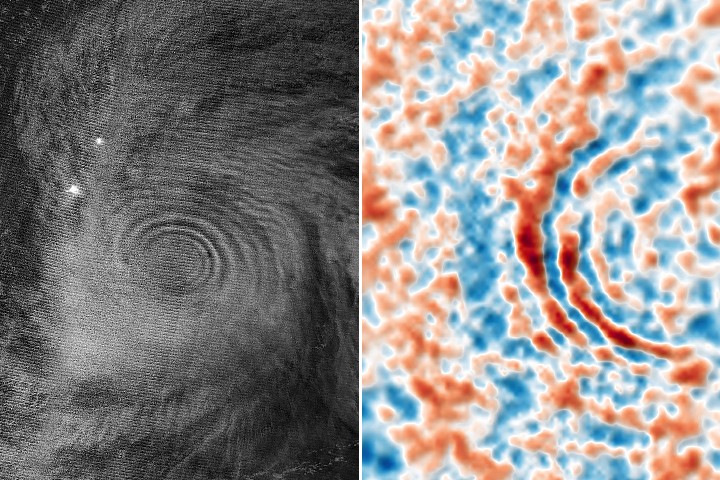
As the storm developed, satellites detected significant atmospheric gravity waves emanating from it. These waves, resembling ripples on a pond, were observable due to airglow, a phenomenon where sunlight-excited molecules release energy during nighttime. The VIIRS (Visible Infrared Imaging Radiometer Suite) on the NOAA-20 satellite captured these atmospheric waves, which typically indicate intensification in tropical cyclones.
The convection process in tropical cyclones generates “hot towers,” towering cumulonimbus clouds that contribute to the formation of gravity waves. Sinlaku’s transformation from category 2 to category 5 storm within 24 hours coincided with the emergence of these waves. Joan Alexander, a senior research scientist, noted the distinct cone-shaped pattern of the waves and highlighted the unexpected presence of nearly complete rings within the mesospheric airglow.
Favorable atmospheric conditions played a role in this observation. The relatively low stratospheric winds at Sinlaku’s latitude in April 2026 likely preserved the waves. Additionally, the moon’s illumination was minimal at 25 percent around April 12, allowing the VIIRS sensor to capture the airglow signals without interference from reflected moonlight.
Further data from NASA’s Aqua satellite indicated that gravity waves were also detectable lower in the atmosphere. By April 13, patterns of warm, rippling emissions confirmed the ongoing influence of the storm. Understanding these gravity waves serves a crucial purpose beyond scientific exploration. They can be pivotal in monitoring storm intensification, especially over the vast openness of the ocean.
Improvements in storm predictions could be achieved through the deployment of geostationary satellites equipped with specialized infrared imagers capable of detecting gravity waves. Such advancements could significantly enhance the accuracy of tropical cyclone forecasts.
Laura Holt, another senior research scientist, emphasized the importance of including stratospheric processes in weather models. Strong convection associated with tropical cyclones profoundly affects long-term forecasts, such as those for the Northern Hemisphere winter, due to sustained gravity wave actions influencing stratospheric wind patterns.
Gravity waves can also impact space weather, as they may cause disturbances in the ionosphere, which can disrupt satellite communications and radio signals. This correlation highlights the broader implications of observing tropical cyclone behavior.
Overall, the understanding of Super Typhoon Sinlaku and its accompanying gravity waves could lead to improved monitoring techniques and informed weather forecasts, benefiting both meteorological science and practical applications in storm preparedness and communication technologies.
The content above is a summary. For more details, see the source article.