Key Takeaways
- CubeSpec is set to be the first CubeSat to conduct high spectral resolution spectroscopy of visible light.
- A High-Precision Pointing Platform (HPPP) developed by KU Leuven will ensure accurate targeting of stars.
- Testing is being conducted at ESA’s ORBIT facility to simulate space conditions for the spacecraft’s operations.
CubeSat Mission Aims to Enhance Astronomy with Precision Technology
The upcoming CubeSpec mission, developed by KU Leuven as part of the European Space Agency’s (ESA) General Support Technology Programme, will aim to be the first CubeSat to perform high spectral resolution spectroscopy of visible light. This mission, utilizing a 12U CubeSat the size of a shoebox and weighing under 30 kg, plays a crucial role in advancing our understanding of stellar structures.
To achieve its objectives, CubeSpec will carry a telescope that demands exceptional pointing accuracy, significantly surpassing what current CubeSat technologies can offer. Leonardo Peri, a PhD researcher from KU Leuven, highlighted that this heightened precision is made possible through a High-Precision Pointing Platform (HPPP). This innovative device features a fine steering mirror capable of rapidly and accurately redirecting starlight towards the mission’s spectrograph, which divides light into its component wavelengths to create a spectrum. This process is akin to how a raindrop separates light into a rainbow.
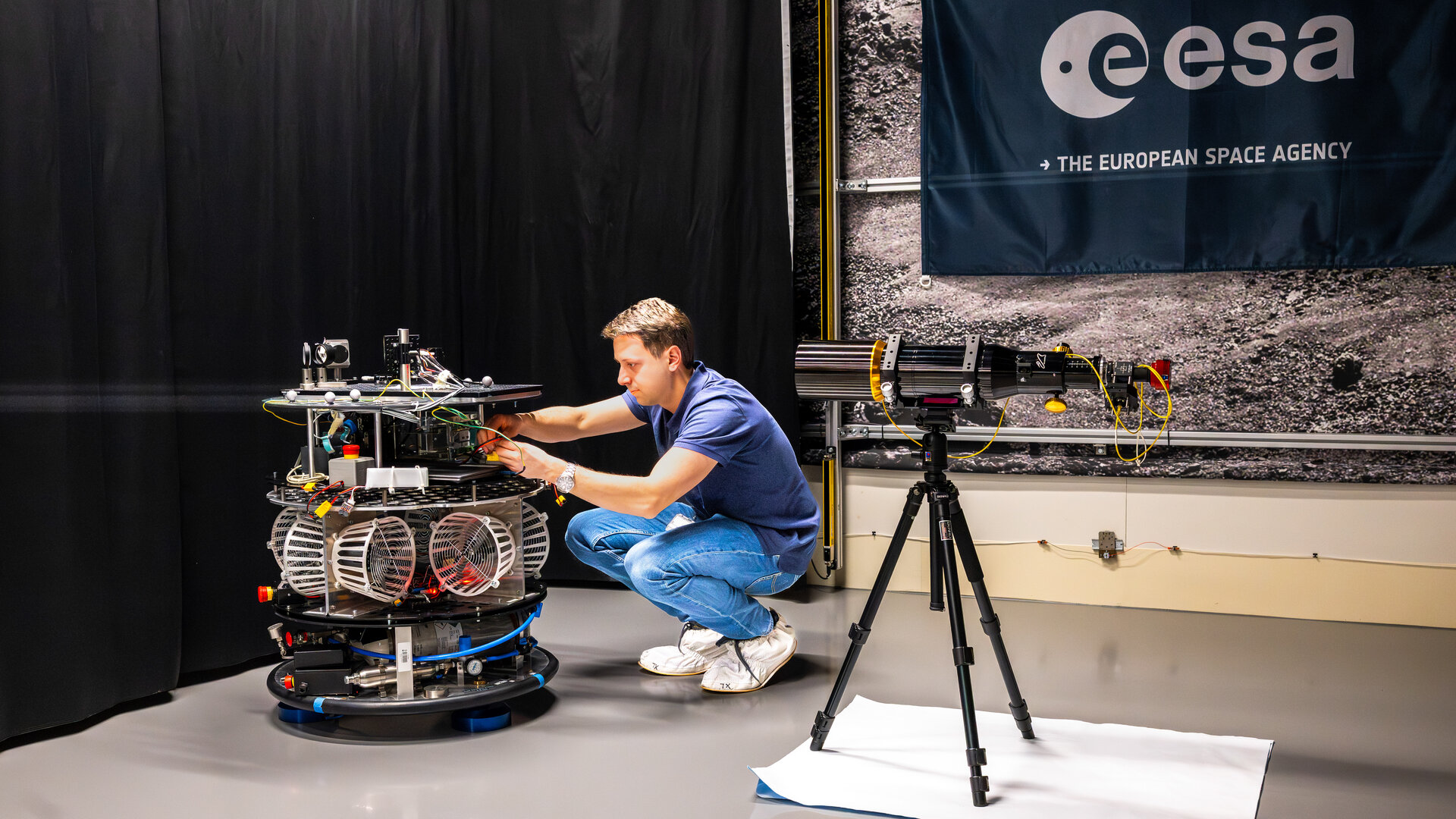
In efforts to simulate the operational conditions CubeSpec will face in space, testing has taken place in the ORBIT facility located at ESA’s ESTEC. The ORBIT facility includes a 43 m² ultra-flat floor designed to replicate frictionless orbital dynamics, with a height variance of less than one millimeter across the surface. Air bearings, which create a minimal friction air gap, allow testing platforms to hover as they would in a true orbital environment.
During testing, a prototype of the HPPP was placed atop a floating platform, using a stationary laser source to mimic a star. Marti Vilella, an automation and robotics engineer at ESA, noted that the HPPP successfully tracked the laser beam, demonstrating its ability to maintain stability despite the platform’s attitude errors, mirroring anticipated operational conditions in actual flight.
Funding for the CubeSpec mission is being provided by the Belgian Federal Science Policy Office (BELSPO) and signifies a collaborative effort to push the boundaries of CubeSat technology in astronomical studies. This mission is poised to significantly enhance our capabilities in space observation, leading to new insights in astronomy.
The content above is a summary. For more details, see the source article.