


Key Takeaways
- Researchers developed a heat treatment for PEDOT:PSS that stabilizes it in water, eliminating the need for chemical additives.
- This approach enhances the material’s performance and simplifies the fabrication of bioelectronics, including wearable devices.
- Initial tests show that heat-treated devices display improved reliability and electrical performance in vivo.
Innovative Stability for Bioelectronic Materials
Recent advances in materials science have revitalized the potential for bioelectronics—devices worn or implanted in the human body that monitor organ and tissue functions. One key material in this field is PEDOT:PSS, a conductive polymer known for its flexibility and biocompatibility. However, its tendency to dissolve in biological fluids has limited its application. Traditional methods to prevent this dissolution often involve chemical additives, which can compromise material properties.
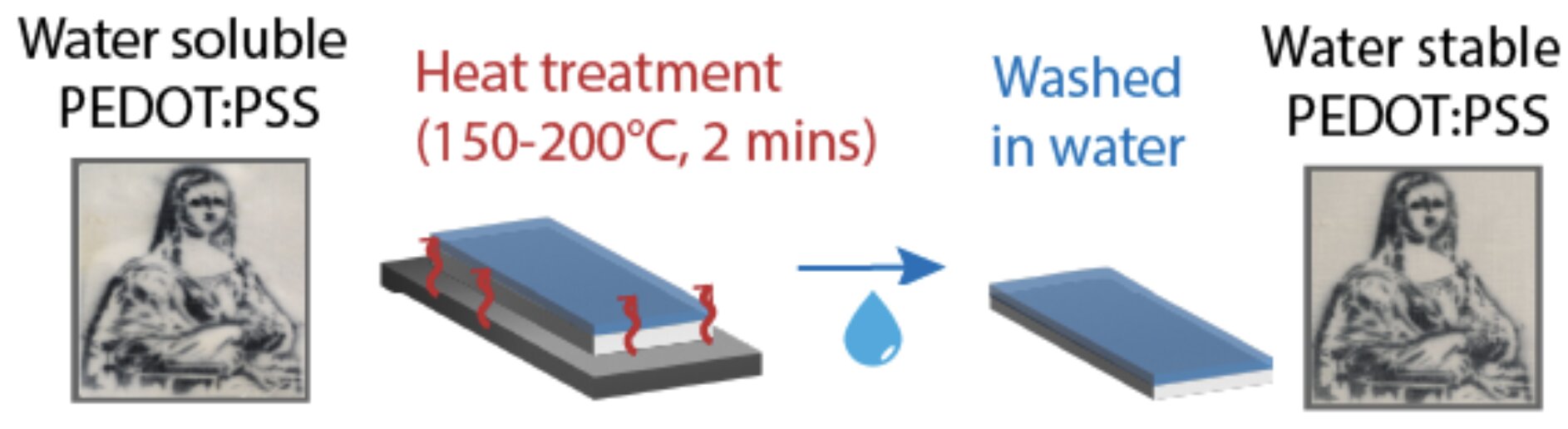
Researchers from Stanford University, the University of Cambridge, and Rice University have discovered a novel and simpler technique to stabilize PEDOT:PSS through heat treatment. This technique is detailed in their recent paper published in *Advanced Materials*. The team found that by heating PEDOT:PSS films at temperatures between 150°C and 200°C for just two minutes, the films become water-resistant without any chemical modifications.
The project began with a serendipitous discovery by Siddharth Doshi, one of the study’s co-authors. While working on photonic devices, he mistakenly baked PEDOT:PSS films at unusually high temperatures, which surprisingly rendered them stable in water. This observation prompted further investigation into the heat treatment’s effects on the polymer’s stability and performance.
Doshi explained that the heat treatment offers a straightforward method; heating unmodified PEDOT:PSS films effectively prevents dissolution in water while also enabling compatibility with various substrates, including flexible plastics and fabrics. The process eliminates the complications related to chemical cross-linkers, which can negatively influence both the conductivity and reliability of the films.
The researchers demonstrated the potential for direct patterning of PEDOT:PSS by selectively applying heat, reducing the need for complex lithography processes. They also utilized focused femtosecond laser beams to create micro-scale 3D printed structures from PEDOT:PSS. This method allows for local stabilization, with significant results even after unexposed material is washed away. Notably, it presents an eco-friendly approach by using only water for processing instead of toxic solvents.
Initial tests of heat-treated devices—including transistors and bioelectronic arrays—indicate higher reliability and electrical performance post-implementation compared to traditional methods. Forner, a Ph.D. student from the University of Cambridge, noted that the devices retained functionality for over 20 days in chronic in vivo experiments, making them viable for long-term use within the body.
The researchers disclosed that the stabilization mechanism likely involves phase separation driven by heat, leading to more robust PEDOT-rich and PSS-rich regions. This change not only enhances stability in water but also improves both conductivity and capacitance—crucial factors for the functionality of bioelectronic devices.
The heat treatment method has the potential to integrate seamlessly into existing manufacturing processes, paving the way for advanced applications. In the future, it could facilitate the development of various PEDOT:PSS-based devices, ranging from implantable systems to wearable electronics.
The researchers are enthusiastic about the implications of being able to 3D-print at the microscale, an endeavor that could bridge the gap between bioelectronics and biological systems. Future research will focus on understanding the thermal stabilization mechanisms more thoroughly, employing advanced imaging techniques to visualize the changes occurring within the material when heated.
The promising results from this research are expected to inspire further exploration in the field, ultimately leading to more effective and stable bioelectronic systems.
The content above is a summary. For more details, see the source article.









