Key Takeaways
- The Hubble Space Telescope revisited the Trifid Nebula, initially imaged in 1997, showcasing changes in this star-forming region.
- New observations reveal star formation dynamics influenced by massive stars, with insights into protostars and their energetic outflows.
- With 36 years of operational history, Hubble continues to provide groundbreaking discoveries and detailed observations of celestial phenomena.
NASA/ESA Hubble’s 36th Anniversary Observations
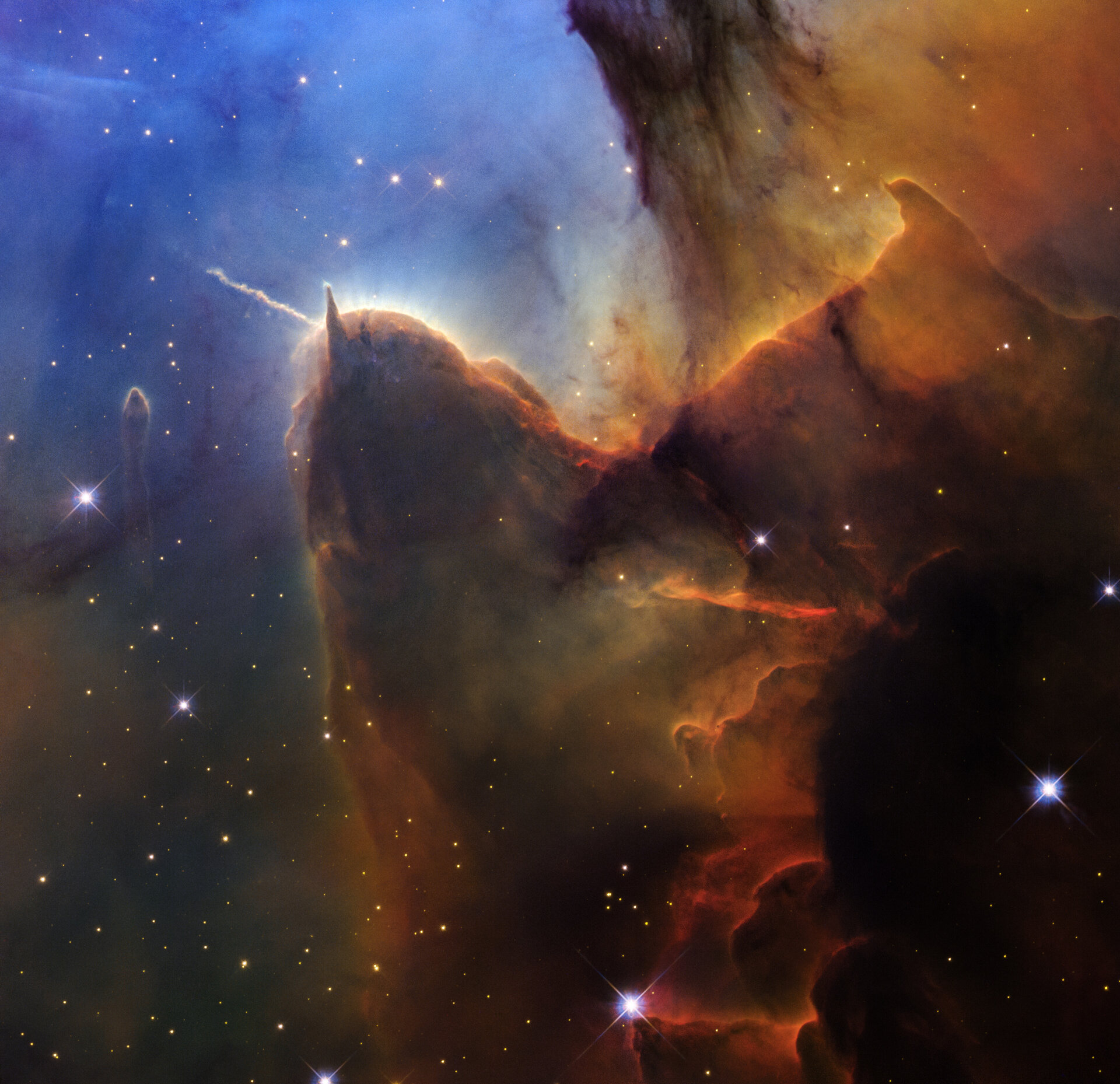
The Hubble Space Telescope recently celebrated its 36th anniversary by revisiting the Trifid Nebula, a star-forming region located approximately 5,000 light-years away in the constellation Sagittarius. The updated image, taken with Hubble’s improved camera, highlights changes that have occurred over nearly three decades since its first capture in 1997. This project showcases the telescope’s ability to document the evolution of celestial formations over relatively short human timescales.
The Trifid Nebula, also known as Messier 20, appears as a dazzling, colorful region reminiscent of an underwater scene. Massive stars beyond the observed area have been shaping the nebula for at least 300,000 years. Their powerful ultraviolet winds create a bubble that compresses surrounding gas and dust, igniting new waves of star formation.
One notable structure in this image is the ‘Cosmic Sea Lemon,’ a rusty-hued cloud of gas and dust shaped like a marine sea slug. This ‘sea lemon’ features jets of plasma, known as Herbig-Haro 399, ejected by a young protostar embedded within. Researchers are studying these jets to measure their speeds and energy output, which provides crucial insights into how newly formed stars interact with their environments.
The upper left portion of the image glows blue, revealing strong ultraviolet light stripping electrons from gas nearby. Over time, this energetic light erodes the gas and dust structures, leaving behind a dispersed area filled with newly formed stars. In stark contrast, the far right corner of the image appears nearly black, indicating dense dust where stars may be forming but are obscured from view.
Hubble’s instruments have proven instrumental in various monumental discoveries over its operational lifetime. In the past year, Hubble has contributed to research concerning early galaxy formations, cosmic anomalies identified with AI assistance, and the observation of asteroids colliding in distant systems. It has also provided crucial data on a range of astronomical phenomena, including comet disintegration and the anticipated collision between the Milky Way and Andromeda galaxies in the distant future.
As Hubble continues to produce remarkable celestial images and findings, it remains a vital asset to astronomers worldwide. Over its lifetime, Hubble has conducted more than 1.7 million observations and facilitated research published in over 23,000 papers, demonstrating its lasting impact on the field of astronomy. Ongoing collaborations with the James Webb Space Telescope are set to further enhance discovery opportunities, emphasizing the telescope’s importance in unraveling cosmic mysteries.
The content above is a summary. For more details, see the source article.