


Key Takeaways
- The India-Africa Strategic Partnership Meet emphasized the need for coordinated grid planning and innovative financing for energy transition.
- Stakeholders highlighted that timely project execution and renewable energy integration are crucial for meeting clean energy targets.
- India’s experiences in power infrastructure and renewable energy were identified as models for enhancing collaboration in Africa.
Meeting Highlights
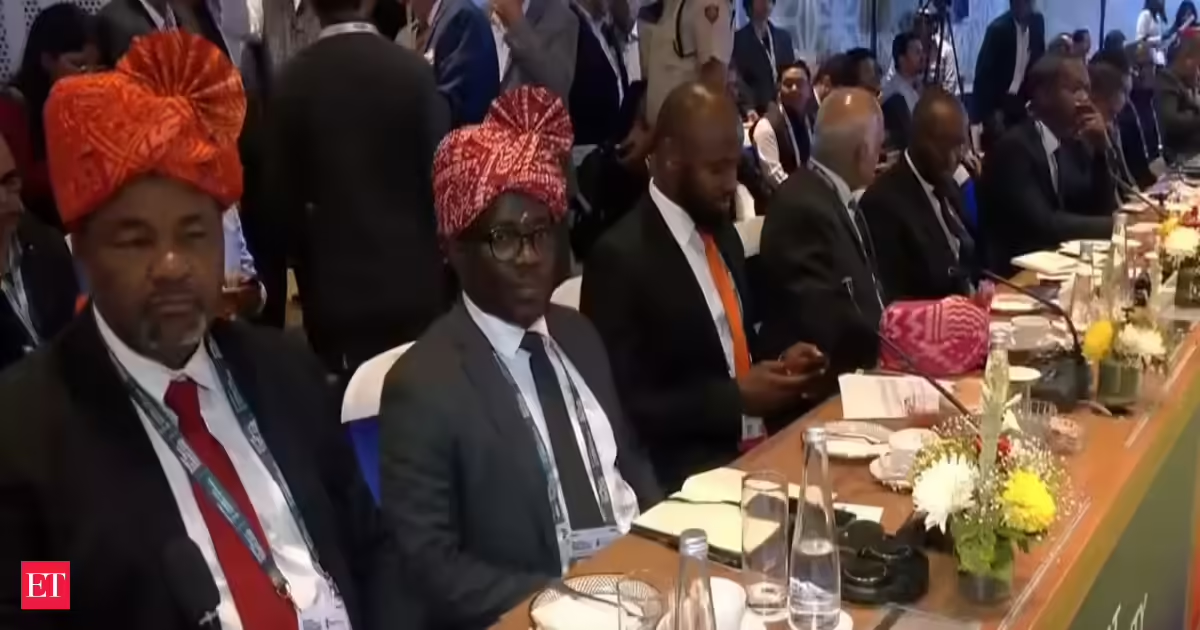
New Delhi hosted the India-Africa Strategic Partnership Meet at the Bharat Electricity Summit 2026, focusing on the critical aspects of energy transition. Stakeholders underscored the necessity for robust grid planning, innovative financing mechanisms, and synchronized execution throughout the electricity value chain, as outlined in an official statement from the power ministry.
Gurdeep Singh, CMD of NTPC Limited, emphasized that a large-scale energy transition hinges on coordinated planning, aggregation models, and risk mitigation strategies to attract private capital. He noted that the next phase of energy transition will depend significantly on efficient project execution, seamless integration of renewable energy into power grids, and timely evacuation of generated power.
Jitendra Srivastava, CMD of REC Limited, pointed out that the focus should shift from ambition to action, highlighting the importance of aligning planning and execution within the electricity value chain. He urged the prioritization of grid-first development, ensuring readiness for power evacuation.
The meeting acknowledged that grid infrastructure is foundational to successful energy transitions, especially as countries enhance their renewable energy capacity. Without concurrent investments in transmission and distribution systems, achieving clean energy targets remains challenging.
Participants noted that aggregation models can enhance project bankability, particularly in emerging markets where fragmented project pipelines discourage large-scale investments. The session proposed blended finance structures—combining public and private capital—as essential tools for risk mitigation and mobilizing necessary funding.
Alain Ebobisse, CEO of Africa50, remarked that Africa is increasingly adopting an investment-driven approach to energy development. He asserted that structuring bankable projects, building transmission infrastructure, and mobilizing private capital are vital for accelerating energy access and transition on the continent.
The discussion recognized that energy transition presents a systems challenge, requiring comprehensive alignment across generation, transmission, financing, and governance. Policymakers and industry leaders concurred that fragmented approaches could hinder progress and inflate costs.
India’s expertise in enhancing power infrastructure, advancing renewable energy, and resolving grid-related challenges was highlighted as a potential model that could be adapted by African nations. Delegates reported that India’s institutional experience and implementation capabilities could foster deeper collaborative efforts in the energy sector.
Overall, the meeting reinforced India’s strategic partnership with Africa, particularly in terms of providing execution-driven solutions, developing bankable projects, and championing a grid-centric energy transition approach.
The content above is a summary. For more details, see the source article.









