


Key Takeaways
- India needs USD 14.23 trillion in investments for its power sector by 2070 to achieve a net-zero scenario with 98% non-fossil fuel generation.
- The shift to clean energy will require robust infrastructure development, including storage and transmission, to handle rising electricity demand.
- By 2070, the share of renewable energy in India’s capacity mix will increase to about 90-93%, with significant growth in solar and nuclear energy.
Under a recently released NITI Aayog report, India is set to require a staggering cumulative investment of USD 14.23 trillion in its power sector to reach net-zero carbon emissions by 2070. This ambitious target envisions that non-fossil fuel-based generation will account for 98% of the country’s energy production. The report emphasizes that India’s development and climate goals are increasingly reliant on the electricity system, which serves as the backbone for achieving both Viksit Bharat 2047 and Net Zero 2070.
The power sector’s growth is crucial for ensuring that economic progress is inclusive and sustainable. Reliable, affordable, and clean electricity is deemed essential for enhancing living standards, boosting productivity, and facilitating a shift towards low-carbon solutions in sectors such as transport, buildings, and industry.
As of December 2025, India has successfully installed nearly 258 GW of renewable energy capacity, positioning itself as the world’s fourth-largest renewable energy market. However, the next phase poses new challenges. The report notes that urbanization, cooling demands, digitalization, electric mobility, and green hydrogen usage will significantly increase electricity demand. This means that the already complex power system must adapt to accommodate a larger share of variable renewable energy sources.
The report outlines electricity’s transition to 2070 using two scenarios: a Current Policy Scenario (CPS), extending current trends, and a more ambitious Net Zero Scenario (NZS). The energy transition is characterized by rapid electrification across the economy. This shift is projected to increase electricity’s share in total energy consumption from 21% in 2025 to nearly 40% by 2070 in the CPS and up to 60% in the NZS.
Per-capita electricity consumption is expected to rise dramatically from 1,400 kWh in 2025 to between 7,000 and 10,000 kWh by 2070, approaching levels seen in developed nations like France and South Korea. Total installed capacity could grow ninefold under the CPS and fourteenfold under the NZS. The capacity mix is also set to pivot significantly towards Variable Renewable Energy (VRE), with renewable energy’s share expected to rise from approximately 43% in 2025 to between 90% and 93% by 2070.
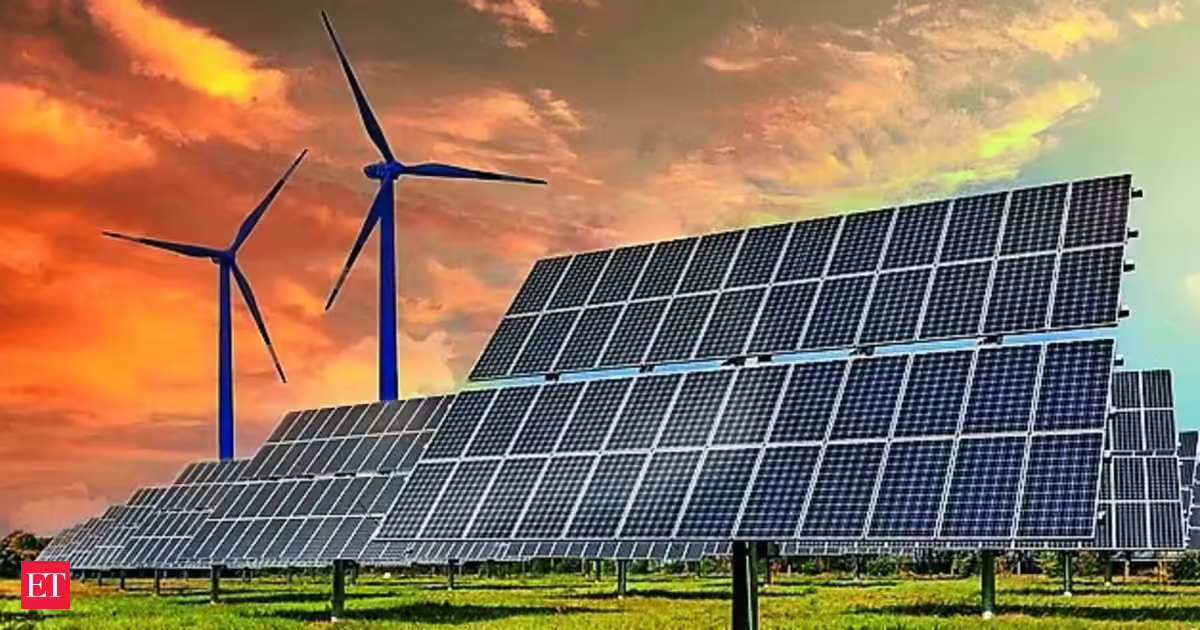
Solar photovoltaic (PV) energy is anticipated to become the dominant source, with projections of capacity reaching between 3,250 GW and 5,500 GW. Onshore wind capacity is expected to surpass 1,000 GW, while offshore wind could contribute an additional 50-70 GW. To manage the intermittency of renewables, battery storage needs considerable expansion, potentially reaching 2,500-3,000 GW under the NZS by 2070, while pumped hydro capacity may rise to around 150-160 GW.
Nuclear energy is also highlighted as a pivotal element of India’s long-term energy strategy, with estimates suggesting an increase from 8.8 GW in 2025 to over 300 GW by 2070, ensuring low-carbon, reliable energy for a renewables-focused grid.
The study also notes the land requirements for expanding VRE capacity will increase, but will still account for a small percentage of the national wasteland, estimated at nearly 7.2% under the CPS and 12% under the NZS by 2070. Ultimately, the financial requirements for this monumental transformation are expected to total USD 8.79 trillion under the CPS and USD 14.23 trillion under the NZS, marking a diverse and capital-intensive transition for India’s power sector.
The content above is a summary. For more details, see the source article.









