


Key Takeaways
- India has established standards for Green Ammonia and Green Methanol under the National Green Hydrogen Mission.
- Emissions for Green Ammonia must be no more than 0.38 kg CO2 equivalent per kg, and for Green Methanol, no more than 0.44 kg CO2 equivalent per kg.
- The standards aim to support decarbonization in various sectors and enhance India’s role as a producer and exporter of green fuels.
Green Ammonia and Green Methanol Standards Introduced in India
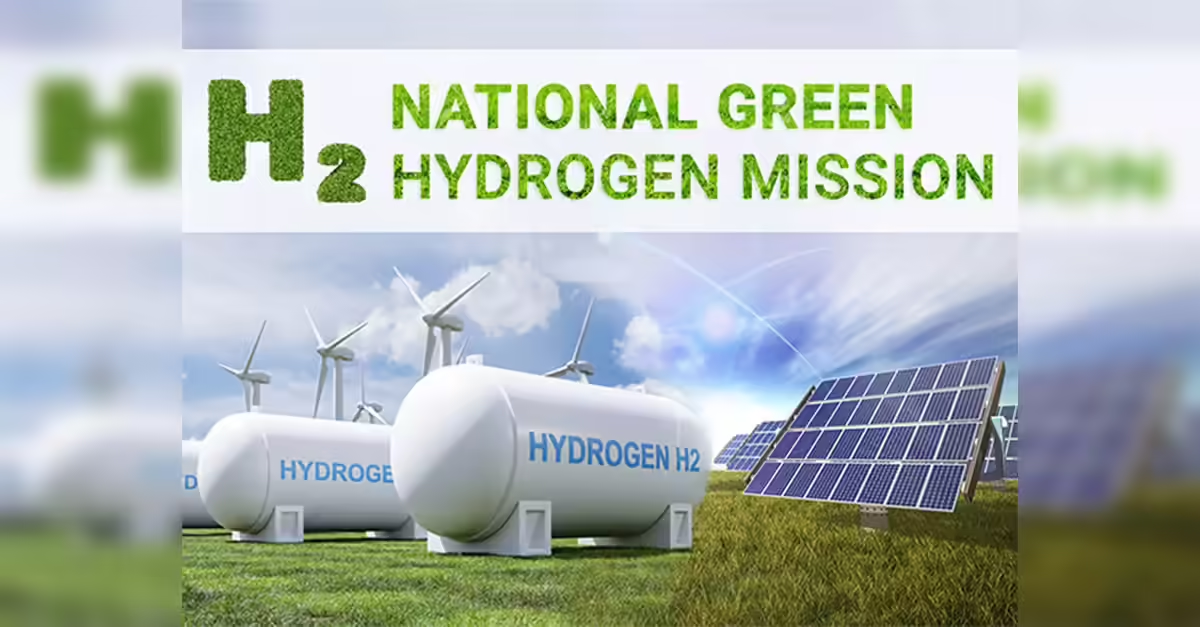
On February 27, 2026, India formally announced the Green Ammonia and Green Methanol Standards, a pivotal advancement in the National Green Hydrogen Mission. These standards, issued by the Ministry of New and Renewable Energy (MNRE), define the emission limits and conditions necessary for classifying ammonia and methanol as ‘Green.’ The classification mandates that the respective products must be generated from Green Hydrogen sourced from renewable energy.
For Green Ammonia, the standard stipulates that total non-biogenic greenhouse gas emissions—including those from production, synthesis, purification, compression, and on-site storage—must not exceed 0.38 kg of carbon dioxide equivalent per kg of ammonia (kg CO2 eq/kg NH₃), calculated as a 12-month average. Similarly, for Green Methanol, emissions must stay below 0.44 kg CO2 equivalent per kg of methanol (kg CO2 eq/kg CH₃OH), also based on a 12-month average.
The guidelines for Green Methanol allow the sourcing of carbon dioxide from biogenic sources as well as Direct Air Capture (DAC) and pre-existing industrial sources. The MNRE has the authority to periodically update these eligible carbon dioxide sources, while ensuring that existing processes can adapt through reasonable grandfathering provisions.
Renewable energy also includes energy generated and stored in energy storage systems or banked with the grid, all adhering to relevant regulations. The MNRE will release a comprehensive methodology for measuring, reporting, monitoring, on-site verification, and certification of these green products in the future.
Tenders, bids, or solicitations issued prior to the standards’ notification can proceed under previous terms. However, with mutual agreement, entities may amend these tenders to align with the new standards when feasible.
The introduction of these standards clarifies the regulatory landscape for stakeholders involved in green hydrogen development. This will not only facilitate the decarbonization of industries such as fertilizers, shipping, power, and heavy manufacturing but will also position India as a trusted producer and exporter of green fuels.
Developers of Indian Green Hydrogen are actively aiming for export markets in Green Ammonia and Green Methanol, and these newly established standards enhance the regulatory framework supporting their initiatives under the National Green Hydrogen Mission.
The content above is a summary. For more details, see the source article.









