


Key Takeaways
- The CPP-CEA at IPB University hosted a webinar featuring experts discussing innovations in environmental control and plant monitoring technologies.
- New research facilities, including smart greenhouses and indoor vertical farms, were introduced to enhance agricultural technology research.
- Real-time monitoring systems and portable devices for assessing plant health were highlighted as key tools for improving productivity and sustainability in agriculture.
Innovative Agriculture at IPB University Webinar
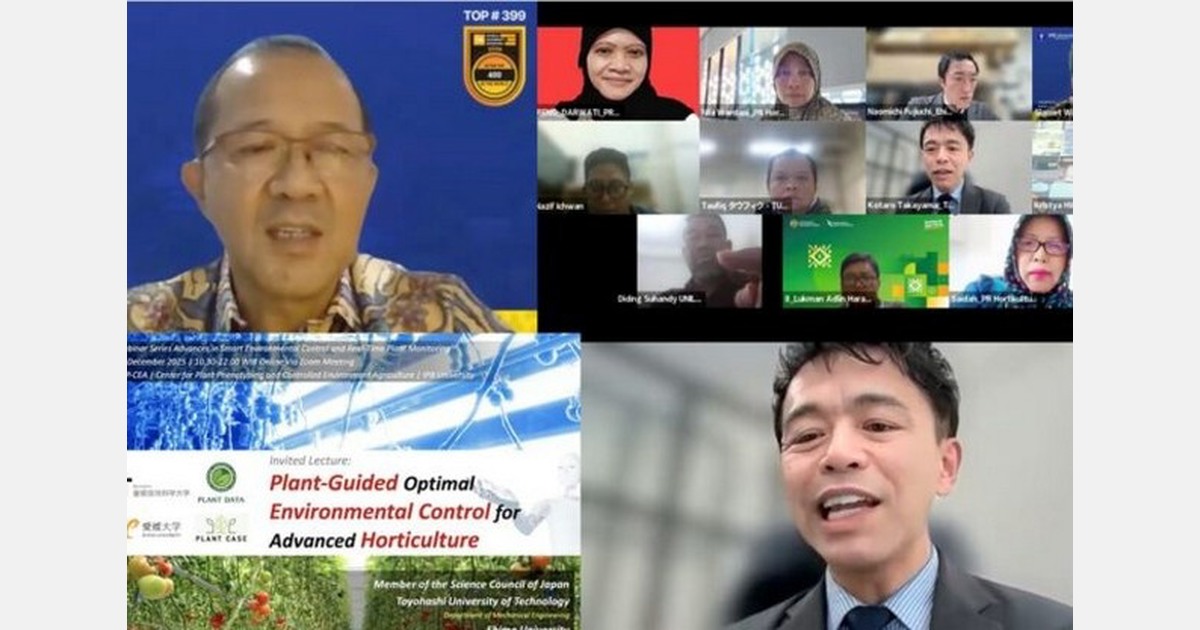
The Center for Plant Phenotyping and Controlled Environment Agriculture (CPP-CEA) at IPB University recently conducted an international webinar featuring two leading experts from Japan, showcasing advancements in smart environmental control technology and real-time plant physiology monitoring.
Prof Aris Purwanto, Vice Dean of the Faculty of Agricultural Technology, reiterated the importance of CPP-CEA as a cutting-edge research center aimed at improving crop productivity and food security through the integration of sensing, modeling, and automation technologies. He encouraged participants to engage in discussions and form collaborative networks for future innovation in sustainable agriculture.
Dr Slamet Widodo, head of CPP-CEA, introduced two new facilities developed through collaboration with South Korean partners: smart greenhouses and indoor vertical farming setups. He emphasized that these facilities would serve as crucial infrastructure for research in plant phenotyping and controlled environment agriculture.
The first guest speaker, Prof Kotaro Takayama from Toyohashi University of Technology and Ehime University, stressed the need for environment-controlled production systems, such as intelligent greenhouses. He introduced a groundbreaking real-time monitoring system for photosynthesis and transpiration that utilizes an effective open-chamber design, which allows for early detection of plant stress and optimization of grows requiring additional light and CO₂.
Associate Prof Naomichi Fujiuchi from Ehime University followed with insights on whole-plant photosynthesis and transpiration monitoring technologies implemented in Japanese commercial greenhouses. He outlined how analyzing plant responses to environmental variables can help identify physiological anomalies and stress, leading to more objective and efficient greenhouse management through mathematical models and automatic stress detection algorithms.
Additionally, Dr Taufiq from Toyohashi University presented a portable photosynthesis measurement device designed for field use by agricultural practitioners. This lightweight tool supports measurements under various lighting conditions, facilitating direct assessments of plant responses.
In closing, Dr Slamet Widodo reaffirmed the critical role of plant physiology technology in enhancing productivity within controlled environment agriculture systems. He concluded that international collaboration and technological advancements would significantly drive the transformation toward more precise, efficient, and sustainable agricultural practices.
The content above is a summary. For more details, see the source article.









