


Key Takeaways
- Researchers at the University of Turku developed a method using leaf skeletons to create bioinspired surfaces for flexible electronics.
- The new biomimetic surfaces enhance properties such as stretchability, conductivity, and durability, making them suitable for wearable sensors and electronic skins.
- This technique is more sustainable than traditional methods, utilizing less energy and enabling production outside controlled environments.
Innovative Biomimetic Approach
A research team from the University of Turku in Finland has created an innovative method to replicate the intricate fractal structures found in plant leaf skeletons, offering a transformative solution for flexible electronics. This breakthrough, published in the journal *npj Flexible Electronics*, demonstrates a method that does not rely on traditional cleanroom technologies, paving the way for more versatile manufacturing processes.
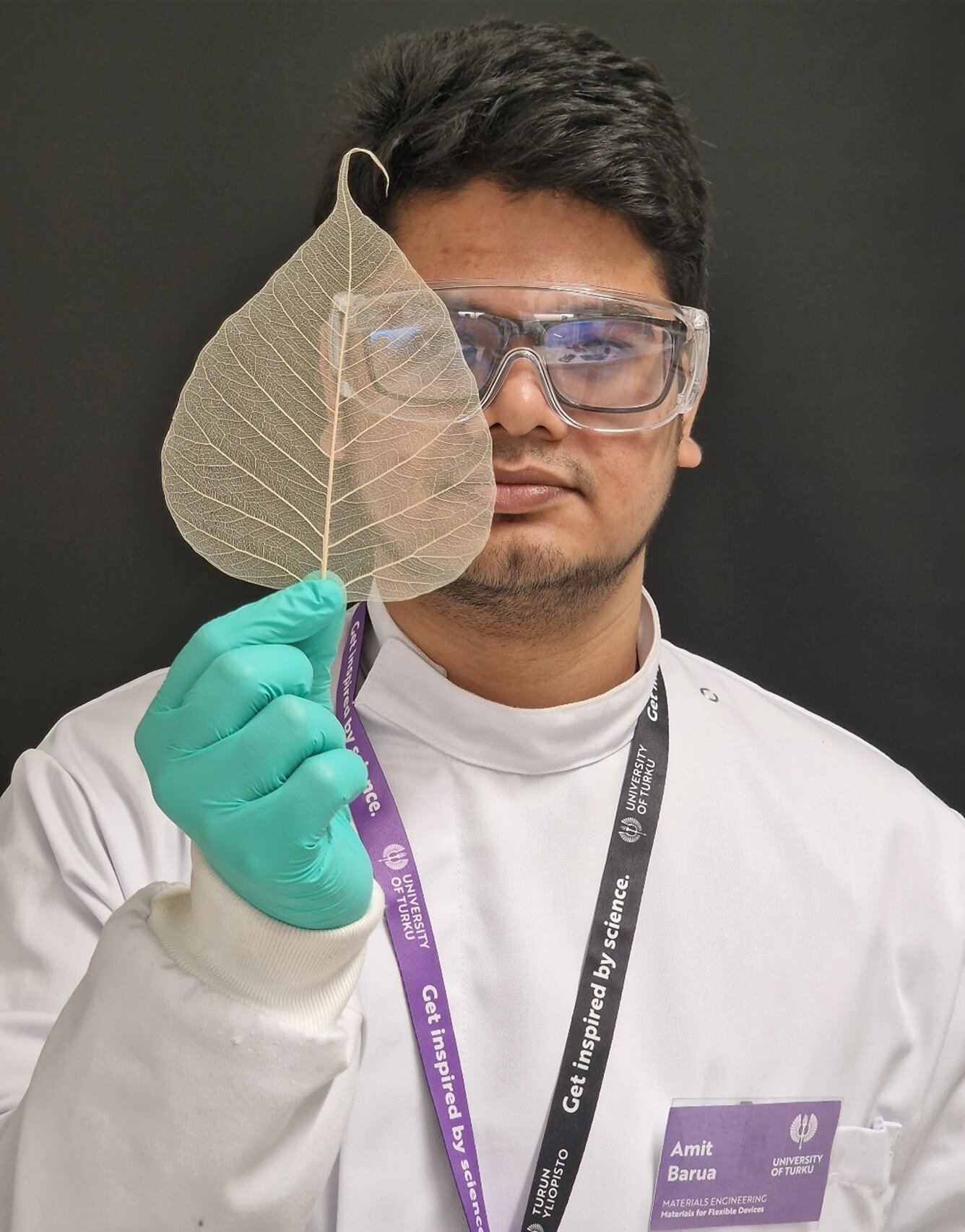
Fractals are structures that repeat a specific shape on smaller scales and can be found in numerous natural forms, such as tree branches and leaf veins. By utilizing dried leaf skeletons, the researchers sprayed various manufacturing materials onto these natural templates. The subsequent surfaces were fabricated with over 90% accuracy, displaying remarkable compatibility with flexible electronic applications, including enhanced stretchability, attachment to human skin, and breathability.
The leaf skeleton-inspired surfaces have advantages thanks to their hierarchical, repeating structures, allowing for maximized surface area while ensuring mechanical flexibility. This essential design feature enhances the electrical conductivity, energy efficiency, and overall durability of the materials, positioning them as ideal candidates for next-generation applications such as wearable sensors, transparent electrodes, and bioelectronic skins.
In comparison to synthetic fractals created via methods like kirigami or origami, these leaf skeleton fractals present naturally optimized structures. They deliver improved flexibility, breathability, and transparency while retaining a significant surface-area-to-volume ratio. However, the original leaf skeletons are not inherently stretchable or durable. The researchers tackled this limitation by employing stretchable and durable polymers, allowing for the creation of surfaces suited for long-term use and large-scale production.
Doctoral Researcher Amit Barua emphasized the significance of blending nature’s efficient designs with advanced materials, stating that this development opens new avenues in the realm of flexible and wearable electronics.
Environmental Considerations
To enhance conductivity, the researchers applied a thin layer of metal nanowires to the biomimetic surfaces, achieving a surface resistivity around 20 Ω. This made the surfaces suitable for various applications, including tactile sensing and electronic skin devices.
The novel biomimetic technique presents a more sustainable alternative to conventional methods, as it is less energy-intensive and does not require controlled environments for production. Additionally, the use of sustainable polymers can further mitigate ecological impact. For large-scale manufacturing, tools such as computer-aided design (CAD) models and finite element method (FEM) simulations for replicating biological designs can be utilized. Depending on the application requirements, silver nanowires can be substituted with more sustainable conductive materials.
Barua noted that traditional fabrication methods for sophisticated microstructures typically require cleanroom conditions. This new approach can circumvent such limitations, potentially leading to lower carbon emissions and a more environmentally-friendly manufacturing process.
This forward-thinking method not only showcases the synergy between nature and technology but also highlights potential pathways towards more efficient and sustainable electronics.
The content above is a summary. For more details, see the source article.









