Key Takeaways
- NASA is advancing swarm technology to enable spacecraft to operate autonomously while collaborating on missions.
- The Distributed Spacecraft Autonomy (DSA) project includes a demonstration involving four CubeSats working together, with minimal human intervention.
- Each spacecraft in the swarm can analyze new data independently, allowing for rapid adaptation to changes during the mission.
Advancements in Spacecraft Autonomy
NASA is working on innovative “swarm technology” to enhance the flexibility and efficiency of multi-spacecraft missions. This technology aims to allow individual spacecraft to make autonomous decisions while collaborating toward shared mission objectives, all without direct human input. The long-term vision includes enabling the efficient allocation of tasks in distributed space missions through ad-hoc networking.
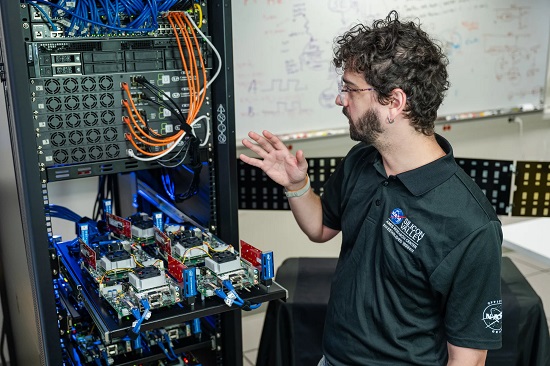
Research on this technology is being conducted at NASA’s Ames Research Center in Silicon Valley, particularly under the Distributed Spacecraft Autonomy (DSA) project. The DSA project involves two primary efforts. First, software for small spacecraft was developed and demonstrated during NASA’s Starling mission, which consisted of four CubeSat satellites working as a swarm. This mission tested the capabilities of autonomous collaboration with minimal human oversight. Second, a ground-based simulation of a spacecraft swarm was carried out in a virtual lunar orbit, providing additional insights into scalability.
Caleb Adams, project manager for DSA at NASA Ames, noted that the software developed for this initiative equips the satellite swarm with an understanding of their scientific objectives and the intelligence necessary to achieve them. “We did not tell the spacecraft how to do their science,” he explained, emphasizing that the team learned what the Starling spacecraft accomplished only after completing the experiment—a significant milestone in autonomous spacecraft operations.
The initial demonstrations of this technology are ongoing, with tests conducted from August 2023 through May 2024. The Starling spacecraft are capable of processing GPS signals that traverse the ionosphere, which can uncover valuable but transient phenomena for the swarm to examine. Each satellite can evaluate and execute plans individually, quickly optimizing their actions in response to new information.
This project, introduced back in October 2017, represents a crucial step toward realizing fully autonomous and cooperative satellite operations in future space missions, highlighting NASA’s commitment to pioneering advances in space exploration technology.
The content above is a summary. For more details, see the source article.