Key Takeaways
- NASA has shipped three small rovers to the Intuitive Machines facility for integration with a lunar lander.
- The CADRE mission aims to demonstrate cooperative autonomous exploration on the Moon.
- The rovers will perform scientific measurements in the Reiner Gamma region after launch planned for early 2026.
Mission Overview
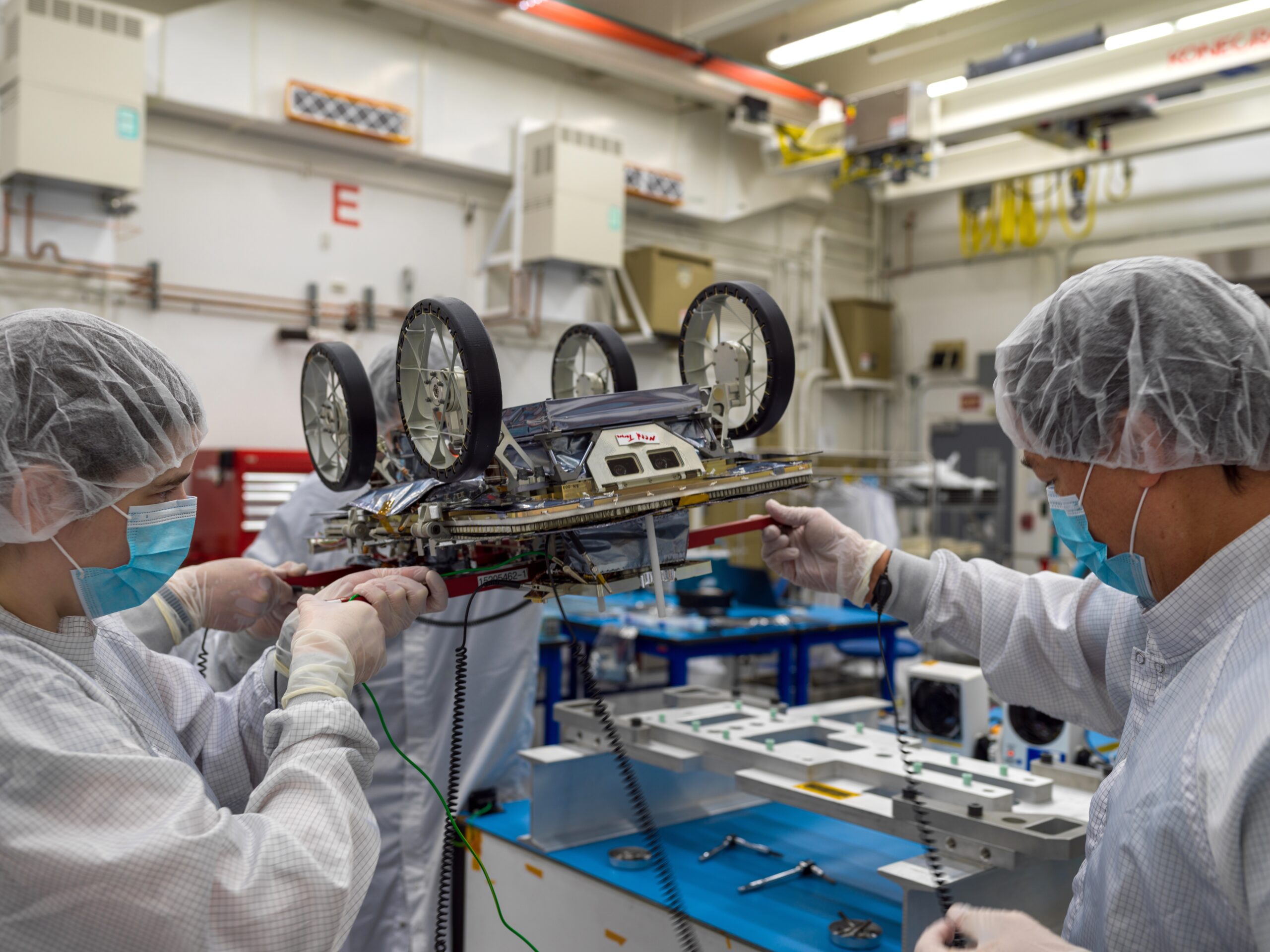
A team at NASA’s Jet Propulsion Laboratory (JPL) has completed the first phase of a mission involving three small rovers designed for lunar exploration. These suitcase-sized rovers were packed and shipped in February to be integrated with a commercial lunar lander for their upcoming journey to the Moon.
The rovers are part of a technology demonstration known as CADRE (Cooperative Autonomous Distributed Robotic Exploration). This project is intended to showcase how a group of autonomous rovers can collaborate to gather valuable data from the lunar surface without needing direct commands from Earth. Equipped with cameras and ground-penetrating radar, the rovers will send back images of both the Moon’s surface and its subsurface regions while testing innovative software that allows them to function cooperatively.
The launch of CADRE will occur aboard Intuitive Machines’ third lunar delivery mission, termed IM-3. The mission has a timeline extending into early 2026 and is part of NASA’s Commercial Lunar Payload Services (CLPS) initiative. Upon reaching the Moon, the rovers will land in the Reiner Gamma region, where they will operate for approximately 14 Earth days of daylight. Their tasks will focus on conducting experiments and gathering scientific measurements, setting a precedent for future missions that may involve similar teams of robots assisting astronauts.
In preparation for shipment, engineers enhanced the deployment system of each rover, designed to lower them onto the lunar surface via a tether. They were securely fastened to an aluminum plate and enclosed within protective metal frames before being placed into shipping containers for transport. The shipment arrived safely on February 9, 2024. Coleman Richdale, JPL’s assembly, test, and launch operations lead, expressed enthusiasm about the successful preparation of the rovers and their imminent deployment on the lunar surface.
The CADRE mission involves not only the rovers and their base station but also a camera system that will document their activities on the Moon. The integration of these components with other NASA payloads will occur at Intuitive Machines’ facility in Houston, Texas, preparing for the launch of the IM-3 mission.
Managed by JPL, a division of Caltech, the CADRE technology demonstration falls under NASA’s Game Changing Development program and supports the broader Lunar Surface Innovation Initiative aimed at advancing technologies for sustained lunar exploration. The project received support from NASA’s Glenn Research Center and Ames Research Center, with hardware components designed and built by Motiv Space Systems and collaborative research conducted by Clemson University.
For more details on the mission, visit NASA’s dedicated page on CADRE at [NASA CADRE](https://go.nasa.gov/cadre).
The content above is a summary. For more details, see the source article.