Key Takeaways
- Three small NASA rovers, part of the CADRE project, have been shipped for their lunar mission.
- The autonomous rovers will gather data from the lunar surface using advanced technology without direct Earth commands.
- Their mission, part of NASA’s CLPS initiative, aims to enhance future lunar explorations and support human missions.
NASA’s Innovative Lunar Rover Mission
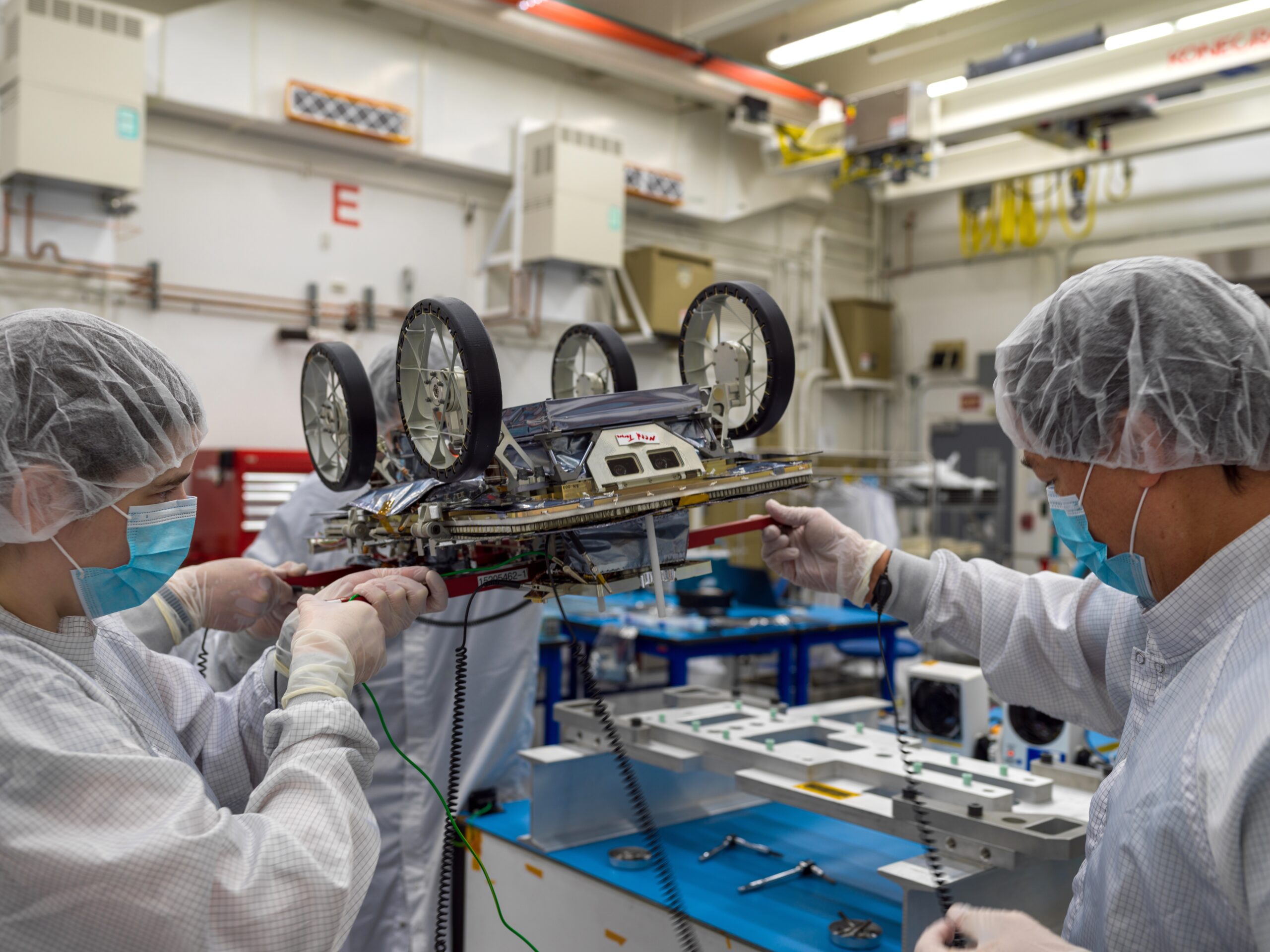
A team at NASA’s Jet Propulsion Laboratory (JPL) has sent three small, suitcase-size rovers to join a commercial lunar lander, marking a significant step toward their upcoming journey to the Moon. The rovers are part of the Cooperative Autonomous Distributed Robotic Exploration (CADRE) project, which will demonstrate their capability to collaborate effectively to gather data autonomously.
The rovers are set to launch aboard Intuitive Machines’ IM-3 lunar lander, which has a mission window extending into early 2026. Once deployed in the Reiner Gamma region on the Moon’s near side, these solar-powered rovers will conduct experiments during lunar days, which last approximately 14 Earth days. They are equipped with cameras and ground-penetrating radars to capture imagery of both the lunar surface and subsurface while independently testing a sophisticated software system that enables their teamwork.
The construction and rigorous testing of the rovers were finalized in February 2024, prior to shipping them to Intuitive Machines’ facility in Houston. Each rover was carefully attached to a deployer system designed to lower it onto the lunar surface via tether. After securing them in protective enclosures, the rovers were transported by truck, arriving safely on February 9, 2024.
Coleman Richdale, the assembly, test, and launch operations lead at JPL, expressed excitement about this milestone, stating, “Our small team worked incredibly hard constructing these robots and putting them to the test… we can’t wait to see the lunar surface through CADRE’s eyes.”
The CADRE project is managed under NASA’s Game Changing Development program and is part of the agency’s Lunar Surface Innovation Initiative, aimed at advancing technologies for sustainable lunar exploration. Collaborating organizations include NASA’s Glenn Research Center, Ames Research Center, Motiv Space Systems, and Clemson University, highlighting the interdisciplinary effort behind this innovative mission.
In summary, the CADRE project represents a crucial advancement in robotic space exploration, with the potential to enhance future missions involving both robots and astronauts on the lunar surface. The integration of multiple NASA payloads with the lander will contribute to gathering vital scientific data and support the long-term goal of establishing a sustained human presence on the Moon.
The content above is a summary. For more details, see the source article.