Key Takeaways
- A potential dwarf planet named 2017 OF201 has been discovered beyond Neptune, challenging the existence of the theoretical Planet 9.
- 2017 OF201 is about 700 kilometers in diameter and takes roughly 25,000 years to complete one orbit around the Sun.
- The discovery suggests there may be many more such distant objects, with future observations from the Vera C. Rubin Observatory expected to reveal them.
Discovery of 2017 OF201
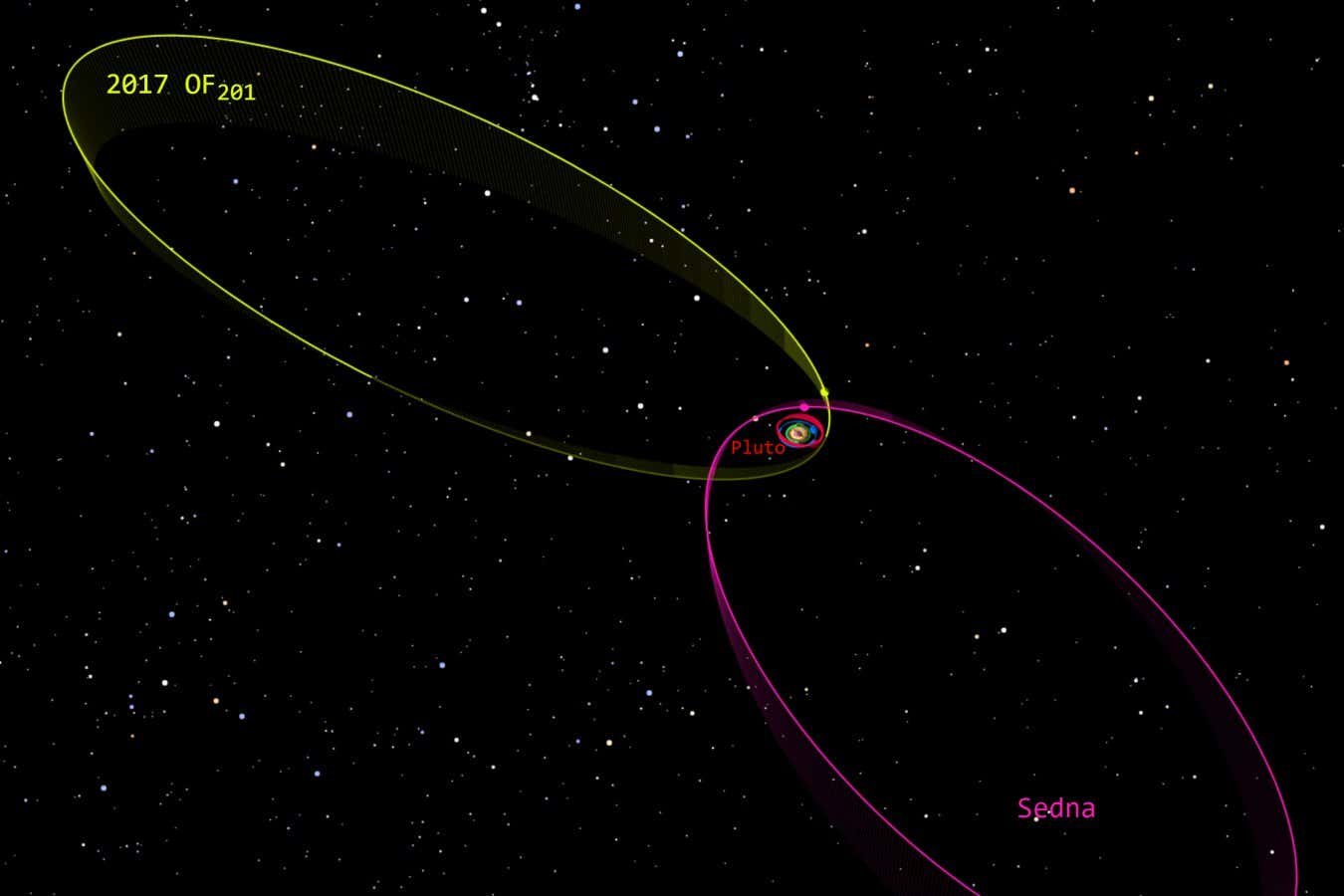
A potential dwarf planet, 2017 OF201, has been identified in the outer solar system, orbiting beyond Neptune. This discovery raises questions about the presence of a hypothetical planet known as Planet 9 or Planet X. The object was first detected by Sihao Cheng and colleagues from the Institute for Advanced Study in Princeton, utilizing data from the Victor M. Blanco Telescope in Chile.
2017 OF201 measures approximately 700 kilometers in diameter, making it large enough to be classified as a dwarf planet, similar to Pluto, which is three times its size. The object is currently located about 90.5 astronomical units (AU) from Earth, translating to roughly 90 times the distance from the Earth to the Sun. As a trans-Neptunian object (TNO), its orbit exceeds that of Neptune, intersecting the Kuiper Belt, a region filled with icy bodies beyond Neptune’s orbit.
Researchers analyzed 19 observations over a seven-year span from the Canada-France-Hawaii Telescope to discern key aspects of its orbit. The closest point of 2017 OF201’s orbit to the Sun, or perihelion, is 44.5 AU, similar to Pluto’s orbit, while its furthest point reaches an astonishing 1600 AU, well beyond the solar system. The unique and distant orbit may be a consequence of gravitational interactions with a giant planet that could have ejected it from the solar system.
Kevin Napier from the University of Michigan describes the discovery as significant, noting that the object resides far enough from the solar system that it could be interacting with stars in our galaxy, similar to its interaction with solar planets.
Implications for the Solar System
The orbits of many extreme TNOs exhibit a specific clustering pattern, which has been interpreted as possible evidence for Planet 9 residing in the Oort cloud. This hypothetical planet’s gravity might influence these TNOs into specific orbits. However, 2017 OF201’s orbit does not align with this clustering, indicating it may be an anomaly within the observed data.
Cheng’s team conducted simulations to explore 2017 OF201’s potential interactions with Planet 9. Their findings suggest that, in scenarios involving Planet 9, the object would likely be ejected after hundreds of millions of years. Conversely, without Planet 9’s gravitational influence, it remains stable. Napier remarked that this data does not support the existence of Planet 9, though Cheng cautions that further data may be necessary before arriving at any definitive conclusions. Cheng expresses a hope that Planet 9 may still exist, as its discovery would be intellectually stimulating.
The candidate dwarf planet takes around 25,000 years to complete its orbit, which means it only spends about 1 percent of its time close enough for detection from Earth. Napier emphasizes the challenges of locating such distant objects, as they are faint and visible only when near the Sun before retreating back into the outer solar system.
The upcoming Vera C. Rubin Observatory aims to enhance the search for more distant objects and potentially uncover additional TNOs and insights about whether Planet 9 truly exists, indicating there may be hundreds more such celestial bodies waiting to be discovered.
The content above is a summary. For more details, see the source article.