


Key Takeaways
- Researchers developed a microcomb that synchronizes optical and electronic signals, addressing frequency mismatch challenges.
- This on-chip device facilitates efficient data transmission and remote sensing, avoiding computationally intensive digital signal processing.
- Potential for further enhancements could expand its application across broader frequency bands in optoelectronic systems.
Optoelectronics combine optical components, which utilize light, with electronic components that rely on electrical current. These systems have the potential to revolutionize high-speed communication, but their adoption has been hindered by difficulties in synchronizing optical signals with traditional electronic clocks. The challenge arises from the significant difference in operating frequencies, with optical signals typically in the hundreds of gigahertz range, while electronic circuits operate in the megahertz to gigahertz range.
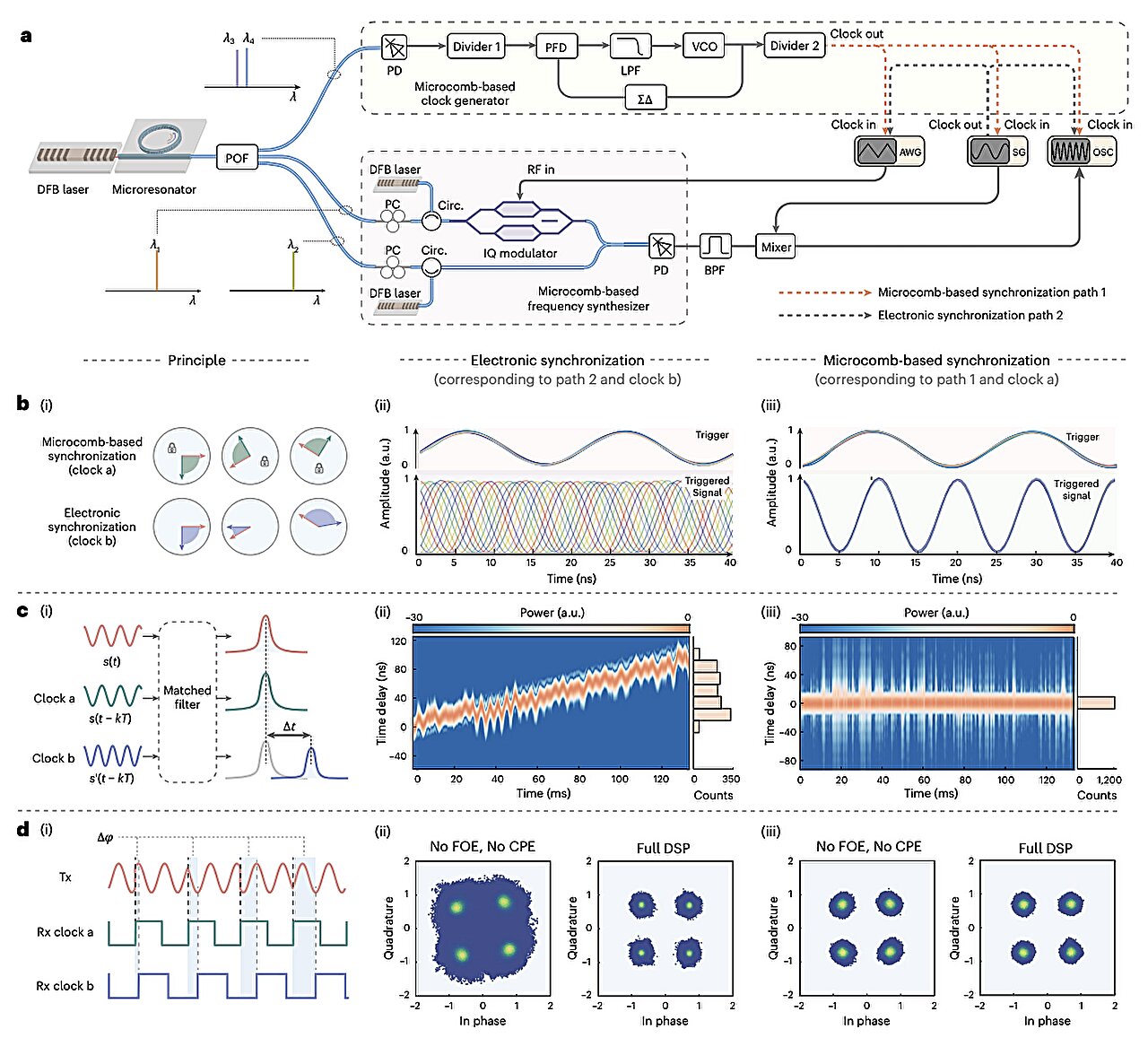
To overcome this issue, a team of researchers from Peking University and the Chinese Academy of Sciences has developed an innovative on-chip microcomb. This compact optical device can generate a precise series of equally spaced frequencies, acting as a reliable clock that synchronizes signals across various frequencies. As noted in their publication in Nature Electronics, optoelectronics could be transformative for fast information systems, but the frequency mismatch had made synchronization difficult.
The new microcomb synthesizes both single-frequency and wideband signals, effectively covering a range that encompasses both the lower frequencies of electronic components and the higher frequencies of optical signals. Unlike previous methods that required complex coherent digital signal processing to align these frequencies, the microcomb allows for synchronization without such demanding computational needs.
The researchers highlighted, “Our synchronization strategy can provide signal manipulation precision and data transmission without coherent digital signal processing.” They demonstrated the microcomb’s capabilities by creating a wireless joint sensing and communication system, where the microcomb was utilized as a transmitter for data communication and remote sensing tasks.
Initial assessments of the microcomb’s performance have shown promising results, prompting the researchers to consider future improvements. They noted that by employing photodetectors with larger bandwidths, they could extend the frequency generation capabilities of the microcomb into the entire microwave and terahertz frequency bands.
A notable advantage of this new technology is its ability to maintain high repetition rates while consuming less power compared to conventional electronic synchronization methods. The continued development of this microcomb could enhance synchronization in a range of optoelectronic applications, paving the way for broader use of optoelectronic systems in technology.
The content above is a summary. For more details, see the source article.









