Key Takeaways
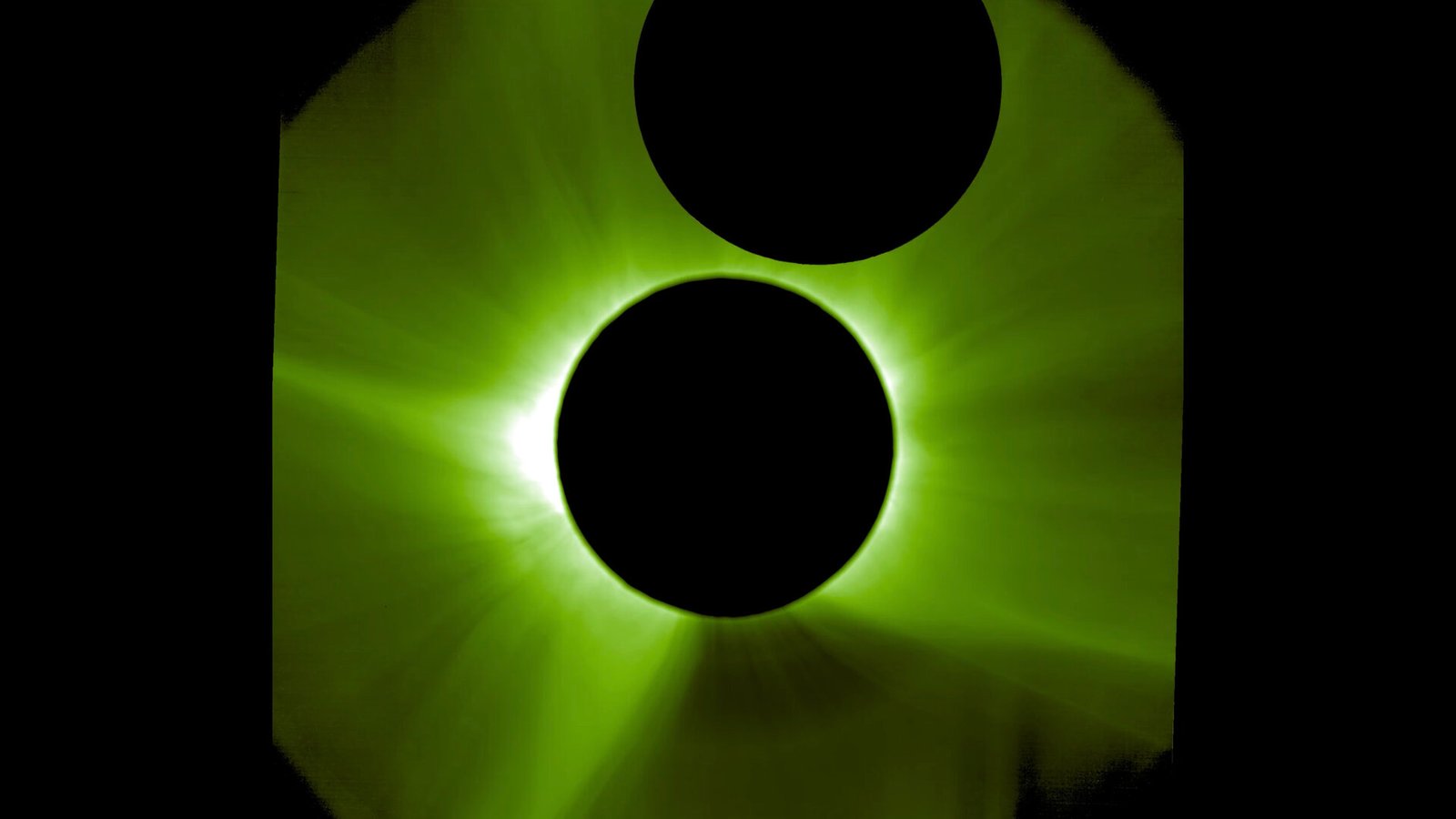
- On August 12, 2026, ESA’s Proba-3 mission captured a unique double eclipse event involving the Moon and the Sun.
- During this phenomenon, the Moon blocked sunlight for 8 minutes and 40 seconds while Proba-3 maintained its own artificial eclipse.
- This rare occurrence allowed scientists to calibrate the ASPIICS coronagraph and observe the solar corona under optimal conditions.
Proba-3’s Double Eclipse Experience
On August 12, 2026, a total solar eclipse swept across parts of Europe, but ESA’s Proba-3 mission had a unique vantage point. The dual spacecraft of Proba-3 are designed to create artificial eclipses by aligning 60,000 km above Earth. The Occulter spacecraft functions as an artificial Moon, providing uninterrupted views of the Sun’s corona through the Coronagraph spacecraft.
Interestingly, on the same day, the Moon obscured the Sun as observed from the Proba-3 mission. Captured by the mission’s ASPIICS coronagraph, the event showcased the Moon crossing the spacecraft’s field of view over three hours. The Moon created a shadow larger than Proba-3’s Occulter, blocking solar light for 8 minutes and 40 seconds while Proba-3 maintained its own artificial solar eclipse.
Due to Proba-3’s proximity to the Moon, the mission enjoyed a significantly longer duration of eclipse compared to the totality experienced on Earth, which was limited to 2 minutes and 18 seconds off the coast of Iceland. This extended double eclipse offered a unique opportunity for scientists, allowing them to calibrate the optical performance of the ASPIICS coronagraph and capture observations of the solar corona in optimal conditions, free from the typical interference caused by the sunlight diffraction.
This double eclipse experience is a rare milestone for the Proba-3 mission. While additional partial eclipses will occur during the upcoming total solar eclipses on August 2, 2027, and July 22, 2028, they will not achieve the full solar disc coverage provided by this recent event.
The Proba-3 mission and its instruments aim to enhance the understanding of solar dynamics and coronal phenomena, providing valuable data for future missions and studies. As the project continues, further opportunities to observe eclipses and study the Sun’s behavior will arise.
The content above is a summary. For more details, see the source article.