Key Takeaways
- The European Space Agency’s Space Rider spacecraft has successfully completed mechanical tests of its ALEK module in the Netherlands.
- ALEK is integral for propulsion and power during Space Rider’s missions, which can last up to three months.
A spacecraft designed for versatility
The Space Rider, developed by the European Space Agency (ESA), is a reusable spacecraft comparable in size to two minivans. It is designed for a variety of missions, including pharmaceutical research and visits to orbital platforms. Capable of missions lasting up to three months, Space Rider is engineered to return to Earth and land precisely using skids following a paraglider descent.
Central to Space Rider’s operation is the Vega-C rocket’s fourth stage, known as AVUM+ (Attitude Vernier Upper Module), complemented by the new AVUM Life Extension Kit (ALEK), developed by Beyond Gravity for Avio. The AVUM+ provides the necessary propulsion and maneuvering, while ALEK supplies electricity and other vital services during the spacecraft’s orbital life, facilitated by two solar panel wings. Before returning to Earth, the expendable orbital module separates from Space Rider’s reentry module.
Testing the structure
ALEK underwent two months of rigorous testing at ESA’s technical facility, simulating the mechanical stresses it would encounter during a rocket launch. The testing process began with the ALEK module being placed on a shaker table, which replicated the vibrations experienced during launch by moving the module sideways. Subsequently, the module was subjected to vertical vibrations on a different shaker, with over 120 sensors measuring acceleration throughout the tests.
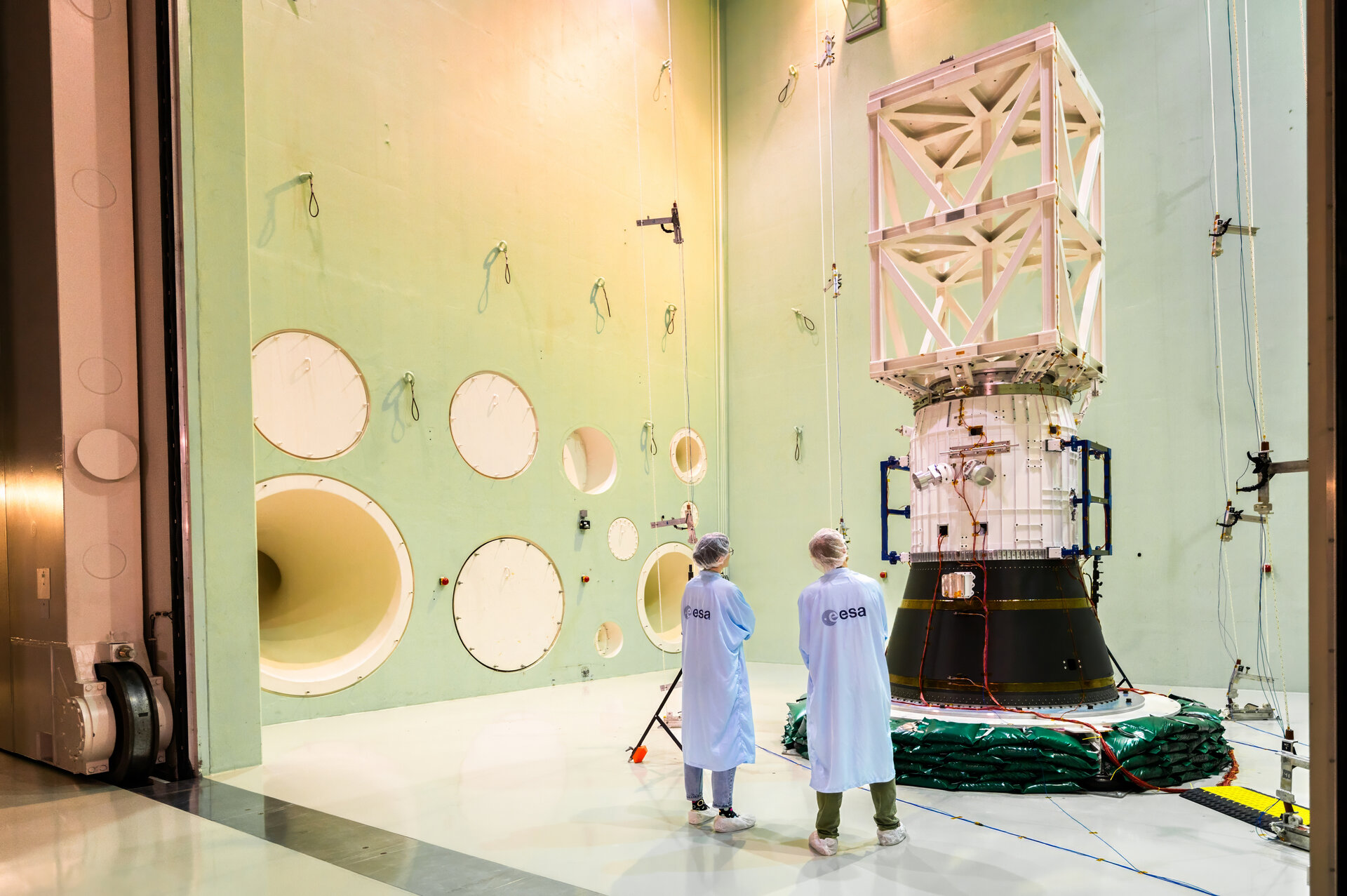
After passing the shake tests, ALEK entered Europe’s largest acoustic chamber, where it endured the extreme noise levels associated with a rocket launch. The chamber’s loudspeakers were maximized to reproduce the intense sounds of a rocket taking off, and ALEK successfully withstood this acoustic barrage. The final phase of testing involved a shock assessment, simulating the stresses that the service module would experience during separation from the Vega-C rocket after launch. This was conducted within the same acoustic chamber to ensure comprehensive data on how shockwaves affect the module’s integrity.
Launch readiness confirmed
Having successfully completed all testing phases, ALEK has been qualified for launch. Future tests for Space Rider are planned, including simulations of the orbital module’s avionics software in Colleferro, Italy. Additionally, a model of the Space Rider reentry module will soon be tested, wherein a full-size prototype will be dropped from a helicopter. During this simulation, the model will deploy its paraglider and demonstrate its ability to navigate safely to a precise landing site.
The successful completion of ALEK’s tests marks a significant milestone for the Space Rider project, underscoring its potential for diverse scientific and exploratory missions in space.
The content above is a summary. For more details, see the source article.